Book Review: “Hidden Potential” by Adam Grant
Hidden Potential by Adam Grant
How Rethinking Growth Can Transform Our Classrooms, Our Teams, and Ourselves
“The true measure of potential is not how high you reach but how far you came to get there.”
— Adam Grant, Hidden Potential
As an educator and school leader, I’ve long been preoccupied with the question of how we identify, support, and unlock student potential. While our current systems reward what is already visible—talent, hard work, performance, and poise—how might we balance this with the recognition of the full range of growth that happens out of view. This is both for our students and those we lead.
In Hidden Potential, Adam Grant invites us to explore this very premise: that potential is not fixed, innate, or narrowly distributed. Instead, it is shaped by context, character, opportunity, and system design. Achievement is what happens when you polish your strengths, but success comes from building your character. This is a book about improving as an individual, as an educator and leader, and how, through intentional shifts, we can support the unlocking of potential beyond static measurements and into the dynamic, messy, beautiful business of human development.
You Would Be Interested in This Book If…
-
You’re a teacher or instructional leader wondering how to support under-recognized students
-
You’re a school administrator reflecting on hiring, leadership development, or DEIJ goals
-
You believe schools should measure growth, not just performance
-
You’re ready to create systems that see further, scaffold deeper, and widen the lens of potential
@welovethatquote Adam Grant, author of ‘Hidden Potential: The Science of Achieving Greater Things on Diary of a CEO. #HiddenPotential #AdamGrantOnDiaryOfACEO #AchievingGreaterThings #ScienceOfSuccess #LeadershipInsights #DiaryOfACEOInterview #AdamGrantPodcast #UnlockingPotential #AuthorSpotlight
Reframing the Meaning of Potential
What makes this book different from other treatments of growth and learning is its blend of rigorous case studies, psychological insight, and systems-level thinking. Grant brings forward stories from chess teams, underrepresented engineers applying to NASA, athletes, and students from equity-deserving backgrounds. While the results in these stories are impressive, it is the processes that he highlights: mentorship, scaffolding, deliberate practice, feedback-rich environments, and cultural belonging.
He writes:
“Character skills and scaffolding can help us unlock hidden potential in ourselves and those around us. But to give more people the opportunity to achieve greater things, we need something bigger… better systems in our schools, teams, and organizations.”
This call to build systems of opportunity resonates deeply in schools, where we must ask: Are we creating the structures that allow students to see themselves as capable? Are we opening doors and windows, or are we inadvertently closing them?
Grant takes this further by exploring the myth that success is driven by high IQ or solo brilliance. Drawing from research on team performance, he writes:
“Collective intelligence has little to do with individual IQ measures. It turned out that the smartest teams weren’t composed of the smartest individuals.”
Instead, the strongest teams are composed of members with pro-social skills—empathy, turn-taking, collaborative reasoning. This aligns with something I’ve long believed: the smartest person in the room is the room. The work of leadership, then, is to create the protocols, the cultures, and the conditions that allow a group to outperform the sum of its parts. In classrooms, this means investing in project-based learning, team scaffolding, collaborative group structures and feedback practices that reward shared insight over individual dominance.
Character Is How You Show Up on a Hard Day
In Part 1, “Skills of Character,” Grant makes an important distinction:
“Character retains its plasticity. Character is not the same as personality… Character is the capacity to prioritize your values and principles… The true test of character is if you manage to stand by those values when the deck is stacked against you. Character is how you show up on a hard day.”
This emphasis on practicing principles under pressure reframes how we should think about education. It is not simply about transmitting content, but about creating space for students to develop and rehearse the kind of person they want to become. This aligns with current thinking in adolescent development, SEL, and well-being. Through feedback, mentorship, and identity-based learning experiences, we can help students build internal compasses that persist beyond the walls of school.
And so, being a Sponge is at the heart of Learning How to Learn Grant’s story of sponges is more than metaphor:
“Being a sponge is more than a metaphor—it is a character skill… Growth is less about how hard you work than how well you learn.”
This invites us, as educators, to design adaptive learning experiences that go beyond information transfer. Global travel, outdoor education, service learning, and community engagement all give students the chance to absorb, filter, and adapt in real contexts. These experiences cultivate not only cognitive flexibility, but also the confidence that they can handle what the world throws at them. This, too, is hidden potential: the ability to learn how to learn.
So how might we infuse our work wtih Joyful Practice and reject the Myth of the Grind. A quietly radical idea in the book is Grant’s critique of over-practice:
“Although it takes deliberate practice to achieve greater things, we shouldn’t drill so hard that it drives the joy out of the activity and turn it into an obsessive slog…”
One way forward is to engage is deliberate play:
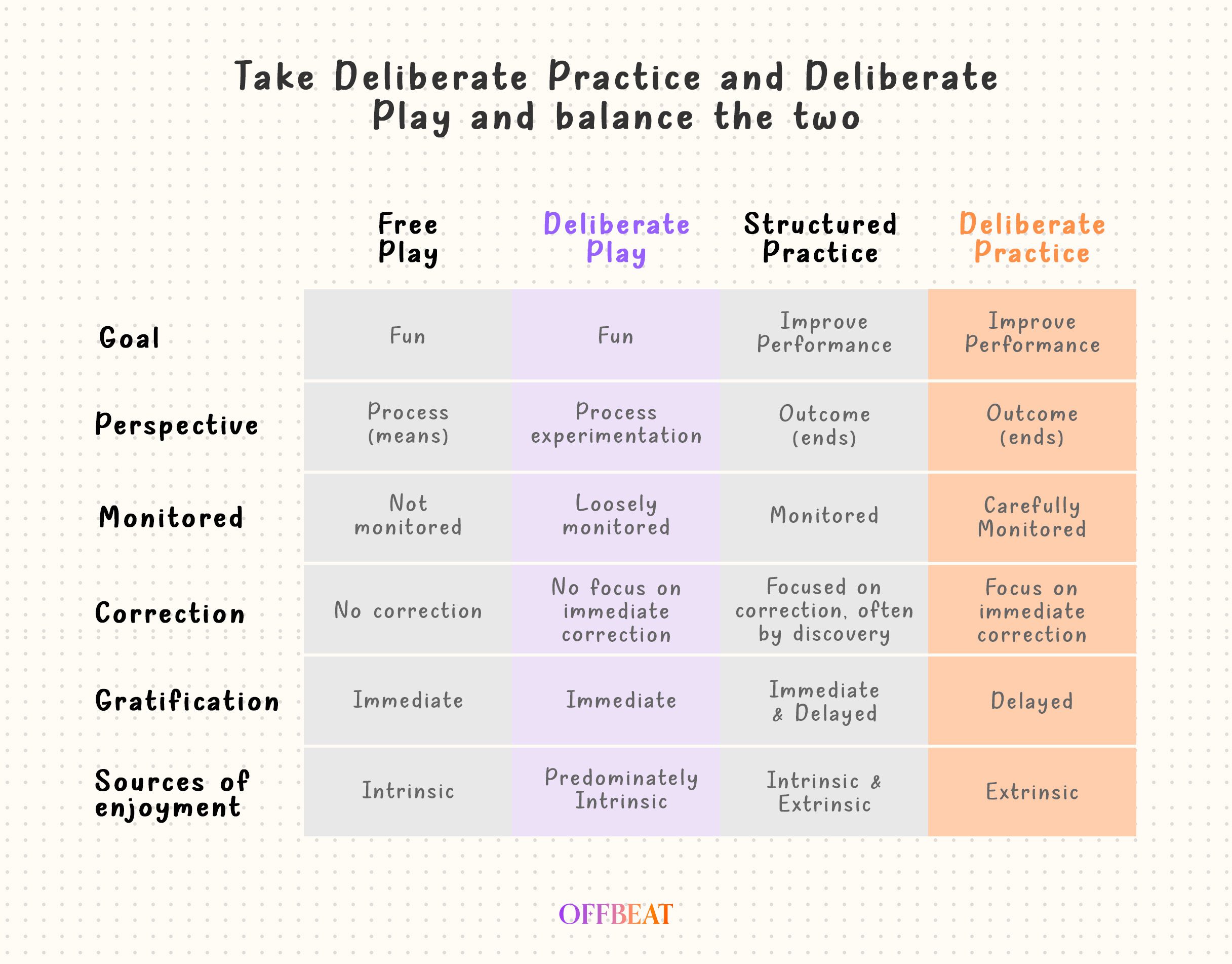
This graphic was found through the work of Nicola Wylie: https://www.offbeat.works/post/hidden-potential-adam-grant-summary-implications-for-l-d This is a great summary of the book as well!
The challenge for modern educators is to strike that balance: rigor with joy, structure with flow. Joy isn’t the opposite of achievement—it’s the engine of sustainable excellence.
Grade Point Trajectory > Grade Point Average
To help us understand this balance, and work towards greater parity is to examine the way that we interpret the all the data of student learning, and team performance, that we take in.
Perhaps the most powerful reframe in Hidden Potential is the concept of GPT: Grade Point Trajectory. Grant argues:
“We can look at the GPA, but also look at GPT—Grade Point Trajectory—calculating the rate of improvement over time, rise over run. Early failure, followed by later success, is a marker of hidden potential.”
This is a profound shift. It urges educators, admissions officers, and employers to honour resilience, not just results. We must ask how far they’ve travelled to get here, not only where a student is. So what then is a Report Card? What then is a Performance Review?
This change in perspective could transform how we understand our students, how we evaluate teachers, and how we define success. It might also help our families of our students understand the changing face of rigor in schools.
In the prologue, Grant reflects on the long-term economic impact of early education:
“Kindergarten matters in many ways, but I never would have expected teachers to leave such a visible impact on their students… Early education develops key skills.”
These skills—proactiveness, collaboration, impulse control, perseverance—aren’t incidental. They’re foundational. And they reaffirm the deep value of experienced, reflective teaching in the early years. If we want to nurture hidden potential, we must invest in those who plant the seeds, and change the way that we tell the story of education.
Final Reflection: Systems That See
Ultimately, Hidden Potential isn’t just about individual growth. It’s about designing institutions that see further—that notice the quiet student with late-blooming brilliance, that invest in character as much as content, that understand failure not as weakness, but as a prelude to flight.
This book offers more than a theory of development. It offers a blueprint for hope, grounded in research and animated by possibility.
“Improving depends not on the quantity of information you seek out, but on the quality of information you take in… Success depends not on how hard you work, but how well you learn.”
In the end, Hidden Potential is a gift to all of us who believe that every learner—given the right conditions—can grow far beyond what we first see.