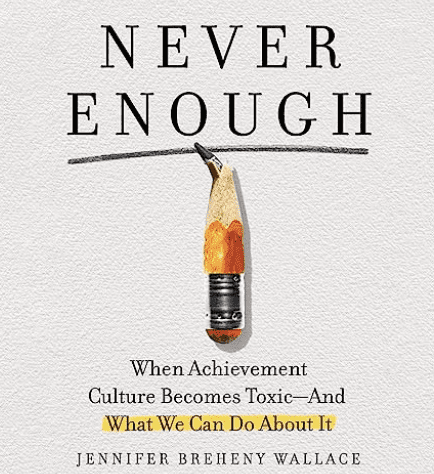
Book Review: “Never Enough” Jennifer Breheny Wallace
“When kids feel that their worth is contingent on their performance … they feel they only matter … if they are successful.” ~Jennifer Breheny Wallace
I picked up Never Enough on the recommendation from a few educators. I expected it to be non-surprising and “preaching to the choir”; however, as I turned the pages, I quickly found myself being surprised by the depth of research bringing to light stories, strategies and solutions to what we know is a mental health crisis in our world. Wallace has written a book that meets you at the intersection of personal conviction and professional responsibility—especially if you’re a parent, school leader, or both.
This book gains its power through the author’s immersive research. Wallace embedded herself with families over several years, listening to teens and parents describe how a relentless culture of achievement was hollowing them out. Drawing on surveys from Challenge Success, Pew, and Gallup, and in conversation with psychologists like Lisa Damour, Wallace presents a compelling case: our kids are performing, but they are not thriving.
And we—the adults who shape their environments—need to change that.
You Would Be Interested in This Book If…
-
You’re a school leader or educator who wonders if we’re fueling
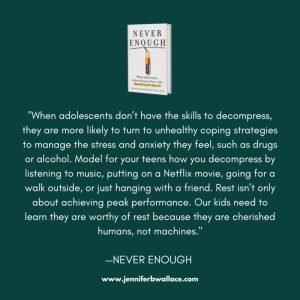 achievement at the expense of well-being.
 - You have children in your life that are suffering, putting too much pressure on themselves, or if you are as well.
-
You’re trying to balance high expectations with deep compassion—for your students, children or yourself; i.e. looking for ways to bring balance between meaningfulness and achievement.
-
You’re ready to build a community that centres identity over accolades; i.e. looking to shift what your school honours and awards.
The Kids Are Not Alright—And They Know It
What really struck me from Wallace’s research is how clearly these kids can articulate their exhaustion. In one interview, a student shared that their greatest fear wasn’t failure—it was not being seen as exceptional. This was grounded into her by her parents, the climate of school, social media pressures, and the college application process.
This echoed something I’ve witnessed in high-performing school environments: students who are deeply loved, well-supported, and still quietly falling apart under the weight of perceived expectations. Wallace doesn’t sensationalize this. Instead, she listens—and helps us listen, too.
“When children are driven by a fear of not being good enough, they become more vulnerable to anxiety, depression, and burnout.”
She shows that students from well-resourced communities—those we assume are “set up for success”—are often the ones internalizing the message that they must earn love and belonging through performance. She quotes one teenager, Beth, who understood that her parents gave her all her needs and wants and in return she knew she “had to be the child that they could boast about to their friends.” But this quickly fell apart for Beth in her post-secondary life. Beth is one of many different cautionary tales from the author’s research.
The Hidden Curriculum: You Matter If You Perform
One of the most painful—but important—ideas in the book is that even well-meaning adults can send signals of contingent mattering. Wallace writes:
“Contingent self-worth is the message that your worth comes from what you do, not who you are. And the higher the perceived stakes, the more kids internalize this.”
Wallance highlights the role that parents can play in reinforcing a ‘perfomance mindset” (if you’re interested in more on this, I highly recommend “How to Navigate Life” by Dr. Belle Liang and Tim Klein)
-
When we praise achievement more than effort or growth.
-
When we allow students to skip family time or rest in the name of “getting ahead.”
-
When we ask “How did the test go?” before we ask “How are you?”
From this book, I took it that as parents, we say we want students to do their best. But they hear us saying, ‘Be the best.’”
That subtle difference—between invitation and expectation—may be the heart of the mattering crisis.

Strengthening the “Mattering Muscle”
Wallace doesn’t suggest we lower expectations. Instead, she offers a deeply human solution: help kids build their mattering muscle. One that teaches them they are valued and needed—not just when they succeed, but always.
She emphasizes that schools must become places of psychological safety, where failure is seen as part of growth, not as evidence of inadequacy. Educators can play a pivotal role in this through their pedagogy and curriculum. She highlights Ms. Taylor from a school named Archer. Wallace followed three female students who, over time, shifted their internal monologue away from a scarcity, zero-sum mindset to one of valueing others. How did this happen? As educators we can set up our classrooms, and indeed our schools in order to:
- Teach, value and praise Interdependency: where my success doesn’t come at the expense of others, and visa-versa. We can do this through project-based learning, and enhancing meaningful peer-review strategies;
- Address the Tension: talk about the world view of scarcity and counter that with a world of abundance ~ where through collective action we raise more than our own boat. We can talk about the difference between ‘benign envy’ and ‘malicious envy’ as well as the role that a “worthy rival” can play in our lives, and share stories of our own experiences in this way
- Use research to show students How success is achieved. Wallace does an incredible job of emphasizing that competition is bad, it’s how we conceive of it. And the biggest culprit is that society is telling students that there is really one one strict way to achieve success.
- She cites a poll from Gallup where there are six key characteristics from a post-secondary experience that denotes greater success in the workplace. Hint: it is not the name or exclusivity of the college! It is about the ability for a student to MATTER in their learning environment.
Reclaiming Home and School as Mattering Havens
There is a powerful parallel between Wallace’s framing and what we aspire to build in schools—communities where each child is known, not ranked. In her resarch, she met Tara Christie Kinsey, from Associate Dean at Princeton University, who responded to the many, many students who would come to her office, depressed, anxious, worried, burned out. Kinsey says,
It’s not their fault. It’s the faul of the system, which has produced these amazing, hardowking kids whoare just maniacally jumping through hoops, but they don’t feel a sense of meaning, a sense that what they do matters or adds any real value… Of course we know from decades of research that meaningless achievement doesn’t give the payoff we think it will.
So what might schools do: double-down, or reinvent: Consider these two questions posed by two different educators from her research:
“If we actually gave in, and a developmentally reasonable schedule emerged, we might achieve a healthy balance for our students at the cost of our schools’ distinctiveness; we might lose our edge, and become a vanilla school, and who would want to come to a vanilla school?”
VS.
“How might we reverse engineer a K-12 education that gives students what they really need?”
She notes that families and schools must reclaim their roles as “mattering havens”—spaces where unconditional value is felt. And she’s clear: this doesn’t mean removing structure, accountability, or ambition. It means untethering identity from outcomes. It means providing a sense of value to contributions outside of the classroom: volunteering, peer-mentoring, and who students are beyond their grades ~ i.e. their interests and pursuits outside of school.
One of the most useful reframes in the book was this:
“Success doesn’t guarantee mattering. But mattering creates the conditions for success.”
There are great connections in “Never Enought” to other leadership books I have reviewed: The Power of Mattering, Unreasonable Hospitality, and How to Navigate LIfe, that all speak to the same truth: relationships first. Systems second.
Final Thought
Reading Never Enough was like reading a wake-up call written for compassion. Wallace offers not blame, but clarity. She shows that thriving isn’t about lowering the bar—it’s about changing where we place it. It’s isn’t about getting rid of ambition and success, it’s about reevaluating how we get there, and who helps us achieve.
And maybe, just maybe, it’s about learning to say to our kids and colleagues alike: You matter to me—no matter what.
Let’s start saying that out loud.