Book Review: Free Agent Learning (Julie Evans)
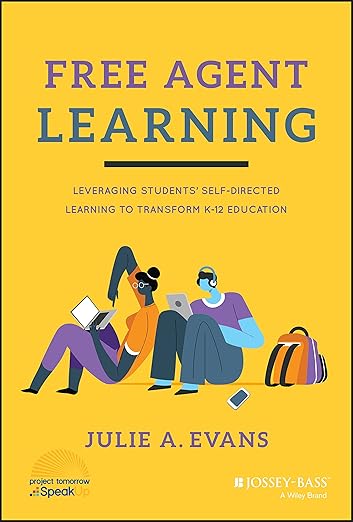
Book Review: Free Agent Learning by Julie A. Evans
Why Student Agency Should Reshape the Way We Structure School
“School is no longer the sole repository of knowledge. Students increasingly have the agency and the means to adopt new self-directed, interest-driven behaviours outside of school.”
— Julie A. Evans, p.1
“The voyage of discovery is not in seeking new landscapes, but in having new eyes.”
— Marcel Proust
Julie A. Evans’ Free Agent Learning invites educators to develop “new eyes” for learning—not only in how it’s delivered, but where it’s happening. The book is built on over a decade of data from the Speak Up research initiative and blends insights from Daniel Pink, George Couros, Tony Wagner, Clayton Christensen, and many others. Her central thesis is clear: students are already self-directing their learning outside of school, often in ways that are more aligned to their future goals than the in-class experiences provided to them.
You Would Be Interested in This Book If…
-
You are a school leader or teacher rethinking the “when,” “where,” and “why” of learning;
-
Your school has a Portrait of a Graduate—and you’re wondering how to make it real;
-
You believe purpose and agency are the keys to 21st-century student engagement;
-
You want research-backed insights on how students are learning outside of school and how to bring that into your own practice
1. The Student Vision for Learning
 Evans outlines four essential concepts at the heart of the student vision for learning: social-based, untethered, contextualized, and self-directed learning. These pillars reflect a belief that students learn best when they have agency, relevance, and connectivity to real-world ideas and collaborators.
These core elements are echoed in the Free Agent Learning model itself, which builds on them with four key learner attributes: place independence, power ownership, purposeful technology use, and passionate motivations. Each of these attributes is supported by technology, but grounded in something deeper: students’ desire to do meaningful work and grow in competence.
The book deep-dives into each of these concepts to present a consolidated whole captured in the Student Vision for Learning. This is the bulk of the book, that is brought to life through research backed insights, so that the reader is brought to what appears to be a no-brainer conclusion – schools much move away from status quo.
2. Reimagining Structures, Time, and Place
One of the most powerful quotations comes from page 147:
“Traditional school environments still rely on outdated institutionalized structures… rigid bell schedules, non-culturally responsive curriculum, and standardized metrics that are blind to individual academic strengths.”
Evans doesn’t just critique school as it is—she invites educators to redesign it around how students actually learn. Drawing on Couros’ distinction between “school” and “learning,” she encourages us to ask: how might we open time, place, and pathway for deeper learning, not just deliver content on a fixed clock?
These are concepts we’ve been exploring at Cohort 21 and throughout CIS Ontario schools. Also, I am proud to say that my school, Kingsway College School has a Sr. School that is founded upon many of these concepts. www.kcs.on.ca.
3. Technology Is a Verb
Too often, educators see technology as a tool for engagement. But Evans reframes it as a verb—something that brings learning into real-time. Students are already using technology to pursue passions, gain credentials, explore careers, and build digital portfolios. The book is filled with case studies of students using YouTube, Discord, Reddit, and niche forums to fuel their own intellectual growth.
As educators, we need to see this for what it is: not a distraction, but evidence of agency in action. We must ask: How do we scaffold and amplify this kind of learning, rather than sideline it?
What is missed in this discussion of technology is the bans on smartphones across the country, and it is disappointing that she doesn’t address it; however, this doesn’t minimize her argument on how we can leverage it further than we do right now.
4. Purpose Is the Engine of Free Agent Learning
This book resonates deeply with the ideas in How to Navigate Life by Liang & Klein. Purpose is not just a side benefit of good learning—it is the stimulant of agency. Students are most motivated when they understand the “why” behind what they’re doing and can see a future tied to their present actions.
“A graduate profile outlines the necessary foundation for students’ future success… it serves as a true north.” — p.182
Evans argues that Portraits of a Graduate must go beyond aspiration and become design tools. At Kingsway College School, our Portrait must be paired with systemic reflection: Are we creating the conditions where students can develop autonomy, access, and identity—inside and outside of school?
https://www.gettingsmart.com/podcast/dr-julie-evans-on-free-agent-learning/
Final Thoughts:
Free Agent Learning is a must-read for educators ready to redesign school with—not just for—students. It doesn’t offer a silver bullet, but it does offer something better: a research-informed, purpose-driven roadmap for empowering learners.
The book closes with three foundational assumptions about students that every educator should post in their office:
-
Students want to do well
-
Students enjoy learning new things and building things
-
Students value their teachers
If we start there—and design forward—Free Agent Learning becomes less a concept and more a call to action.