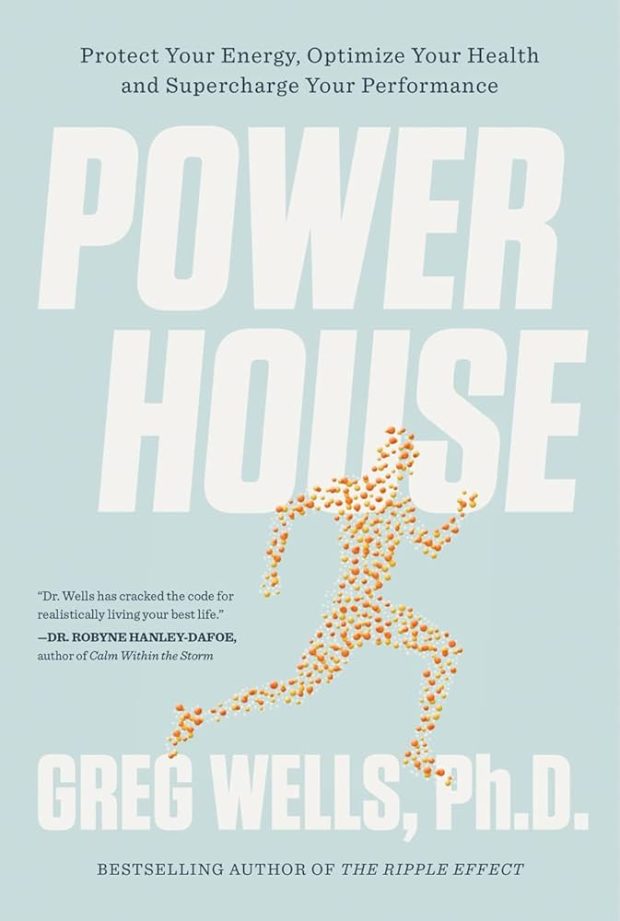
Book Review: “Powerhouse” by Dr. Greg Wells
“It’s unnatural and even unhealthy to never experience stress. Stress can give us a positive push. It can tell us about ourselves and our surroundings. We experience stress when we are challenged—and overcoming challenges can be some of the greatest moments in our lives.”
— p.11
You would be interested in this book if…
(1) You are a leader trying to perform at a high level without burning out.
(2) You are an educator navigating what feels like a human energy crisis.
(3) You want science around stress, fatigue, and performance, as well as resilience and health
(4) You believe that sustainable excellence must be rooted in biology, not bravado.
1. The Energy Crisis We Don’t Talk About
I often say that we’ve never known more about how the human brain works in education. Dr. Greg Wells makes the parallel case for the body: we have never known more about how to energize ourselves at the cellular level—and yet we are more depleted than ever.
“Although often used interchangeably, fatigue and burnout are a bit different… Burnout is a three-dimensional syndrome, including overwhelming exhaustion, feelings of cynicism, and lack of efficacy.”
— p.93
Fatigue can be recovered from. Burnout erodes identity. Wells goes further:
“I believe we are in the midst of a human energy crisis… Chronic stress is higher than ever, leading to unprecedented levels of burnout.”
— p.96
In education—and leadership broadly—this lands heavily. The answer, Wells argues, is smarter energy management, starting with the mitochondria—the cellular “powerhouses” that convert oxygen and nutrients into usable energy.
It’s not about ‘work-life balance’ per say, it’s about sustaining performance.
2. Breathe: Oxygen Is Strategy
Part One, Breath, explores something deceptively simple: oxygen.
Breathing is the gateway to flow states, recovery, and stress modulation. Wells reframes stress as adaptive, not adversarial. Stress, when cyclical and recovered from, builds capacity. Chronic, unmanaged stress drains cellular energy and pushes us toward burnout.
For leaders, this is profound. The question is not “How do I eliminate stress?” It is “How do I recover from it?”
Breathing becomes a tool—not just for wellness—but for cognitive clarity and resilience.
3. Move: Joyful Performance, Not Grinding
The second section, Move, dismantles grind culture.
“The idea is not to grind through life, but to find people, places, and activities that spark joy. What do you love to do that also moves your body?”
— p.89
This is where Wells challenges education culture directly. Many of us operate as though exhaustion is a badge of honor. But movement—especially joyful movement—enhances mitochondrial function, cognitive sharpness, and emotional regulation.
As leaders, this reframes physical health from “personal hobby” to “professional strategy.”
I have long believed that movement is foundational. Any educator can tell you that – especially our incredible JK-SK educators 🙂
4. Energize: Fuel, Recovery, and Sustainable Output
In Energize, Wells dives into nutrition and cellular repair. The focus is practical: what you eat either fuels mitochondrial health or depletes it.
But more importantly, this section reinforces a theme running throughout the book: performance is cyclical.
Energy → Effort → Recovery → Growth.
Without recovery, there is no growth. Without fuel, there is no sustained effort.
This resonates deeply in education, where many operate in a constant sprint toward the next break. Wells offers a different model: daily micro-recovery instead of seasonal collapse.
5. Thrive: Designing a Life, Not Just a Career
The final section, Thrive, pulls everything together. Wells provides a 100-day mitochondrial challenge—a structured, practical pathway toward cellular optimization.
But what struck me most was the philosophical undercurrent: this book is about designing a life of sustainable excellence.
It doesn’t promise balance in the simplistic sense. I’ve never believed in work-life balance as a clean split. What PowerHouse does instead is nuance that idea. You may not be able to divide work and life evenly—but you can protect your energy.
You can choose:
– Recovery over collapse
– Joyful movement over grind
– Productive stress over chronic stress
– Sustainable ambition over heroic burnout
Final Word
PowerHouse is a science-backed playbook for leaders who want to perform at a high level for a long time.
In a profession—and a culture—that often confuses exhaustion with excellence, Dr. Greg Wells makes a compelling case: sustainable performance begins at the cellular level.
This is not a soft book. It is a strategic one. Especially the 100 Day Mitchondrial Challenge!
Highly recommended for educators, leaders, and anyone serious about thriving—not just surviving.