Book Review: “Be Yourself at Work” (Claude Silver)
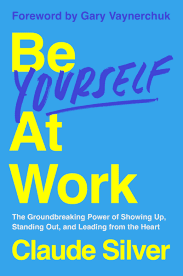
Thanks to Jason Rogers, my podcast-partner-in-learning, for recommending this book to me after listening to Claude Silver at a conference.
This book is about her life and coming into how to lead herself and herself with others. If you’ve been following the “Leadership Lab”, part of the Cohort 21 community with @jmedved, @tfaucher and @gvogt, you’ll know this a critical place to start any journey into leadership. Claude bring her life experiences to bear and shows how it lead her to lead with both courage and compassion, and how to harness that emotional intelligence not as a side effect of great leadership but its source. Claude Silver’s Be Yourself at Work is a book about heart-centered leadership, but it’s also about self-awareness, communication, and the discipline of presence.
You’d be interested in this book if you were:
(1) Getting started on your Leadership Journey
(2) Looking for new ways to reframe your leadership style
(3) Interested in strong communications skills to match a kinder, more compassionate way to lead
(4) Interested in a more modern take on some key stoic practices, like appreciating what is in your control and acting accordingly, understanding the difference between urgency and importance, etc…
You may not be drawn to this book if you expect a traditional leadership manual. Silver doesn’t give us a formula; she gives us language — and more importantly, a way of being.
@chiefheartofficer Leaders, vulnerability is your superpower! 💡 If you want your team to share their journey, you’ve got to open up first. #careeradvice #theworkculture #emotionaloptimism #kindness #chiefheartofficer #inspirational #leadershipadvice #leadership #claudesilver #empathy #HRTikTok #HRADVICE #vaynermedia
The Two Parts of Leadership
The book is divided into two sections:
-
Leadership of Self
-
Leadership with Others
The first half explores what it means to truly know yourself — to understand your emotional triggers, your inner dialogue, and the “songs in your head.” The second half moves outward, offering a framework for building emotionally intelligent teams and cultures.
Silver calls this “the architecture of belonging.” It’s the idea that teams thrive when they can trust each other not only to perform but to be human. She never shies away from accountability, hard conversations or difficult decisions – in fact, she argues, and convincingly, that emotional wisdom, and embodied learning, are critical to success in times of crises and urgency.
Firstly, leaders practicing this approach can distinguish between real and manufactured crisis. Secondly, when leaders practicing this are faced with an actual crisis, they are better equipped:
“The companies that can distinguish between real and manufactured urgency show up differently. They’re more creative, more resilient, and – this is important – more capable of handling actual crisis when they arrive, because they aren’t burnt out. People have the energy and care to show up when it counts the most.” (pg. 147)
“You better get another song in your head.”
At the beginning of the book, Silver shares a story that defines everything that follows. Early in her life, she was on a 90-day outdoor experience called WordBound. It was day one, and she was already in tears — hiking at the back of the pack, full of self-pity, and repeating a Nine Inch Nails lyric in her mind: “Head like a hole, black as your soul, I’d rather die than give you control.”
When one of the guides came down to check on her, she asked, “What song is in your head right now?” Silver told her. The guide looked at her — muddy, tearful, exhausted — and said, “Well, you better get another song in your head.”
That line became a lifelong mantra. As Silver writes, it was “Her words weren’t just tough love – they were a lifelife and I was ready to grab hold of it. For the first time in a long time, I could imagine telling myself a new story.”
This book draws upon her experiences then, and now as Chief Heart Officer, but someone who studied transpersonal psychology and spirtuality, came out as gay, an entrepreneur, and now a CHO (Chief Heart Officer) at a global consulting company. She puts this all to great use in order to inspire leader to be more present, more themselves and more equipped to bring out the best in others.
It’s a moment that anchors her entire philosophy: we can’t control everything, but we can always choose our mindset. Leadership, in her view, begins with emotional awareness — knowing when to change the song.
The Neuroscience of Emotion
At the centre of Be Yourself at Work are three interlocking practices: emotional optimism, emotional bravery, and emotional efficiency. These are not slogans; they are daily disciplines.
-
Emotional Optimism is the act of assuming good intent and believing in the possibility of people and progress — not blind positivity, but hope grounded in trust.
-
Emotional Bravery is the courage to hold the hard conversations and stay present in discomfort. As Silver reminds us, “Real bravery isn’t the absence of fear — it’s the choice to stay human when it would be easier to hide.”
-
Emotional Efficiency is what happens when compassion meets clarity — when we lead with empathy but also define boundaries, expectations, and follow-through.
Silver believes that “emotions are data” — they tell us what’s really happening beneath the surface of our organizations. Ignoring them doesn’t make us professional; it just makes us disconnected. Her writing, grounded in decades of practice as VaynerMedia’s Chief Heart Officer, bridges psychology, leadership, and culture with extraordinary warmth.
Silver roots her approach in both psychology and neuroscience. She reminds us that emotions aren’t random; they’re data. Before you feel an emotion, your brain gives you about four seconds — a window to pause, reflect, and choose your response. And once the emotional chemicals flood your body, they remain for about ninety seconds.
Those ninety seconds, she says, are a sacred space: “If you can ride the wave rather than drown in it, you’re already leading yourself.”
It’s this ability to pause, to sit with emotion rather than react from it, that forms the foundation of heart-centered leadership. Silver argues that emotional maturity isn’t about suppressing feelings; it’s about understanding them, embodying them, and then responding with clarity and care.
The DNA of Teams
One of Silver’s most practical and powerful contributions is her framework for what makes a highly effective team. She identifies five key elements — a subtle but important correction from the often-quoted four:
-
Clarity of Purpose – knowing why we’re here.
-
Clarity of Roles – knowing what each of us contributes.
-
Goal Orientation – knowing what success looks like.
-
Interdependence – knowing how we rely on each other.
-
Continuous Improvement – committing to getting better, together.
“When these five are present,” she writes, “trust isn’t a policy — it’s a practice.”
Silver doesn’t stop at theory. She provides scripts and templates for how to lead with empathy and accountability — how to have tough conversations, how to re-establish trust, and how to rebuild connection when things go sideways. She even includes exercises for teams to explore “what trust sounds like” and “what safety feels like.”
Speaking from the Heart
One of the most valuable aspects of Be Yourself at Work is how concrete it becomes in the second half. Silver doesn’t just describe effective communication — she models it. She includes real case studies of high-stakes conversations and walks readers through her process step-by-step.
She provides scripts and conversation starters that could be posted on any office door.
She invites leaders to speak from what she calls the heart line — the space between empathy and honesty. “Clarity is kindness,” she writes. “If you care about people, tell them the truth. Do it with love, but do it.”
This is what makes the book feel both accessible and profound. It’s not theory. It’s practice.
Why It Matters for Educational Leaders
For those of us leading in schools, Silver’s message resonates deeply. Emotional bravery, optimism, and efficiency are not abstract virtues — they are leadership competencies. Our teams, like hers, depend on clarity of purpose, trust, and belonging.
Her reminder that “we’re not in the business of control; we’re in the business of belonging” feels especially powerful in educational spaces. Teachers, students, and parents alike flourish when they feel safe enough to be themselves — when leaders create the emotional scaffolding for growth.
Final Thought
Claude Silver’s Be Yourself at Work is more than a book about workplace culture. It’s a meditation on humanity in leadership. It challenges us to tune our internal soundtrack — to replace the noise of fear, doubt, or control with a song of trust, presence, and compassion.
“Get another song in your head,” she reminds us. For leaders, educators, and teams alike, that might just be the most transformative piece of advice you’ll ever receive.