
How Peer Recognition Transformed Student Attitudes Toward Formative Learning
The Challenge We Identified
Here’s a problem I have seen in classrooms everywhere: students view formative practice (ie. non-graded work) as a “warm-up” to the “real work”—summative assessments. They ask, “Will this be graded?” rather than “What will I learn?” This mindset disconnects them from the learning process itself and prevents them from understanding how practice builds mastery.
My specific challenge was this: How might we help students unlearn the belief that only graded work matters, and instead see formative practice as the foundation for genuine learning and summative success?
I knew the root issue wasn’t a lack of practice opportunities. It was a lack of visibility—students couldn’t see their own growth, and they didn’t understand how their daily practice connected to their summative performance.
The Design Thinking Process
Through a Design Thinking process, I explored three potential solution pathways:
- Connect formative practice to summative assessments by using learning skills from formative work to guide summative tasks
- Celebrate the formative process and student progress to help them see the value in all learning
- Intentionally track student growth without focusing on grades, so they can see their development over time
As I dug deeper, I realized these three ideas weren’t competing—they were interconnected. But I needed to start somewhere. So I asked myself: What’s the one lever I can pull that will create immediate, visible impact?
The answer: peer recognition and celebration.
The Experiment: Student of the Week
Here’s what I designed and implemented:
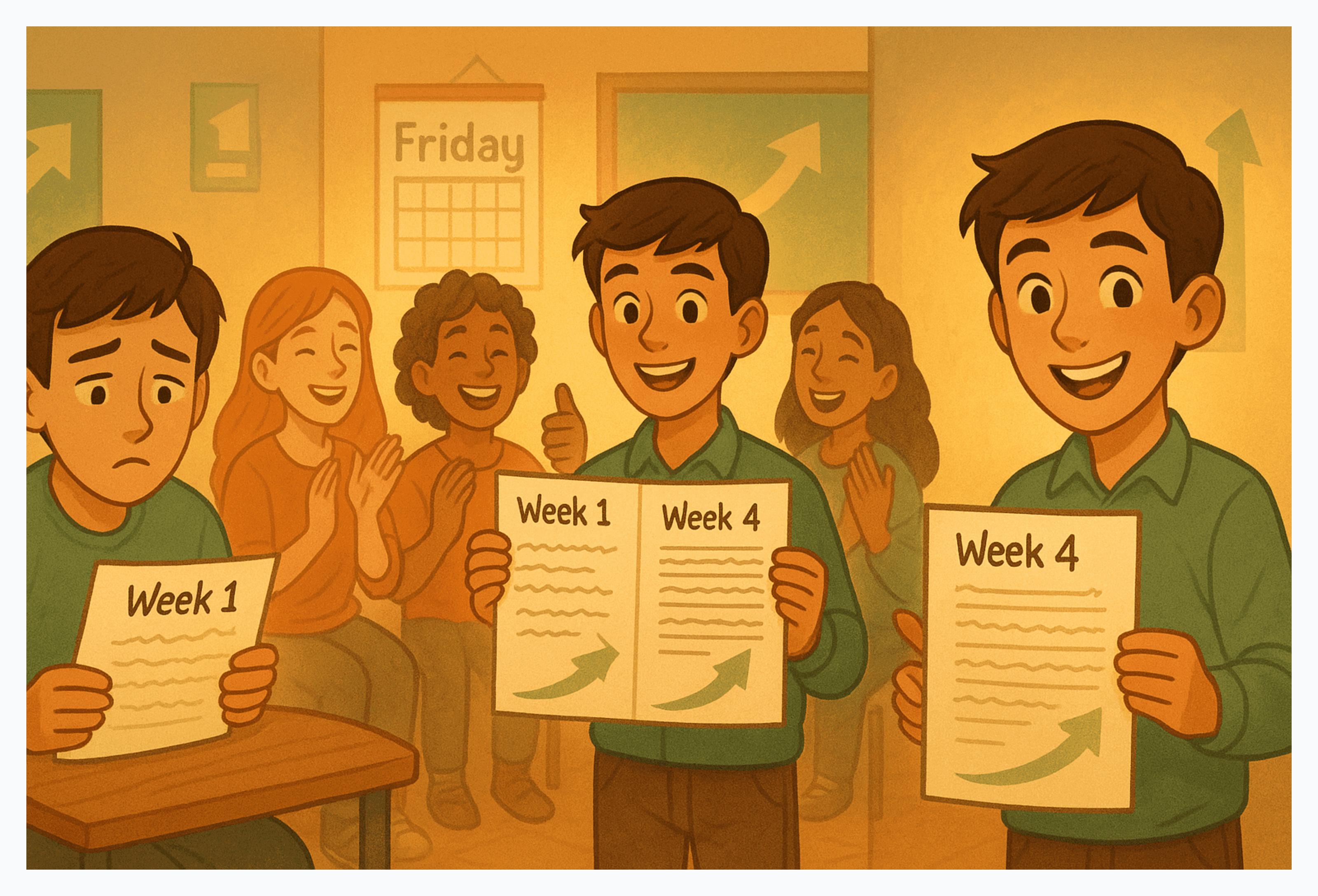
A weekly peer celebration period where students recognize one classmate who has shown remarkable learning and growth. Before/after comparisons of student work (Week 1 vs. Week 4) made the growth tangible and visible.
The Setup:
- Every Friday, we dedicated 10 minutes at the end of class to peer recognition
- Students nominated one peer based on observable growth in their formative work—not grades, but progress
- The nominated student shared a before/after example of their work and reflected on what they learned
- The class celebrated together
Why I chose this approach: Peer recognition is powerful because it’s social, immediate, and shifts classroom culture. When students see their peers valued for growth rather than perfection, the message becomes clear: learning is a process, and progress matters.
What Actually Happened
The results surprised me in the best way.
Student Engagement Shifted: A few days after the first celebration, I noticed students were more engaged in formative practice. They weren’t asking “Will this be graded?” anymore. Instead, they were asking, “Can I use this for my before/after comparison?” The practice itself became the goal, not the grade.
Peer Recognition Created Positive Accountability: Students started paying attention to each other’s growth. They noticed improvements in their classmates’ work that I might have missed. This peer awareness created a positive accountability cycle. Students wanted to show growth because they knew their peers were watching and celebrating it.
Formative Learning Was Reframed: By celebrating growth publicly and consistently, there was a fundamental change in how students talked about their learning. The narrative shifted from “Did I get a good grade?” to “How have I grown?” That’s the mindset shift I was after.
What’s Next?
This pilot was successful enough with one class that I have decided to scale it. Next term, I will roll out the peer celebration system with at least two more classes.
I have also explored how to involve families by sharing the experience with the student of the week’s parents by email. Seeing their child’s before/after work and understanding the growth journey their student is on provides even further encouragement.
I am also documenting this more systematically. I will continue to collect student work samples, recording reflections, and tracking summative performance data. By April, I’ll have a fuller picture of the impact.
Why This Matters Beyond My Classroom
Here’s what I want to share with other educators: You don’t need a complete overhaul to shift student mindsets about learning. You need one powerful lever.
For me, that lever was peer recognition. For you, it might be something different. But the design thinking process of identifying the real problem, exploring multiple solutions, testing one focused experiment, and repeating based on real feedback, is the framework that works.
Students want to see themselves as learners. They want to understand how their effort connects to their success. They want to be celebrated for growth, not just grades. We just have to create the conditions for that to happen.
My peer celebration system did that. And now my students are showing me what’s possible when formative learning is visible, valued, and celebrated.
If you’re struggling with the same challenge, I’d love to hear from you. What levers are you pulling in your classroom? What’s working? What surprised you?
Hi Victor!
This is so amazing! I can also relate with the “is this going to be graded?” questions from students. The approach you have laid out is great. In my classes, I have them do “shout outs” or “put up’s” – it’s more informal but also celebrates growth and being acknowledged by their peers and it’s great to build into the classroom culture.
As a performing arts teacher, my student’s formative feedback is also more on display and it’s constant – either written or verbal (more verbal). I can’t remember what your background is in but have you spoken to some drama, dance, art, music or PHE teachers at your school and how they approach giving formative feedback? The different perspectives might help you with this even more! I’d be happy to chat with you on this further at the next F2F as well as it’s something I am quite interested in.
Hi Victor!
Thank you so much for sharing your thoughts, your process and your practical experience! The fact that you already took some practical steps is very impressive and inspiring!
I can definitely relate to the issue of “Will this be on the test?” I find that especially in the last few years the pressure to get high grades have been even more pronounced among students and their parents, and it starts younger and younger with every single year. I like the approach you are suggesting, especially after your quite successful launch. The emphasis on process rather than result, on before and after, is such a great experience for your students on so many levels, including, but not limited to developing their sense of agency and confidence, metacognition, respect for the effort, hard work, trying new things without being afraid to “fail”. It also takes so much vulnerability to stand in from of the class and show your “before” work… but what great lesson in grit and what a hope-giving moment for those who may be ready to give up, but now feel inspired by another student, just like them, who showed so much growth.
I have so many logistical questions, such as what the nomination process looks like, did you have any issues with social dynamics (students nominating their friends, rather than based on merit), was there any pushback from the parents, etc. Looking forward to connecting during our next face to face! Keep up the great work!
Your post strongly resonates with a challenge I see often in my own classroom: students viewing formative work as less valuable simply because it isn’t graded. That familiar question “Will this be graded?” highlights how assessment culture can disconnect students from the learning process itself. I appreciate how clearly you identify the real issue as a lack of visibility, not a lack of practice.
I was especially drawn to your use of the design thinking process. Rather than jumping to a solution, you explored multiple, interconnected pathways and then intentionally chose one powerful lever to start with. The decision to focus on peer recognition feels both strategic and impactful.
The Student of the Week approach reframes success around growth rather than performance. Making learning visible through before/after work samples helps students see progress as something concrete and worth celebrating. The shift you describe, from students asking about grades to asking how their work shows growth, is a powerful indicator of real mindset change.
I also appreciate the emphasis on peer accountability and classroom culture. When students notice and celebrate each other’s progress, learning becomes communal rather than competitive.
Your plans to scale this practice and involve families further reinforce the value of growth over grades. This post is a great reminder that meaningful change doesn’t require an overhaul, just one thoughtfully chosen lever that helps students see themselves as learners.
Victor, I really enjoyed reading this. Your How Might We question gets right to the heart of the issue, students attaching value only to what’s graded, and you’ve named the root problem well, visibility of growth. The “Student of the Week” peer recognition is such a simple lever, but it’s powerful because it shifts the culture, not just the task, and your evidence is compelling, the language change from “Is this graded?” to “Can I use this for my before/after?” is massive. For our next session, I’m curious, what’s the one non negotiable piece you need to keep in place as you scale this to two more classes so it stays about growth, not popularity or performance?
– Gareth