Book Review: “Facing Our Futures” by Nikolas Badminton
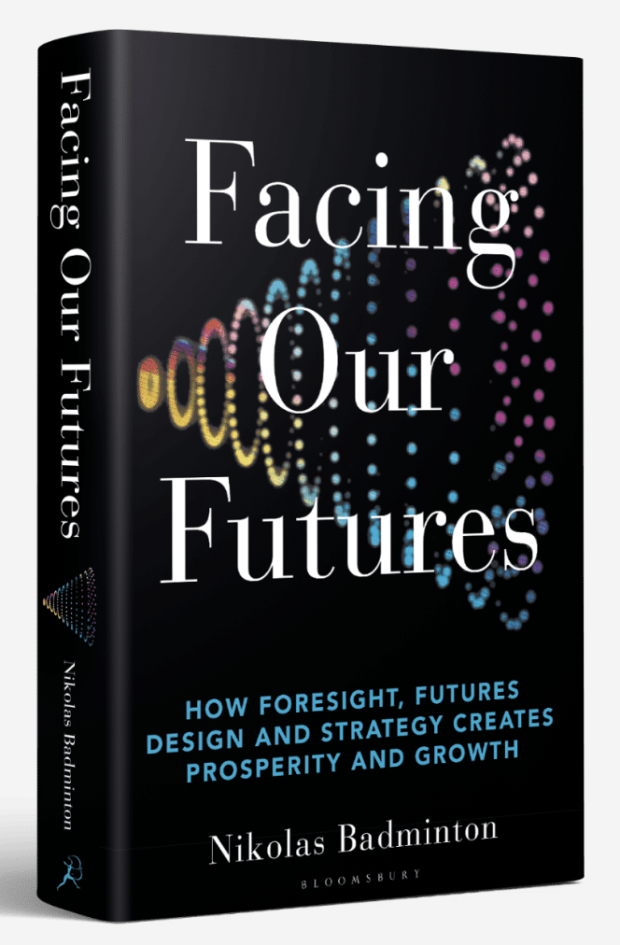
Book Review: Facing Our Futures
Nikolas Badminton
“As the first quarter of the 21st century draws towards a close, it is quite clear that possible dystopias loom… Only by anticipating possible dystopias and confronting the meaning of them as part of strategic foresight can we gain the courage and motivation to choose something better.”
— Glenn Hiemstra, Foreword (p.14)
You would be interested in this book if…
- You are responsible for leading an organization through uncertainty.
- You believe schools should prepare students for the future rather than simply preserve the past.
- You enjoy thinking about systems, innovation, technology, and societal change.
- You are interested in strategic planning, design thinking, or futures studies.
- You want practical tools that help you think further than the next quarterly report or strategic plan.
We Don’t Need Better Predictions. We Need Better Imaginations.
One of the greatest misconceptions about futurists is that they predict the future. But in fact Nikolas Badminton dismantles that myth almost immediately. You see, a futurist, he argues, doesn’t attempt to predict the future. A futurist explores many possible futures.
That subtle distinction changes everything. As Badminton writes,
“The work that I do… is about suspending our beliefs of how we imagine the future to be and opening our eyes and minds to the possibilities for many futures and new ways of operating in the world together.” (p.16)
That phrase—suspending our beliefs—may be the central leadership lesson of the entire book. Too often, organizations become trapped by their own assumptions. Schools are particularly susceptible. We continue designing learning experiences around assumptions that served previous generations while the world around us changes exponentially.
Badminton reminds us that leadership is less about confidently defending today’s assumptions than it is about courageously questioning them. Questioning them in ways that is full of hope, optimism and practical outcomes that defy the terrifying futures we hear about almost everyday.
The Future Isn’t Singular—It’s Plural
One of my favourite ideas throughout the book is the reminder that there is no such thing as the future. There are futures, plural: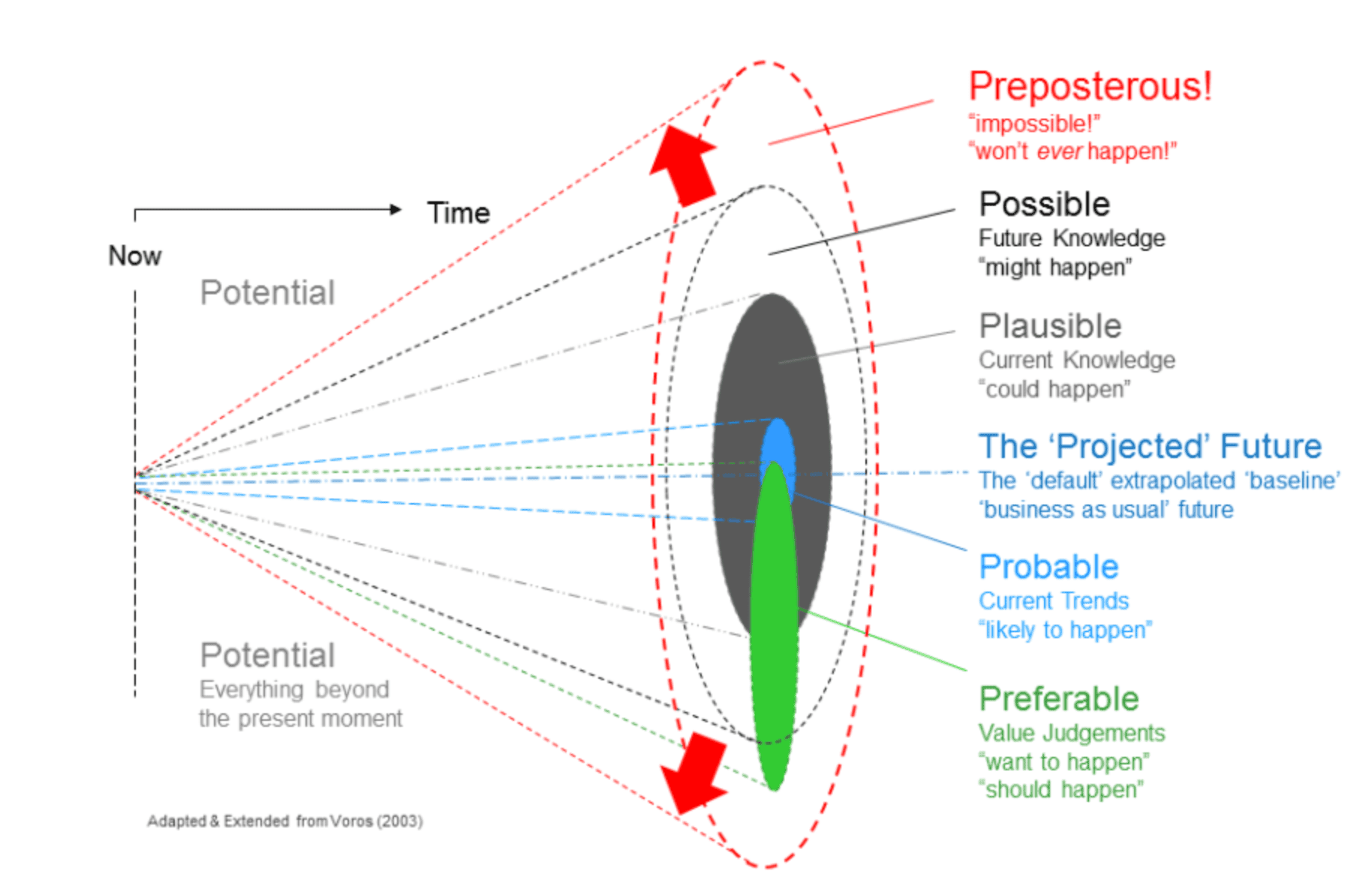
He introduces readers to what futurists call the Futures Cone, distinguishing between:
- projected futures,
- probable futures,
- plausible futures,
- possible futures,
- preferable futures,
- and perhaps my favourite—the preposterous future.
The point isn’t to decide which future is “correct.” The point is to deliberately expand our thinking. As Badminton writes,
“If we let go of the notion that there’s only one future… we need to diversify futures.” (p.36)
He argues that organizations frequently suffer from what he calls a poverty of imagination. It reminded me of Sir Ken Robinson’s call to action: that schools kill creativity… Therefore, the greatest risk facing leaders today may not be uncertainty, it may be believing there is only one way uncertainty unfolds.
This is not something that we want to pass down to future generations!
This connects beautifully with Roger Martin’s work on integrative thinking and strategy. Great leaders don’t simply choose between existing options—they imagine new ones.
Becoming a Futurist Is About Learning to See Differently
Perhaps the strongest section of the book outlines the actual work futurists do. This is disciplined curiosity, not crystal-ball gazing. Badminton outlines six core practices:
- signal scanning,
- trend identification,
- scenario building,
- speculative fiction,
- connecting future ideas to today’s reality,
- and continual sense-making.
He then describes the mindset required of futurists:
- Question your assumptions.
- Practice curiosity.
- Suspend judgment.
- Become comfortable with ambiguity.
- Read widely.
- Listen deeply.
- Embrace creativity.
- Think in decades instead of quarters.
As someone working in education, I couldn’t help but think: Why don’t we have more futurists in schools?
Badminton references H.G. Wells’ call, nearly a century ago, for universities to establish Professors of Foresight. Imagine if every faculty of education included futures studies alongside curriculum, assessment, and pedagogy. Imagine strategic planning beginning not with budgets and enrolment projections—but with possible futures.
We Cannot Build Better Futures If We Refuse to Imagine Dark Ones
This was perhaps the most refreshing—and courageous—part of the book – Badminton refuses to write only optimistic futures. He deliberately explores dystopian ones in order to be responsibly, and dare I say inspired; not because he is pessimistic. He writes,
“I am overwhelmingly positive and optimistic, and yet I am not afraid to investigate the darkness and consider the dynamics of dystopian futures.” (p.116)
This resonated deeply. Too often strategic planning asks:“Where do we want to go?”
Badminton asks another equally important question: “What happens if we don’t?”
He introduces concepts such as:
- Black Elephants
- Black Swans
- Black Jellyfish
Each representing different kinds of uncertainty that organizations routinely ignore. As educational leaders, we’ve lived through one. COVID-19 wasn’t unimaginable, it simply wasn’t imagined enough. What else are we leaving off of the table as we plan ahead?
Strategy Begins by Looking Back from Tomorrow
 One of the strongest practical ideas in the book is backcasting. Rather than asking, “What should we do next?” Badminton asks, “Imagine we’ve already built our preferred future. What had to become true for us to get there?”
It’s a subtle shift. But an incredibly powerful one. The future becomes less about prediction and more about intentional design. This reminded me immediately of the strategic planning work we’ve been doing at Kingsway College School.
Mission and vision are not destinations. They’re future stories.
The strategy exists to connect today’s reality with tomorrow’s preferred possibility.
Final Thoughts
Near the end of the book, Badminton quotes Kevin Kelly:
“No one wants to move to the future today… We are stuck in the short now.” (p.246)
Perhaps that is the greatest challenge facing leaders. We’re excellent at managing today’s problems. We’re much less comfortable imagining tomorrow’s opportunities. Facing Our Futures is ultimately a call to expand our temporal horizon. It asks leaders to think beyond election cycles, annual budgets, strategic plans, and school calendars.
It encourages us to become more future conscious through creativity, ethical pragmatism, courage, hope, curiosity, systems thinking, and continual learning. Most importantly, it reminds us that the future is not something that happens to us. It is something we actively participate in creating.
For educational leaders, that may be the most hopeful message of all.
If schools are truly preparing young people for an unknowable future, then perhaps our greatest responsibility is not to teach them the answers.
It is to cultivate the imagination, curiosity, and courage to ask better questions. What will your futures hold? What will the futures of our students hold? I don’t know the answer, but I know who does!