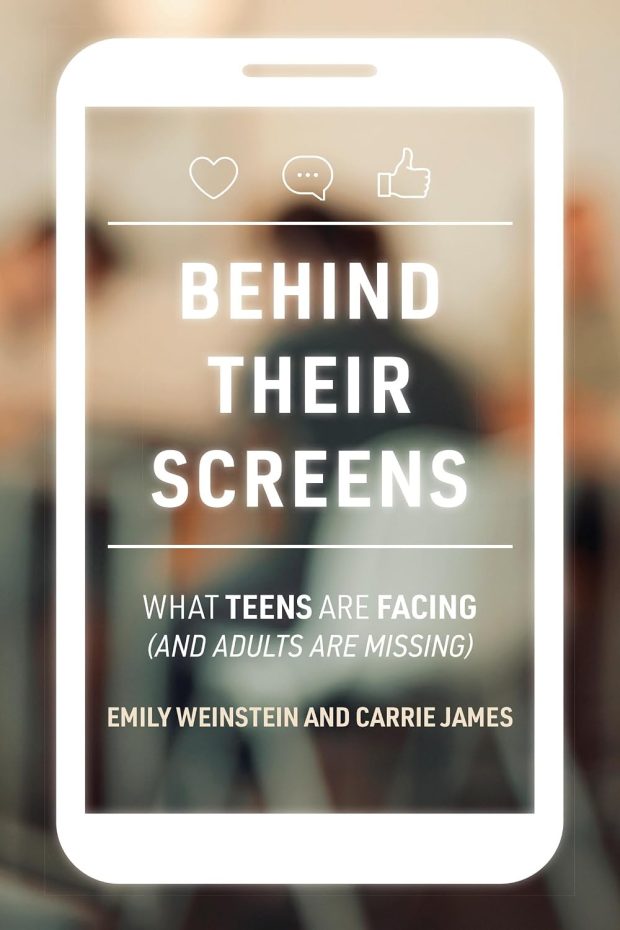
Book Review: “Behind Their Screen” (E Weinstein & C James)
“In truth, research findings about technology are almost always more nuanced. Admittedly, nuanced findings don’t make for the snappiest headlines.” (p.17)
Few topics in education generate more passionate opinions than teenagers and technology – specifically ‘screen time’ and ‘GenAI’. This book focuses on screen time, but much can be applied to our current conversations around GenAI and the role that educators and parents can play.
Ask almost any educator or parent whether smartphones and social media are helping or harming young people and you’re likely to receive an immediate answer. Headlines often reinforce those positions, presenting technology as either the root of a mental health crisis or an indispensable tool for modern life.
Emily Weinstein and Carrie James ask us to pause before choosing a side.
Their book, Behind Their Screens, invites us to understand something far more important: the lived experiences of the young people who navigate these digital spaces every day. The authors don’t attempt to settle the debate over whether technology is “good” or “bad.” They let us into the perspectives of youth.
Throughout the book, the authors continually:
(1) Bring in the voice of students through quotations. These serve to punctuate how nuanced and complex this discussion is. These quotations really stuck, and stay with me as I consider how to parent my own kids in this season of their lives.
(2) Challenge readers to reflect using a simple but powerful protocol:
I used to think…
Now I think…
That invitation to reconsider our assumptions may be the book’s greatest contribution.
You would be interested in this book if…
- you are a parent trying to better understand your child’s digital world.
- you work with adolescents in schools.
- you’re interested in the intersection of technology, development, and well-being.
- you’re looking for research rather than sensational headlines.
- you believe understanding young people begins with listening to them.
Teenagers Are Not a Monolith
One of the strongest ideas introduced early in the book is the concept of differential susceptibility.
The authors explain:
“Even if all teens browsed the exact same content, posted the exact same types of updates, and spent precisely the same amount of time using social apps, they wouldn’t all be affected in the same ways.” (p.22)
It’s a deceptively simple observation, but one with profound implications.
Too often, conversations about social media assume that every young person experiences technology identically. Weinstein and James remind us that teenagers arrive with different personalities, different family contexts, different friendships, different coping strategies, and different vulnerabilities.
Borrowing the metaphor of dandelions and orchids, they show how some adolescents appear remarkably resilient across many environments while others are more sensitive to the conditions around them.
As educators, this should feel familiar. The same classroom, lesson, or feedback rarely produces identical outcomes for every student. Why would we expect social media to?
Rather than searching for universal answers, the book encourages us to develop deeper curiosity about individual experiences.
Understanding Adolescence Requires Multiple Lenses
One of the aspects I appreciated most about this book is its refusal to oversimplify.
Throughout the text, the authors repeatedly return to three complementary lenses:
- a developmental lens, reminding us what is enduring about adolescence;
- an ecological lens, emphasizing that digital experiences never occur in isolation but are shaped by families, schools, peers, and communities;
- and a digital lens, examining how platform design amplifies both opportunities and challenges.
Together, these perspectives answer the central question posed by the book:
What are teens facing that adults are missing?
The answer, it turns out, is often context. Technology doesn’t replace adolescence. It reshapes the environment in which adolescence unfolds. That distinction matters for me as I lead the learning at my school, and also as I lead the approaches to learning and development of adults and children.
Digital Life Is Designed to Pull Us In
The chapter on screen use avoids simplistic arguments about addiction while acknowledging something many adults instinctively recognize.
Today’s technologies are intentionally designed to capture and maintain attention.
Infinite scrolling. Autoplay. Notifications. Variable rewards. Algorithms that learn our preferences.
These aren’t accidental features. They’re deliberate design decisions. Yet the authors resist placing the entire burden on teenagers. Instead, they write:
“Today’s technologies are vital, valued, and hard for everyone to manage.” (p.51)
How often do adults criticize teenagers for behaviours we ourselves struggle to regulate? Rather than assuming our role is simply to reduce screen time, Weinstein and James encourage us to help young people develop digital metacognition—the capacity to recognize when technology is serving them and when it is quietly beginning to shape their behaviour.
That strikes me as a far more enduring educational goal than simply limiting minutes on a device.
Friendship Has Always Been Complicated. Technology Makes It Visible.
Perhaps my favourite chapter explores friendships. The challenges teenagers experience—belonging, exclusion, uncertainty, social comparison—are hardly new, and existed long before a digital world was available.
What is new is the permanence, visibility, and speed with which those experiences now unfold.
The authors unpack everything from response-time anxiety to performative enthusiasm, from “likes” to private group chats, showing how digital platforms layer additional complexity onto relationships that were already emotionally demanding.
I was particularly struck by their discussion of Dunbar’s Number—the idea that humans can sustain roughly 150 meaningful social relationships. Technology may allow us to connect with thousands of people, but it doesn’t necessarily increase our capacity to belong. Reading the stories of the teens from the authors’ research was particularly enlightening!
That distinction between connection and beloning feels especially relevant in schools, where students often experience unprecedented levels of connection while simultaneously reporting increasing loneliness.
Disconnecting Isn’t Always an Option
One of the book’s most important contributions is its challenge to a common adult response:
“Just turn your phone off.”
The authors explain why this advice, while well-intentioned, often overlooks teenagers’ realities.
“Most teens can’t just turn off their devices to escape cyberbullying or hostility… Disconnecting comes at a high cost.” (p.81)
For many adolescents, logging off also means missing conversations with friends, school updates, extracurricular information, and the social interactions that shape daily life.
In other words, disconnection may reduce one source of anxiety while creating another. Another example of how this book, again, encourages understanding before judgment.
The Internet Doesn’t Forget—But People Grow & Change. What is accounted for?
The final chapters may have been the most thought-provoking. Weinstein and James wrestle with questions surrounding digital footprints, cancel culture, and what they describe as the tension between calling out and calling in.
- What happens when mistakes made at fourteen resurface at twenty-four?
- When should accountability remain?
- When should growth matter?
These aren’t questions with easy answers, but they are precisely the kinds of ethical questions educators should be discussing with young people. Schools have always believed in learning, perhaps we also need to believe more deeply in the possibility of change.
Developing Digital Agency
The book concludes with one of its strongest practical frameworks: Weinstein and James encourage adults to cultivate agency.
They identify three interconnected forms:
- Personal agency — helping young people develop the knowledge, habits, and judgment to make thoughtful choices.
- Collective agency — learning how peers can support one another in creating healthier digital cultures.
- Proxy agency — recognizing that parents, teachers, and other trusted adults have both the responsibility and the influence to advocate on young people’s behalf.
This framework shifts the conversation from control to capacity. The goal is not simply to protect teenagers from technology; rather, it is to prepare them to navigate it wisely.
The authors conclude with three reminders that feel equally relevant to classrooms, staff rooms, and family dinner tables:
- Ask rather than assume.
- Lead with empathy rather than eye-rolling.
- Choose complexity over commandments.
There may be no better summary of the entire book.
Final Thoughts
As schools continue to grapple with questions about smartphones, artificial intelligence, social media, and digital citizenship, Behind Their Screens offers something increasingly rare: nuance.
Rather than fueling polarization, Weinstein and James help us replace certainty with curiosity.
Rather than asking us to fear technology or celebrate it uncritically, they encourage us to understand the young people growing up alongside it.
For educators, this is perhaps the most important shift of all. Our responsibility has never been to prepare students for the world we inherited. It is to help them flourish in the world they are inheriting. That work begins by listening more carefully to what life looks like behind their screens.
Highly recommended for every educator, school leader, and parent seeking a deeper understanding of adolescence in the digital age.