
HMW Question: How might we help students unlearn the belief that only graded work matters, and instead see formative practice as the foundation for genuine learning and summative success?
The Challenge
Students often see formative practice as a “warm-up” to the “real work”—summative assessments. This mindset undermines their engagement with the learning process itself and disconnects them from understanding how practice builds mastery. The core issue: students struggle to connect formative practice to summative performance, and they lack visibility into their own growth over time.
Solution Pathway
Create a Weekly Peer Celebration System that makes student growth visible and socially valued through:
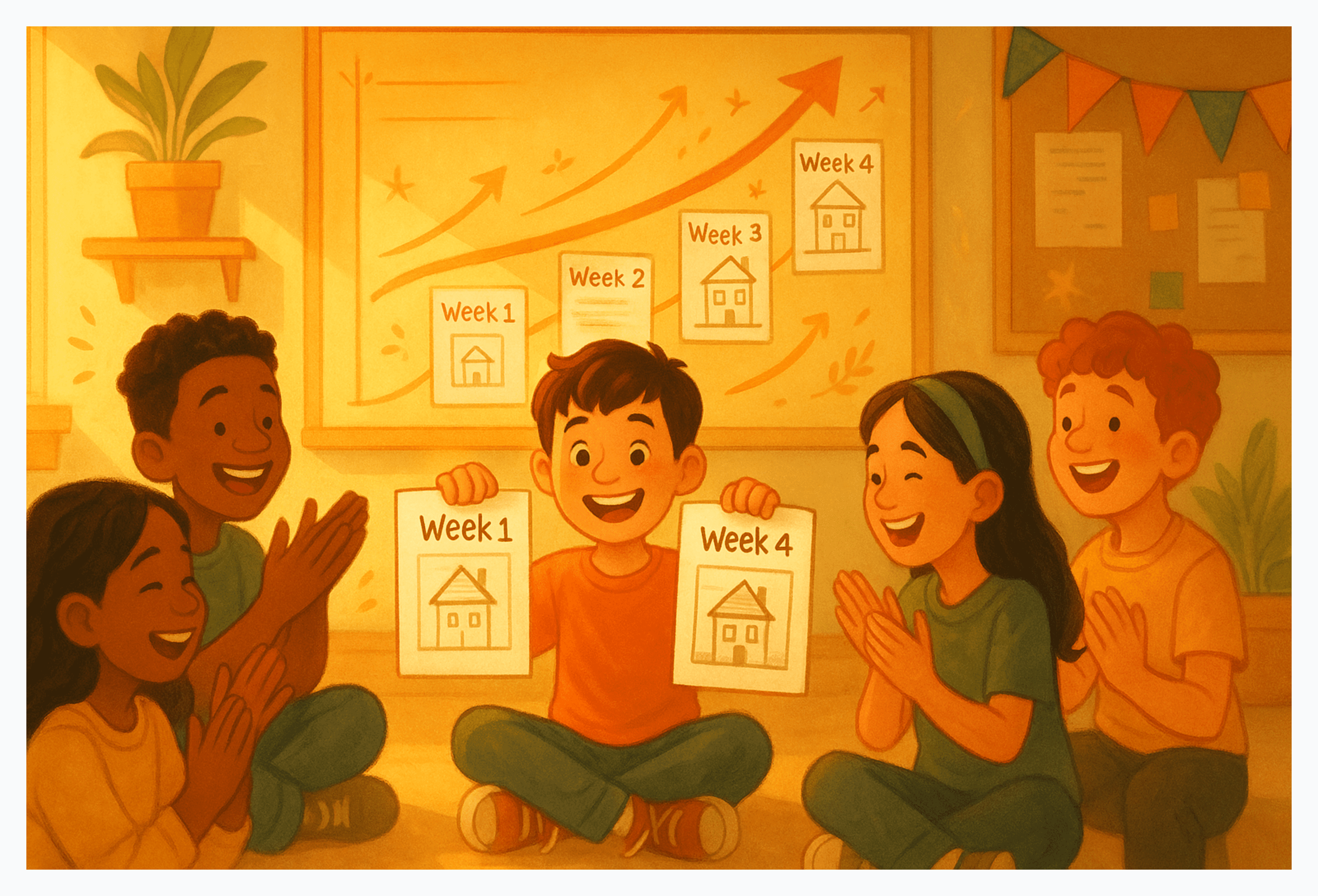
- Visibility: Before/after photo comparisons of student work (Week 1 vs. Week 4, for example)
- Celebration: Weekly peer recognition moments where classmates highlight one student who has shown remarkable learning and growth
- Community: Involve students, peers, teachers, and families in recognizing progress
The Experiment
Pilot Design:
- Test Group: One class
- Duration: One unit or term
- Mechanism: Weekly peer celebrations featuring before/after photo comparisons of student work
- Success Metric: Improved summative performance + observable shifts in how students talk about their learning (from “Did I get a good grade?” to “How have I grown?”)
Why This Works
This experiment applies three powerful design thinking principles:
- Empathy: Recognizes that students need to see themselves as learners, not just “grade-getters”
- Repetitive Refinement: Starts small (one class, one mechanism) to learn what works before scaling
- Social Reinforcement: Uses peer recognition to shift classroom culture—when peers celebrate growth, it becomes valued
Actionable Next Steps (December 2025 – April 2026)
December 2025:
- Select pilot class and establish a baseline of current student attitudes toward formative vs. summative work (quick survey or observation notes)
- Gather Week 1 work samples (photos or digital copies) from all students
- Design weekly peer celebration ritual (e.g., Friday 10-minute celebration, structured peer feedback format)
January 2026:
- Launch weekly peer celebrations with before/after comparisons
- Document student reactions and engagement (notes, photos, quotes)
- Adjust the format based on what’s working (e.g., timing, peer selection process, celebration format)
February – March 2026:
- Continue celebrations and collect mid-point work samples for comparison
- Conduct informal check-ins with students: “What have you noticed about your own learning?”
- Monitor summative assessment performance and compare to previous baseline data
April 2026:
- Analyze summative performance data and student mindset shifts
- Gather student reflections: “How did seeing your growth change how you think about practice?”
- Document lessons learned and decide on next steps: Scale to other classes? Refine the model? Add family involvement?
Key Insights for Design Thinking Journey
This mindset moves from a broad challenge to a focused, testable experiment. By starting with peer celebrations and before/after comparisons, I am creating a low-lift, high-impact intervention that addresses the root issue: visibility and social value of growth. This is the foundation for helping students reframe what “learning” means.
The goal isn’t perfection in April—it’s learning what works so it can be repeated and grown to a larger scale. Each week of celebrations is data. Each student reflection is insight. Each summative result is feedback.
It is not just about changing grades. It is about changing how students see themselves as learners. That’s the real innovation.
Victor, this is a challenge that so many of us face. I think you are spot on with the ideas that to reframe students’ thinking, they need regular feedback and a focus on celebrating growth as a classroom community.
My teaching partner and I focus on the idea of GROWTH with our students, the importance of comparing ourselves to ourselves (not others!), and celebrating every bit of progress and growth. This has created a very supportive classroom community where students are constantly celebrate their own and each other’s progress.
You could try setting up a bulletin board where students can add notes to celebrate their moments of growth and make them visible to others.
Something that can be very powerful in helping to shift mindsets as well is the Power of Yet. It can help students to identify areas of struggle (things they don’t know how to do YET) and then give them clear reasons to celebrate once they have figured out how to do these things.
I look forward to hearing about how the Weekly Peer Celebration System is going!