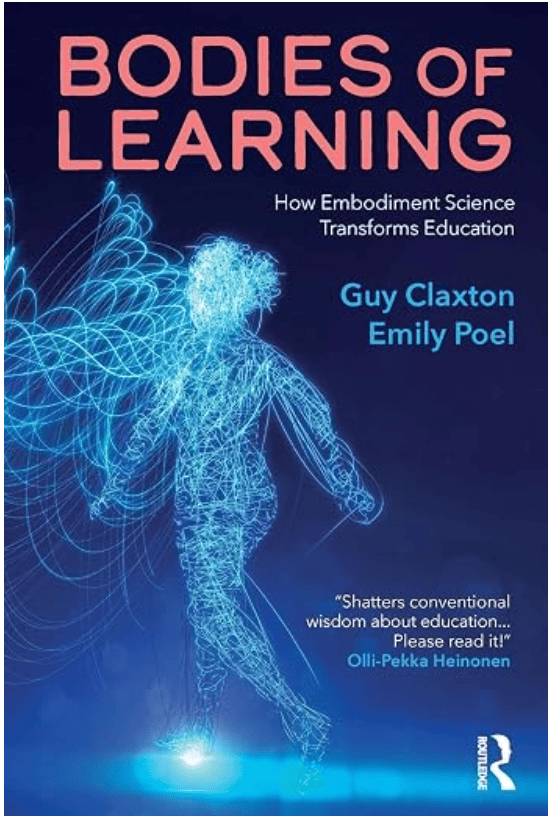
Book Review: “Bodies of Learning” by Guy Claxton & Emily Poel
“Embodiment science rejects this presumption of fixity and opens up an exciting new possibility: that schools can be a well-designed epistemic apprenticeship, a training in the learnable and transferable crafts of thinking cogently, critically, creatively, and collaboratively about important matters in their personal, social, and political lives.” (p.10)
Every once in a while, I read a book that makes me look at something we have accepted as normal in education and wonder: Why do we still do it that way?
Bodies of Learning by Guy Claxton and Emily Poel did this to me repeatedly.
We know more about the brain, body, memory, emotion, cognition, relationships, and learning than at any other point in human history. And yet many of the fundamental structures of school remain rooted in assumptions about intelligence and learning that are decades—sometimes centuries—old.
Claxton and Poel bring together an extraordinary body of research from what they call embodiment science, which seeks to understand the interconnected nature of our physical and mental functioning and experience. And from that science emerges a deceptively important question:
Does learning depend upon a relatively fixed amount of intelligence or ability—or are young people’s very capacities as learners shaped by their experiences at school?
If it’s the latter—and the research presented throughout this book makes a compelling case that it is—then we need to think much more carefully about the kinds of experiences schools are creating.
You would be interested in this book if…
- you believe our growing understanding of learning science should be changing what happens in classrooms;
- you are interested in the relationship between cognition, emotion, physical well-being, relationships, and learning;
- you question our continued reliance on standardized measures of intelligence and achievement;
- you’re interested in experiential learning, student agency, curiosity, and developing better thinkers;
- you are a school leader wondering how we might redesign schools around how young people actually learn;
- you are interested in the practice of embodiment learning.
There Is No Brain Without the Body
Western education has inherited a powerful idea: the mind and body are somehow separate. The serious work happens above the neck. This is where we think, reason, and even remember. Meanwhile, the body takes care of the brain – transports the brain from classroom to classroom, ensures there is enough energy, etc…
Claxton and Poel patiently dismantle this assumption.
They take readers through the history of intelligence, IQ testing, neuroscience, and the artificial separation between cognition and the body. In its place, they present an understanding of learning as embodied, embedded, and enacted.
We don’t simply learn with our brains: we learn with our whole selves. Therefore, our daily rhythm and energy matters. It means that our emotions matter. Every great teacher will tell you too, that our relationships matter. We know our physical surroundings matter. And more so than ever, educators are concerned and hyper-aware that our sense of safety matters.
And importantly, these factors don’t merely affect whether students feel good about learning, they affect learning itself:
“The brain, as master economist, constantly tries to conserve energy by predicting what’s likely to happen next, rather than starting from scratch every time. Learning, especially the kind of learning that stretches us, draws heavily on the body’s energy reserves, not just physically but also emotionally and socially.” (p.65)
This has significant implications for schools, because now we can see that rest isn’t necessarily time away from learning and that the skills and networked relationships aren’t something we attend to before getting to the curriculum. We also are more attuned than ever that emotional regulation isn’t peripheral, it is central.
Curiosity Is the Biological Engine of Learning
One of my favourite passages comes later in the book, when Claxton and Poel synthesize what the last several decades of research have revealed:
“The sharp distinction between what is of the body and what is of the mind have crumbled… We know that learning is often social and distributed, that learning naturally and essentially involves feelings and emotions… We know that surroundings have a powerful influence on how you learn as well as what you learn…” (p.138)
And then comes this wonderful sentence:
“Curiosity is the biological engine of learning.”
I love that. It immediately connected for me with Alex Hutchinson’s The Explorer’s Gene and Adam Grant’s Hidden Potential. Curiosity isn’t simply a nice disposition to add to the list of attributes we want in graduates.
It is fundamental to how humans learn, which raises an uncomfortable question.
How often does school actually cultivate curiosity? And how often do our structures inadvertently suppress it?
If curiosity is the engine, we should be designing schools that give it fuel: meaningful problems, ambiguity, exploration, choice, conversation, experimentation, and opportunities to pursue questions whose answers aren’t sitting conveniently at the back of a textbook. Let’s remember what the late, great Sir Ken Robinson said about schools… Have we come any further since his call to action?
Perhaps We Have Been Measuring the Wrong Things
Claxton and Poel also challenge the history of intelligence testing and the assumptions that have grown around it.
They quote psychologist Robert Sternberg:
“One of the most serious falsehoods permeating our society is the belief that standardized tests of intelligence are good and somehow highly meaningful and comprehensive measures of intelligence. Intelligence, however, is not about problem solving on a contrived test. It is about problem solving in the real world.” (p.116)
For educators, that distinction matters enormously. If intelligence is primarily something we have, our role is largely to identify and measure it.
If intelligence is something that can be developed, the responsibility of schools becomes very different. We have to create environments that stretch it.
Claxton and Poel offer a compelling description of high-quality thinking. It includes being:
- well-informed,
- humble,
- self-aware,
- critical and analytical,
- imaginative,
- tolerant of vagueness and uncertainty,
- systemic,
- and contingent.
Then they pose the question that school leaders should probably spend some time sitting with:
Do schools and colleges systematically build young people’s generalized dispositions for high-quality thinking and for the detection of shoddy rationality?
Their answer?
“Occasionally but not reliably.”
Ouch.
Learning Needs Resistance
There is another idea running through Bodies of Learning that I think is especially important right now.
Young people need to wrestle with things.
Ideas.
Problems.
Uncertainty.
Conflicting evidence.
Failure.
Questions without obvious answers.
Claxton and Poel compare this with strengthening a physical muscle. Our capacity to think becomes stronger, more agile, and more sophisticated through use. This strikes me as particularly important in the age of generative AI.
If a tool can increasingly summarize, generate, calculate, explain, organize, and answer for us, then the temptation will be to make learning increasingly frictionless.
But perhaps friction is sometimes the learning.
The struggle to formulate the question. The discomfort of not knowing. The attempt that doesn’t work. The conversation that changes your mind. The slow realization that your original assumption was wrong. These aren’t inefficiencies to be engineered out of education.
They may be precisely the experiences through which capable learners are built.
School as an Epistemic Apprenticeship
This was the idea in the book that resonated most strongly with me, because it is something that we have centred at my school, Kingsway College School.
What if we thought about education as an epistemic apprenticeship? The term sounds academic, but the idea is wonderfully practical. An apprenticeship doesn’t merely tell someone about carpentry. The apprentice works alongside the carpenter. They watch. try, fail, receive feedback, and from that they develop judgment, they notice subtleties, and then gradually take on more complex challenges.
Eventually, they begin to see and think like someone who understands the craft.
Claxton and Poel ask:
“What would be the life skills and attitudes that would fit young people for a wide range of lifestyles in a globalized and digitized 21st century?” (p.292)
And then:
“How would a traditional apprenticeship model have to be adapted and developed in order to achieve such educational goals without losing the benefits of the model?” (p.292)
These are fantastic questions.
Imagine treating thinking itself as a craft worthy of apprenticeship.
Students wouldn’t simply learn science.
They would apprentice in thinking like scientists.
They wouldn’t simply study history.
They would practise interrogating evidence, recognizing perspective, tolerating ambiguity, and constructing interpretations.
They wouldn’t simply learn information about the world.
They would practise becoming increasingly sophisticated at making sense of it.
That feels like an incredibly important purpose for school.
From Learning Science to Learning Design
This is also where Bodies of Learning becomes enormously practical.
The final portion of the book moves from theory into application and offers 87 things to try at school.
Some feel innovative.
Others will be reassuringly familiar to excellent educators.
But the point isn’t novelty.
It’s evidence.
The authors explore habit formation, mindfulness, interoceptive awareness, breathing, visualization, reflection, attention, movement, and dozens of other approaches to creating better conditions for learning.
They write:
“Mindfulness and interoceptive awareness training develop the ability to feel what is happening in the body with a friendly curiosity rather than judgment and reactivity.” (p.156)
And importantly, the book itself tries to practise what it preaches.
Sections conclude with opportunities to practise and reflect.
Pause.
Notice.
Breathe.
Visualize.
Zoom in.
Zoom out.
Try something.
Reflect on what happened.
That structure makes Bodies of Learning feel less like a neuroscience textbook and more like an invitation to become a better observer of learning—our students’ and our own.
Final Thoughts: What Would We Build If We Started Again?
I finished Bodies of Learning thinking about the enormous gap that sometimes exists between what we know about learning and how we organize school.
We know learning is social.
We know emotion matters.
We know relationships matter.
We know physical environments matter.
We know curiosity matters.
We know prior knowledge matters.
We know safety and regulation matter.
We know that intelligence is far richer than performance on standardized tests.
And we know that young people develop their capacity to think by actually thinking—wrestling with meaningful ideas and problems rather than merely demonstrating that they remember information.
So what should we do with that knowledge?
That’s the challenge Claxton and Poel leave us with.
For teachers, it means examining the experiences we design.
For school leaders, I think the challenge goes further.
How might we structure schools themselves around what we now know about learning?
What might happen to our schedules?
Our classrooms?
Our assessment practices?
Our professional learning?
Our understanding of student well-being?
Our use of technology and AI?
Our relationship with the outdoors and our communities?
And perhaps even our definition of academic excellence?
Because if schools really can become the “well-designed epistemic apprenticeships” Claxton and Poel imagine, then our task is much larger than helping young people acquire knowledge.
We are helping them develop the bodies, minds, habits, dispositions, relationships, and judgment they will use to encounter a complex world.
And that is an extraordinarily exciting vision for what school could be.
Highly recommended.