Book Review: Humans of AI by Joe Wilson
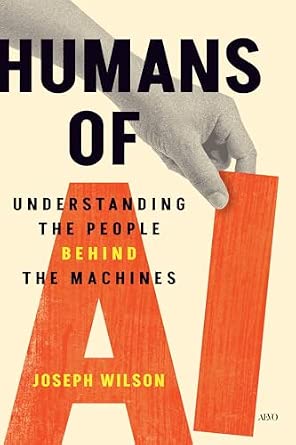
“When technology works, it’s invisible… No matter how good our computing technologies become, they will never write humans out of the picture altogether.”
— p.280
You would be interested in this book if…
- You are an educator or school leader navigating the rise of generative AI, and want a broader perspective.
- You want to understand not just what AI does, but who is behind it.
- You are skeptical of the hype and want a more human-centered, critical lens.
- You believe that technology is never neutral — it reflects culture, values, and power.
1. The “Human Stack”: Reframing What AI Really Is
One of the most powerful contributions of Humans of AI is its reframing of the “tech stack” into what Joseph Wilson calls the “human stack.”
“The tech stack is often spoken of as it exists independently of the humans who run it… we can think about the humans who work throughout the tech stack as an equivalent ‘human stack.’”
— p.9
This is the core thesis of the book: AI is not an autonomous force. It is a deeply human system — designed, trained, maintained, corrected, and interpreted by people. It is not something that is inevitable, either…
Wilson structures the book around these people: pioneers, engineers, entrepreneurs, ghost workers, linguists, rationalists, believers, and detractors. Each group represents not just a role, but a worldview — a way of understanding what AI is and what it could become. In this way, we see beyond the veneer of VCs and into the very physical and human side of AI.
For educators, this is critical. It pushes us beyond tool adoption and into cultural analysis. If AI is human, then its biases, limitations, and possibilities are human too.
2. The Power — and Danger — of Metaphor
From the earliest days of AI, we have relied on metaphor to make sense of machines. The “brain,” the “neural network,” the “assistant.”
Wilson traces this back to early systems like ELIZA in the 1960s, where users began to treat simple scripts as if they possessed real understanding. This is where he introduces the concept of pareidolia — our tendency to see human qualities where none exist. The danger is subtle but profound:
We assume the model we use to make sense of a phenomenon… becomes, over time, literally true.
Neural networks are not brains. They are mathematical models. But the metaphor is so powerful that we begin to forget the distinction. And this may be what fools us the most: it is magic! is it human?!
For schools, this matters. When students say AI “knows,” “thinks,” or “feels,” we must pause. These are not just linguistic shortcuts — they shape belief systems. This book brings us back to the physical nature of AI, and not just the sodering and wires, either. It brings us back to the conversations, discussions and interactions of the humans who are building, training an UXing.
Joe reminds us that belief systems shape behaviour.
3. The Illusion of Automation: Ghost Workers and Hidden Labor
Perhaps the most striking section of the book is Wilson’s exploration of ghost workers — the invisible human labor behind “automated” systems.
“A lot of the technology we think is automated… is in fact performed manually by ghost workers.”
— p.101
From content moderation to reinforcement learning (RLHF), from data labeling to editing AI outputs, human beings are deeply embedded in every stage of AI development.
Even more startling are the examples:
- Self-driving cars requiring human intervention for miles at a time, working out to 1.5 humans controlling self-driving cars vs. 1 human to actually drive it!
- Companies presenting human labor as artificial intelligence, where Builders.ai was discovered to have 700 Indian engineers masquerading as AI.
- Entire systems propped up by unseen, under-acknowledged workers, and in this book we get to meet a few of them, and see that their experiences are dark, and de-humanizing.
This is where the anthropological lens becomes essential. AI is not replacing humans — it is reorganizing human labor, often obscuring it.
For educational leaders, this raises important questions:
- What are we actually teaching students when we say something is “automated”?
- Whose labor is being hidden?
- What does digital literacy mean in this context?
4. Stories, Power, and the Politics of AI
Wilson also explores how narratives shape reality — particularly in the world of venture capital and innovation.
“This makes the stories entrepreneurs tell about AI crucial… they are investing in the narrative of transformational change.”
— p.92
AI is not just built on data. It is built on stories:
- Stories of efficiency
- Stories of disruption
- Stories of inevitability
These narratives influence funding, adoption, and public perception. And often, they obscure complexity.
This connects directly to your work in strategic planning and leadership. The question is not just what is true? — but what story is being told, and by whom?
5. Culture, Language, and the Limits of Data
One of the most important — and under-discussed — aspects of AI is its relationship to culture and language.
Wilson highlights a stark imbalance:
- Over 50% of internet text is in English
- Only ~5% of the world speaks English
This creates a profound bias in training data.
Even more compelling is his discussion of oral traditions, such as Anishinaabe storytelling. These knowledge systems are:
- Contextual
- Relational
- Dynamic
And they resist being flattened into static datasets. And this too raises a critical question for educators:
What happens when we try to digitize knowledge that was never meant to be fixed in place?
6. Ethics, Agency, and the Future of Being Human
Throughout the book, Wilson explores competing ideologies within the AI ecosystem — rationalists, believers, doomers, and others — each offering a different vision of the future.
But what emerges is a deeper tension:
- AI as liberatory (expanding human potential) for the few
- AI as controlling (flattening human complexity) for the masses
He captures this paradox powerfully:
The people behind AI are not peripheral… they are the culture that gives life to the concept of AI.
— p.213
And perhaps most importantly, he warns us not about AI becoming too powerful — but about it being not good enough, and still being used anyway. He deepens this thread by calling upon the Oroborus – the snake that eats its own tail.
What will happen when GenAI has been trained on the data? It will start to be trained on its own outputs – therefore deepening the bias, deepening the miscommunication and limiting the development of language.
That, for schools, is the crux.
Final Word
Humans of AI is a necessary counterbalance to the hype cycle surrounding generative AI.
It reminds us that:
- AI is not inevitable — it is constructed
- AI is not neutral — it is cultural
- AI is not autonomous — it is human
For educators and leaders, this book does something essential: it pulls us back to the 30,000-foot view.
Before we rush to integrate AI into our classrooms, our policies, and our systems, we must first ask:
Who built this?
Who benefits?
Whose voices are missing?
Highly recommended — not as a technical manual, but as a human one.
Thank you so much for writing and sharing this review Garth Nicols! I will prioritize my reading of Joe Wilson’s ‘Human’s of AI’. The review highlights aspects of the story of AI that we need to be more aware of! What is the full picture of the costs of AI? Who are the humans behind AI? This book raises many questions that educators should be asking.