Book Review: The Power of Mattering (Zach Mercurio)
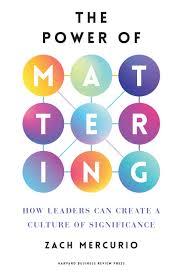
Book Review: The Power of Mattering by Zach Mercurio
In The Power of Mattering, Zach Mercurio makes a compelling case for why cultivating a sense of mattering is not only a deeply human act, but a critical leadership skill—especially in schools and educational institutions. Drawing from neuroscience, sociology, psychology, and wisdom traditions, Mercurio advances the notion that mattering—”feeling significant to those around you”—is foundational to wellbeing, performance, and sustained engagement in life and work. For school leaders, the book is both a mirror and a toolkit: it asks us to examine how we make others feel, and offers practical ways to make everyone feel seen, heard, and valued.
Mercurio’s central claim is that “the unending search for significance is the essential force animating human behaviour.” As educational leaders, this insight gives us an immediate and actionable mandate: to help the people in our communities—students, staff, parents—feel like they matter. In doing so, we tap into a primal human need that, when fulfilled, enhances not only personal wellbeing but also institutional performance and cohesion.
But let’s be clear, mattering isn’t about being right, nor is it about seeing your ideas taken on by leadership. It is the act of feeling listened to, acknowledged for your value, and feeling that your value is needed. It is not about getting your own way.

The book identifies three interrelated practices that constitute mattering: Noticed, Affirmed, and Needed—a model Mercurio abbreviates as the N.A.N. framework. These are deceptively simple concepts that can transform the culture of a school when practiced with intention:
- Noticed: seeing and hearing others with presence and attentiveness.
- Affirmed: reflecting back someone’s unique value and contribution.
- Needed: showing others how they are indispensable to a shared purpose.
Each domain is explored through research, personal stories, and case studies. For example, Mercurio recalls an employee saying, “Don’t give me a free sandwich or certificate, remember my name and say thank you.” Post-pandemic, with the rise of “death nudges” and existential questioning, this insight lands with urgency. In an era of mass disengagement and burnout, it is often these small but intentional actions that define workplace satisfaction and team cohesion. I connect this back to “How to Navigate Life” by Dr. Belle Liang and Tim Klein and their concept of a purpose mindset: you can find your purpose by mattering at work.
Importantly, The Power of Mattering distinguishes mattering from similar concepts like belonging or self-esteem. Mattering is not simply being included—it’s being essential. As Mercurio writes, “Mattering is actionable.” It is not a vague feeling; it is a measurable, relational experience that leaders can cultivate.
The book goes beyond theory, offering actionable tools and reflective practices. For instance:
- The “So That…” Mindset encourages reframing everyday tasks in terms of their broader purpose: “I’m writing this staff memo so that my team is aligned and confident.”
- Laddering involves showing team members how their individual work supports the overarching mission. As one janitor at NASA famously said, “I’m helping put a man on the moon.”
- Cognitive Job Crafting helps employees reshape their mental narrative around work by connecting tasks to real impact.
One of the most powerful reframes Mercurio offers is:
“We cannot expect our voice to have significance with others before the voices of others are significant to us.”
This reverses the traditional model of top-down communication, calling on leaders to be emotionally and cognitively present. He warns against “automaticity”—our tendency to appear as though we’re listening while actually operating on autopilot. The alternative, articulated attention, is a core competency of mattering-based leadership: choose what and who to pay attention to, and show it.
The text is also richly supported by Indigenous wisdom, including the Navajo proverb: “Act as if what you do makes a difference—it does.” This ethic threads through the book, elevating its message beyond organizational culture to a philosophy of life.
For educators, Mercurio’s work aligns closely with research by Carol Dweck and David Yeager on motivation and mindset. His synthesis of positive psychology, neuroscience, and cultural wisdom makes this book both academically grounded and applicable.
Check out this great video on the Power of Mattering through interviews of some of the people that are featured in the book:
School leaders will find in The Power of Mattering both affirmation and provocation. While many of the strategies may appear as common sense—greet people, listen actively, show appreciation—Mercurio’s contribution is to elevate these actions into a systematic, intentional leadership practice. Making others feel like they matter is not just a feel-good add-on to our work; it is the work. As Mercurio argues, “Creating a culture of mattering is a foundational leadership competency.”
While this book is focussed on business and not for profits, I would highly recommend this book for anyone in a leadership position within a school, or educational organization. It challenges us not only to lead more compassionately but to understand why doing so is essential for the flourishing of our people and our institutions.