Book Review: “Leadership Presence” Halpern & Lubar
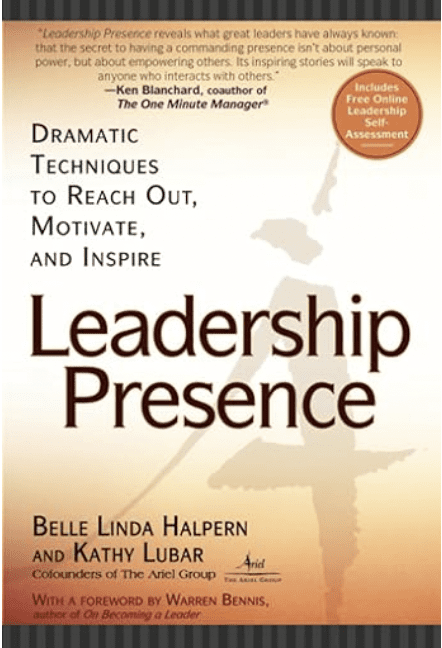
I want to thank the retired Head of School, Derek Logan, for recommending this book to me. This book is over 20 years old, and it still packs a punch. The authors take their lessons and learning from the theatre, from being consultants of The Ariel Group, and from their experiences working within larger companies, to help the reader understand what leaders need to succeed, and to make those they work with succeed. Many of these are now tried and true ways of leading, but it is always good to go back to the original thinking of when leadership was being reimagined from the older, predominately top-down models, to what we know to be true of effective leadership today.
In this way, reading this book is seeing how what we know today about leadership is still in its nascent stages – still much research is being done on leading through vulnerability, transparency – and is being tested within the new paradigm of social media, the values of younger generations and the shifting workforce.
You would be interested in this book if you:
(1) are looking to level up the way you show up at work to be more inspirational and authentic
(2) are required to speak in public often and want to perform more effectively through not just what you say, but how you say it
(3) are new to leadership and are ready to reflect, respond and reimagine what it means to lead in today’s world
(4) are already leading and want to explore the roots of how leadership has changed over time
What is Leadership Presence:
Presence is defined by the authors as, “the ability to connect authentically with the thoughts and feelings of others…It is a set of skills, both internal ane external, the virtually anyone can develop and improve.” Think of some of your most inspirational leaders that you might aspire to emulate ~ they probably have amazing leadership presence: the ability to recognize, and capitalize on moments; the ability to connect authentically with others regardless of the situation, and are very self-aware. This is leadership presence.
The skills are available to all of us to level up our Leadership Presence, but to be clear, this isn’t about becoming someone else. This is about knowing what is already inside of you, and developing the habits and skills that draw out what makes you authentically you, as a leader.
Leadership Presence & Being Present
This is the ability to be completely in the moment, and to be flexible enough to handle the unexpected. This section talks about those things that might make it challenging for leaders to be in the moment: fear, inner critic. Now, if this was written 3 years later, 2007 with the launch of the iPhone, there may be more numerous challenges, but their solutions, their strategies still ring true:
(1) Focus on the Physical: be in your body and recognize any rise in discomfort, breath through them;
(2) Change your Perspective: reframe your perspective from a ‘bigger place’ by recognizing the larger context and forces acting on the issue, the people you are with, and even larger, the local and broader community;
(3) Let Thoughts Go, Let Feelings Be: this is really about being curious about the moment – not what you are thinking in that moment, but really about what is it about the moment that is causing the fear or challenge?
This reminds me of a having developed a really good inner coaching approach, stoicism and mindfulness. A really good reminder from the authors here, and some great exercises to refine your approach as a leader.
And Presence also requires Flexibility to be able to respond and welcome everything known and even the unexpected.
There is much planning and control in business, but we think it’s mre accurate to say that business is about trying to plan and control in the face of a constantly shifting world ~ pg. 56
Here, the authors draw upon what is now a standard phrase in leadership: The Improv Approach of “Yes And…” – how to walk the fine line between asserting authority and responding to others’ needs. (pg. 63). There is a lot in this section about the different archetypes of leaders, which I won’t get into, but what is significant is that regardless of the archetype that you most resonate with, there are skills and strategies to help you draw upon the strengths of that approach in a way that is authentic to you, while still accomplishing flexibility.
Leadership Presence & Reaching Out
Leaders reach out and connect with people, and they fail to do so at their own peril. ~ pg. 79
How might leaders use their presence to reach out and shine the spotlight on others in order to capture their hearts and minds? ~ This is a key question that leadership presence demands to be answered each and every day. For example, how might leaders use empathy in a way that not only connects, but really reaches beyond to understand how their own voice is being heard by others. This requires of leaders to study and know:
(1) What makes the people you lead tick?
(2) How to connect with them through feelings
(3) That as a leader you can connect with anyone
This reminds me of the work of High Performing Teams and coaching: when you are challenged trying to connect with a colleague, you can focus on a skill, or a character-trait that you admire, and you can connect with them on this. So, you can look for things that you like and respect about this person – what makes the tick?
Then you can connect with them by showing them that they matter. (For more on this check out my book review on “The Power of Mattering” by Zach Mercurio) Build connection through empathic listening, acknowledging and then validating by sharing something of yourself.
Leadership Presence & Expressiveness
Expressiveness is more than charisma:
The baility to express feelings and emotion appropriately by using all means of expression – words, voice, body, face – to deliver one congruent message ~ Pg 129
Expressiveness is about bringing credibility to “Being Present” and “Reaching Out”. Tone, and Looks are critical: body language accounts for up to 90% of highly emotional, and / or challenging conversations. So you bet these authors lean in heavily to their experience in Theatre. “Great leadership works through emotions…” (pg. 137) So it is vital to not only use emotions, but to ensure that the emotions are congruent with the message, and with how that message should be landing with the audience.
Leaders are responsible for the level of energy, excitement and therefore quality of experience at work (Pg. 141). The authors provide great and effective anecdotes from the theatre and actors. They share stories about people that they have consulted for, and the great equalizer is about vulnerability. Brene Brown’s work wasn’t even conceived of in 2004, and here are the authors talking about its importance throughout this book.
Vulnerability means that you are putting yourself out there, in joy, excitement, even anger and passion. It is all effective if it is for a purpose:
If you want to invest what you do with more emotion, you must ask yourself the same questions an actor asks: What am I fighting for? What do others want? What are the obstacles? Then use your answers to select the appropriate verb that captures your passionate purpose. (pg. 152)
I am reminded (again and again) of the work of Dr. Belle Liang and Tim Klein in “How to Navigate Life” and how the work of @tfaucher and @gvogt in our Leadership Lab. It is just so vital to know your purpose – they will drive you as a leader.
Leadership Presence and Self-Knowing
If “motivate” means to get others to do the right things, then “inspire” mean to help others do great things…Inspiring leaders were those, we concluded, who knew themselves ~pg. 193
Knowing ones’ self means that you’ve been able to distill the learnings, and integrate them into your ways of knowing and doing, from all of your experiences. It also means that you are able to articulate these to yourself and others. (pg. 195)
An amazing example that they hold up as a self-knowing leader is Eleanor Roosevelt. Her work to bring awarenss and support to equity deserving groups required her to know her principles, values and then the courage and bravery to speak publicly. (pg. 197) You need to know and follow your values:
In leading with values:
(1) Tell people you are leading with your values – what they are and how they are helping you make choices
(2) Values extend your work – don’t just get the job done, do it in alignment with your values
(3) Be aware and proactive in the scrutiny of your actions against your values – if you are clear and transparent with your values, be prepared to have to explain your choices in that language to others.
One of the features of this book is their integrated exercises to support the reader to practice the work they advocate. This section is no different. There are many different questions they pose to help the reader get to their values, but one of them that stands out and is consistent across the current neuroscience and social science research is DOCUMENTATION ~ right things down: not just what happened, or what you did, but how you felt, why you did it, and what you think the impact was.
Another exercise that they advocate, and this too is consistent across the current neuroscience and social science research is STORYTELLING:
Stories work so well because they engage the heart and the mind, and because they help people make changes in their behaviour… That is the key source of their power. ~ pg. 216
While this book was written what seems like a life-time ago, in terms of research and the sea-change we’ve seen in what makes effective leadership, there is so much value. I can highly recommend this book for its storytelling, the exercises and practices within, and because it shows you how far we’ve come as those of us who consider ourselves to be students of leadership.
@gnichols
Thank you, Garth, for this thoughtful post and for surfacing the deep connection between presence and leadership. It resonates with me that leadership presence begins with centering the self—quieting the inner critic, being flexible, and showing up authentically in the moment.
But what happens after that centering? Once we are truly present, what do we do with that presence?
This is where the power of mattering comes in. Research reminds us that people don’t care until they feel cared for, and that “hurry and care can’t coexist” . Presence creates the conditions for noticing, and noticing is the entry point to mattering .
Some questions I’m sitting with:
• When I am fully present with someone, how do I use that awareness to help them feel seen, heard, and valued?
• In my everyday interactions, what small signals might I send that communicate “you matter here”?
• How do I balance being valued myself with adding value to others ?
• What practices can I build into my leadership so that every conversation not only listens, but leaves the other person more secure in their significance?
Leadership presence, when extended outward, becomes a practice of creating mattering for others. And when people feel irreplaceable, they act irreplaceable .
Thank YOU for taking the time to write these reviews and posts. Your unique take and perspective when applied to our school context is incredibly valuable. Keep the reviews rolling!
J