Book Review: Leading Through Strategy (T. Olverson)
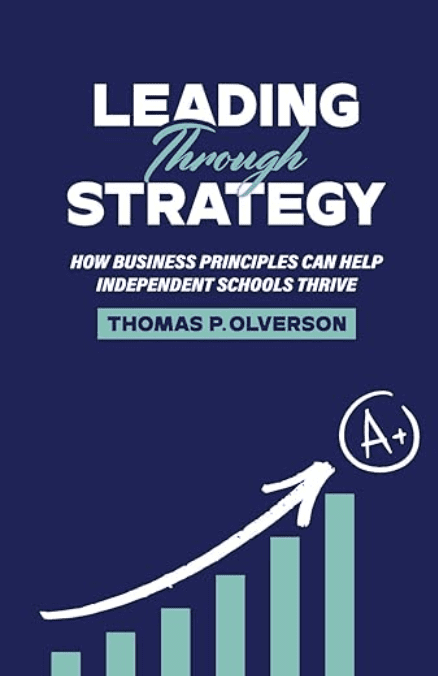
Leading through Strategy brings to life the role of a Head of School in the Independent School world. Thomas Olverson is the former Head of School of Rivers School, outside of Boston. This is the retelling, by him, of his learning, growth and development as Head of Rivers, alongside it’s growth and development into one the most respected school is this highly competitive market of education. It is full of great anecdotes, lessons and directives for new Heads to consider.
”My hope is that you can learn what questions to ask, how to frame your strategic challenges, and most importantly, how to think about them logically and creatively.” (Pg. 23)
You would be interested in this book is you were:
- A Head of School that is new to the role (first 5 years)
- Part of school undergoing a strategic planning process
- Interested in the business of schools
- Reengaging with strategic thinking and business approaches in the not-for-profit world

What is Strategic Planning?
“…Strengthening your school’s market position should be the goal of independent school strategic planning. It provides the most powerful lens to ultimately add value to your school.” (Pg. 17)
Olverson spends the entire book addressing the problems and challenges that come with strategic planning when led by those that don’t really, truly understand it. He leans heavily into “Playing to Win” by Martin and Lafely.
- A plan is not a strategy: there are common reasons why strategic planning failed for schools:
- Lack of vision
- Sacrificing the future in the name of solving problems
- Overestimating the capacity of the school to deliver any strategic plan
- Overly detailed planning becomes checkboxes to tick
- Lack of focus on strengthening the position of the school in the market
- Lack of training in strategy and business for Heads of Schools
”But most importantly, Rivers’ success came from a way of thinking about change and the future, looking at how the critical components fit together to create a virtuous cycle, understanding the risks and rewards of each strategy, and most importantly, tapping in tot he collective imagining of talented people who want to achieve something big.” (Pg. 15)
To support strategic planning then, a Head needs to ask 5 key questions:
-
- What is your winning aspiration?
- Where do you want to play?
- How will you win?
- What are the capabilities of the organization?
- What structures are needed to achieve the goals?

These questions need to answered by a few people/groups: firstly, the community; what insights can your community provide you that may be in your blind spots? For example, perceived cost to quality, lived experience of students as it pertains to your value proposition, and most importantly, what is your value proposition understood by the community?
Secondly, the administration of the school; what can they tell you about the faculty culture, the internal structures and systems of the school that are working, that are challenging and acting as roadblocks.
Other groups and people to consider are specific slices of your community by grade, by programming, etc… What might you learn with more nuance about a the experience of the entry grades of your schools? Why they chose your school, and what lived up to their expectations and what didn’t?
While the consultative process is important, it cannot override the role of the Head in leading the strategy of the school.
The Role of the Head
Olverson’ s message is clear to anyone reading this book: the Head is responsible for the design and delivery of strategic planning and ultimately the success of the school. A political strategy of listening to everyone and trying to answer their concerns and wishes is not going to accomplish a meaningful strategy. (Pg. 27). Likewise, any successful Head of School will have to recognize their formal and informal ‘power’, and how to use, delegate, give away, and apply it to achieve the outcomes.
“ … I wanted to control the narrative and set the strategic priorities. And I was willing to take the heat. What I did not want was a watered-down political document” (pg. 26)
To understand the school, a new(ish) Head of School should conduct an in-depth analysis called a SWOT (Strength, Weaknesses, Opportunities and Threats) analysis. This should be done by the Head of School, to develop their own perspective of the school, and form a basis for more inquiry and for formulating impressions. It is also a key process to identify fidelity within the school between the mission and vision and the lived experience of the community. (Pg. 32) Olverson adds: “I have seen the value of being the “expert”” (Pg. 33) He goes into a great story about how to be an expert, too long to repeat here, but is an example of great analogies that reinforce his perspectives.
Two other key points about being an expert is a Head’s relationship with consultants: “A consultant can help by providing guidance on how to take the journey, but she should not hand the head a distilled set of findings and vision. The Head should never outsource the chance for deep learning.” (Pg. 20)
And as a Head, it is vital to nurture, develop and seek to understand your own emotional intelligence. This is critical when it comes to leading the school through change.
Leading Faculty through Change:
Without hiring, nurturing and growing a talented faculty, “A school leader can have the greatest ideas imaginable… but those ideas will only remain dreams.” (Pg. 43)
To be an effective leader, you have to be able to connect with the key resource that will make a strategic plan optimized. A talented faculty are the key drivers of putting a vision into reality, and – most significantly – understanding how that delivery is going, how effective is it, and what needs to be adjusted once begun. This can only be done through effective relationships between the Head and the faculty. Something that Olverson stresses throughout the book:
“The Head’s capacity to ‘read the audience’, seek advice, and choose a strategy that will allow the faculty to see the [vision and challlenges that come with it] without getting defensive – all of these actions can be crucial to success. Effective Heads of School must have a high EQ…” pg. 21)
Another key element to leading through change having an unwavering commitment to talent. Attracting and retaining, growing and sustaining talent within a school should be a top priority. It is this group that a Head will rely upon. (Pg. 53) And it is this group that will be the smartest person in the room. Accessing and attending to the talents of the team is dependent upon a Head’s ability to create the conditions to encourage this talent to shine and be key contributors. (Pg. 53)
One approach that Olverson advocates is to have clear and transparent expectations for teachers. If we want to tout the special qualities of our faculty as a key value at a our school, we must provide a system and path for meaningful professional growth and accountability. This is what it means to invest in our faculty. What does being a top-teacher mean by way of disposition to relationship building, content-knowledge, and pedagogical skills?
For Olverson, at Rivers’, it meant looking for candidates that had the desire to learn from mistakes, and a fierce determination to figure out the pathway to success. These were the attributes needed to achieve the strategy he was laying out for Rivers’ at the time. What might be the attributes of your schools’ faculty?
Challenges to Change That a Head Must Address
”Only the leadership of the Head can overcome the significant headwinds preventing the school from [abiding by the agendas of others, trends, or manipulative community members whose informal power has gone unchecked]. Pg. 71
Therefore, when the agenda of others begin to sway the direction of the school, it is up to the Head to, “…constantly look for ways to solidify the school’s identity while ensuring the mission is being lived.” (Pg. 72) This underscores the role that strategy plays – it must be tied to the market position of the school, and to the mission, vision and values. These are the anchors.
This involves hard conversations, such as when a committee has to wrestle with the hard truth that even though some of the market is attracted by a particular quality of the school, it many not be value it enough to pay tuition for it. (Pg. 75) Or, when a board is enchanted by a trend or fad, and wants the school to embrace it, but it would mean taking time and resources away from a key differentiator. The list goes on and on…Therefore the Head must make sure that, as Druckker famously wrote: “The main this is to make sure the main thing is the main thing.” (Pg. 76) Thus, where will the school compete, and where won’t it compete?
Another challenge with change, comes with the accountability to the change on the ground. How will qualitative and quantitative data help you tell your story of change and value? For an effective Head and their team, accountability isn’t about looking good, it is about how to work harder and smarter to achieve the strategy. (Pg. 81)
Here is where Olverson shines. “Head-courage” is a term he uses to describe how many educators tend to be ‘people-pleasers’ because we care, we nurture and we want our students, and their families, to feel successful. However, “Head-courage” is required because with change comes upset, grief and even people leaving your community.
“When a Head want to make bold changes, she must abandon the need to be liked by all… EQ is critical in navigating the change process; however, Heads beware! The kind of change that I am talking about will inevitably make some stakeholders angry.” (Pg. 82)
Thus “Head-courage” indicates a Head’s true commitment to building the schools’ value. (Pg. 83)
How to Address Challenges Through Effective Systems and Structures
“Well designed structures have the power to promote communication, connect action to purpose, and tap the collective genius of the team. They are a crucial management tool for long-term school improvement but only if their work is connected to achieving the vision.” (Pg. 110)
Here Olverson draws upon the popular archetype of the “Leader as Architect”. In this part of the book, he explores the psychology of understanding others, power – both formal and informal – and how and where it is expressed, and how systems and structures can harness these to drive value and purpose.
“New Heads should remember that not all operations need their attention early on. I paid very little attention to the work of the various parent volunteer organizations at the school, not because I was unappreciative, but because I needed to concentrate on those capabilities vital to reaching [our goals].” (Pg. 113)
Olverson’s second major point is about the composition of the board. Open and honest communication with the Head and Chair are vital from the outset. They have to be working not only to an aligned purpose, but they must be working alongside one another. This begins with effective onboarding of the head that allows for critical questions, deep understandings of the history of its members, as well as understanding the structure and purpose of the board committees. (Pg. 117)
Early on, the Head is the best person to connect the dots between the vision and mission with the strategy and tactics. Successful Heads are obsessed with results, understand the risks, and it is the work of the Head and the Chair to drive the implementation of these goals. Thus, annual goals for the Head of school must reflect a partnership, not an evaluation. Annual goals and the assessment of a Head must be in service to achieving something great – the vision and improved position in the market. (Pg. 145)
“Once Trustees assume that the school is playing the long-game, they will much more readily jettison the unrealistic short-term goals that all too often sacrifice the future of the school.” (Pg. 151)
I highly recommend this book, as it brings to life the lessons provided by leaders in industry, like Martin and Lafely, as well as Drucker. It also puts them into an educational context and through storytelling and anecdotes, really brings to life the role of the Head in this complex, demanding job.
For classroom teachers, how might strategic thinking support understanding school decisions or their role in achieving strategic goals. Reading this book can provide bottom-up understanding of the business of independent schools. This will allow you not only to seek to understand the why and what of decisions, but also to get more involved and engaged with the decisions – either supporting them, or effectively questioning how they are helping the overall purpose and mission of the school.
For CIS Ontario educational leaders, there is a clear provocation in this book: The current landscape and educational trends (e.g., financial sustainability, enrollment shifts, market positioning amidst demographic changes) are fraught with uncertainty, and no ‘standard’ playbook. The only thing that can be viewed as standard are the approaches and mindsets that we know will provide an effective direction, agility and self-assessment for schools as they chart their own path through strategy.