Book Review: “Connections Academics & Purpose (Dr. Cinde Lock)
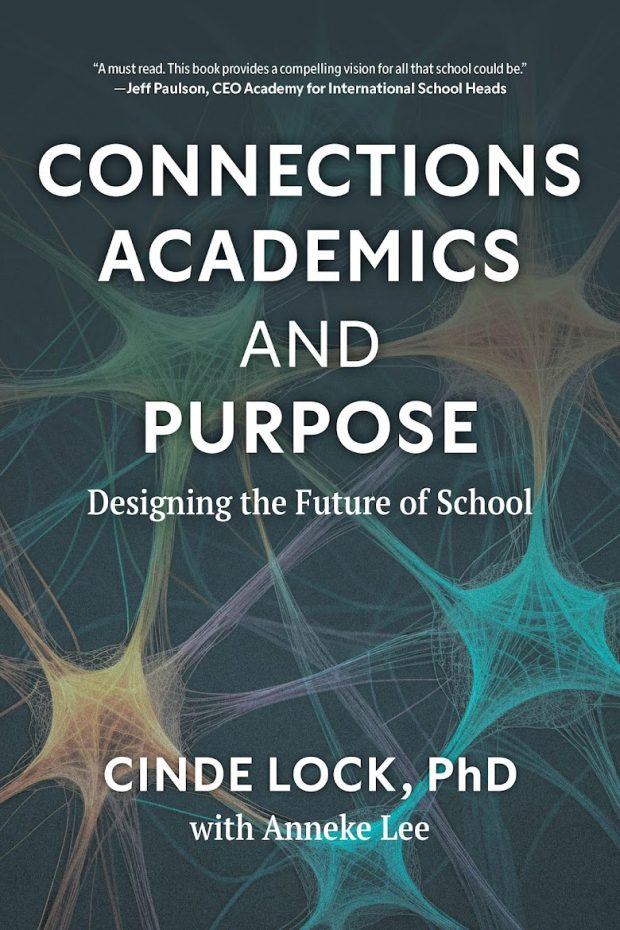
“The CAP method helps students to move beyond themselves, engage with others, learn at their own pace, and show what they can do, rather than obsess over what they can’t.”
— p.19
You would be interested in this book if…
-
You are designing or leading programming that blends academic depth with student agency, purpose, and connection to community.
-
You want to reframe what “rigor” actually means for the future of learning.
-
You are looking for practical, purpose-driven alternatives to the toxic culture of productivity that Jennifer Breheny Wallace critiques in Never Enough.
-
You believe the school of the future must be grounded in wellness, equity, and joyful curiosity, and achievement in curriculum standards.
1. Connection: To Others, To Place, To Purpose
Dr. Cinde Lock begins with the premise that learning doesn’t begin with curriculum — it begins with connection. What happens when students first encounter a real-world problem, build meaningful relationships with community partners, and then use academic knowledge to make an impact?
You get deeper engagement, broader thinking, and a redefinition of rigor.
In this first section of Connections, Academics and Purpose, Lock makes a compelling case for problem-finding as the precursor to curriculum alignment. At Kingsway College School, this model resonates deeply with our own programming: from place-based learning in the Junior School to KCS By Design and PATH in our Senior School, we see connection as the catalyst for meaning-making.
Lock doesn’t stop at human connection either. Where this book ends is really important – it provides a starting point, checkpoint and end points for schools to begin the journey towards meaningful change for students to be future ready. It challenges schools to consider “How can we do better at acheiving what we believe in?” To support this change, the author provides examples from her own experiences and schools, and from others. There are templates too. Highly recommend.
In this process, rigor is redefined to reflect the changing reality of the present and future.
She expands the definition of connection to include the physical world, the natural world, and the community — a point that resonates deeply with our place-based learning model at Kingsway College School. In our Electives and PATH programs, students regularly partner with mentors both within and beyond the school, experiencing real feedback loops and making meaning that crosses disciplines and schemas.
“We need to make certain that our students learn the curriculum expectations. But we also need to help them find meaning in the learning… Once they engage, we can steward their learning and track their progress against the curriculum.”
— p.97
2. Academics: Rethinking Rigor
In traditional education, high achievement is often associated with stress, sleep deprivation, and perfectionism — with students feeling they “can’t drop the ball for even a minute.” Lock reframes rigor as the product of engagement, not pressure. Through CAP, students first connect to something real and then backfill with curriculum, which invites curiosity and intrinsic motivation.
I’ve practiced this model throughout my career, and it works. When the learning — not the grade — is prioritized, students flourish. They come to know themselves as learners, explore their strengths, and tackle meaningful problems with deep focus and creativity. In this way, the purpose of assessment and evaluation aligns with what we know to be true about learning and the brain – we create deep learning experiences where knowledge is able to be transfered across disciplines and applied rigorously to problems, challenges and inquiry.
“As long as every student masters all aspects of the curriculum by the end of the course or school year, not every project needs to have an identical outcome for all students.”
— p.34
3. Purpose: The True Driver of Learning
This is the real gift of the CAP method. As Adam Grant argues in Hidden Potential, excellence grows from systems that allow purpose to flourish — not just practice. Lock reminds us that students don’t need more pressure to succeed. They need purpose to keep going.
CAP projects provide this. When educators shift to a CAP approach, they ask students to identify authentic problems, build partnerships, and develop iterative, long-term solutions. In doing so, students develop what Grant calls “character skills”: perseverance, curiosity, and a bias toward improvement. These are protectors against burnout. As Lock writes:
“Designing exploratory, experiential learning opportunities that don’t involve any types of assessment or grading can be exceptionally powerful for addressing burnout in students.”
— p.54
This is Free Agent Learning in action — driven not by extrinsic rewards, but by students’ own desire to make meaning and impact the world around them. To exercise their agency as they purposefully explore the world and learn about themselves.
4. Assessment: Standards, Not Comparison
Lock supports the shift to standards-based assessment — a path Kingsway College School has been actively pursuing. In Ontarion, we can point to Growing Success (2010) as a missed opportunity for deeper system-wide reform. More than a decade later, many schools still prioritize marks over mastery.
Assessment shouldn’t be about comparing the work of students versus other students; it should be about established criteria that students need to demonstrate achievement towards.
This requires a shift in educator mindset. The teacher plays a different role in the learning process. They are no longer a gatekeeper – rather, they use their knowledge and expertise of curriculum standards, of the content and pedagogy, and connect that to their knowledge of the students: their interests, their skills, and their passion. Educators connect content, curriculum and students with the Wider Community, so that community become co-teachers. And students take ownership of how, when, and where they demonstrate learning.
5. The Call to Action: Begin the Journey
Where this book ends is perhaps its most powerful contribution. Dr. Lock provides schools with a clear starting point, a checkpoint, and an end point for meaningful change. She doesn’t just imagine the future — she maps it out. With templates, examples, and reflection prompts, this book helps schools ask the right question:
“How can we do better at achieving what we believe in?”
Final Word
Connections, Academics and Purpose is more than a title — it’s a framework for the school of the future. It affirms that student agency, wellness, and rigor are not in conflict. They are interdependent. And as our schools move toward preparing students for the future, and not just learning the past; as school move towards skills and real-world issues; as schools move to tackle the growing ‘Mattering Defecit” (as Zach Mercurio, author of The Power of Mattering names it) this book gives us the tools to align programming with what truly matters: not just achievement, but meaningful engagement.
Highly recommended.