Book Review: “Chief Joy Officer” ~ R. Sheridan
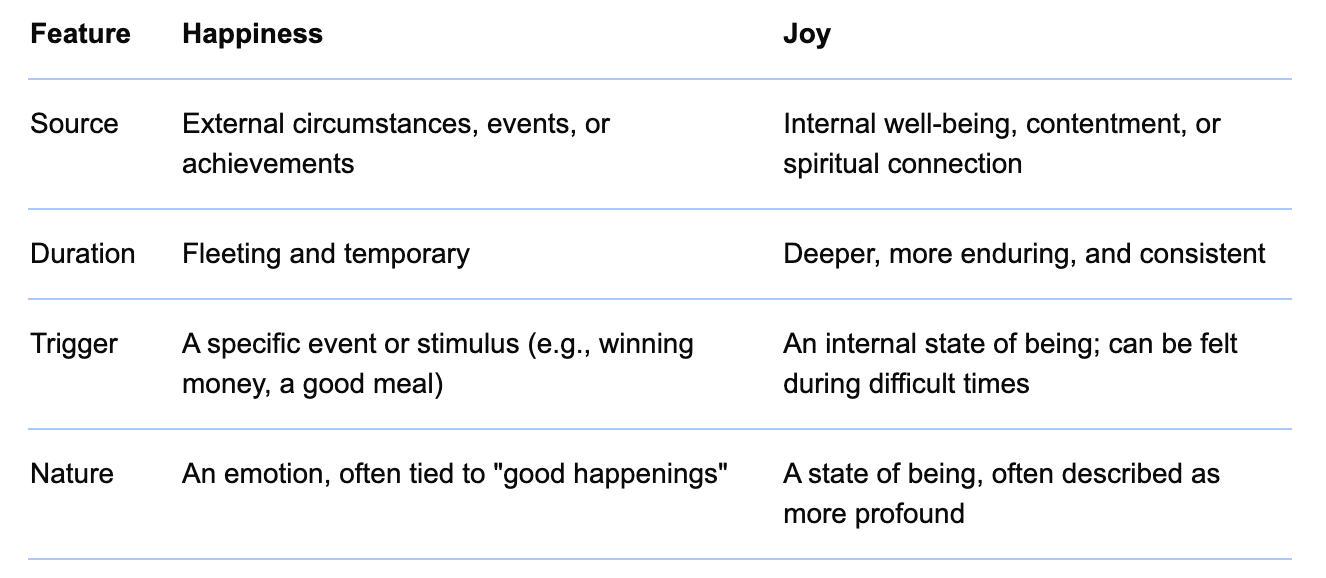
Let’s start the year off with “Joy” and the pursuit of Joy in our lives. Happiness is a more temporary, externally triggered feeling of pleasure, while joy is a deeper, more lasting state of internal contentment. Happiness is often a response to specific events or circumstances, such as getting a new job, while joy stems from a deeper sense of self-satisfaction or spiritual connection that persists even during difficult times. Consider the chart below:
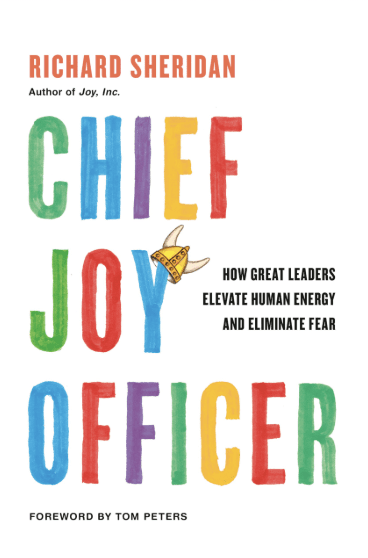
You know those neighbourhood libraries – the cute little covered shelves in front of houses that dot neighbourhoods throughout Toronto, and other cities. They usually have books that are well-loved, and from a time – rarely are there current ones. My wife loves to peruse these little pots of gold for books. A few months ago, she found this book “Chief Joy Officer” and recommended it to me.
It was published in 2018, and is about Sheridan’s work to bring his company “Menlo” in Ann Arbour Michigan, into a new way of working. Characterized as a zero-hierarchy, joyful workplace, Menlo is held up as a cultural north star for the tech-industy companies. And I think that there are some great lessons in here for leaders in any industry.
You would be interested in this book if…
-
You are a leader who believes that culture is not an outcome but a practice, and that joy is not a luxury but a strategic imperative.
-
You are searching for ways to align leadership with authenticity, humility, optimism, and love — not as soft skills, but as essential human competencies.
-
You want to design organizations where fear is eliminated, people feel safe to experiment, and joy becomes both the process and the product.
- You are interested in learning about how systems and structures of other industries can be applied to education.
You would not be interested in this book if…
You are looking for a formulaic, “quick fix” approach to culture change. Sheridan makes it clear that joy cannot be mandated — it must be cultivated through values-driven leadership and daily practice.
The Case for Joy in Leadership
Richard Sheridan, co-founder and CEO of Menlo Innovations, begins with a disarmingly simple yet profound premise: joy belongs at the heart of leadership. Early in the book he writes, “The endless pursuit of the mission is the thing. These guiding principles become your north star.” (p. 14).
That image — the “north star” — resonated deeply with me. In schools, as in organizations, there is always a pull between the urgent and the important. Sheridan’s point is that joy isn’t a fleeting feeling; it’s the product of alignment — when one’s mission, values, and actions all point in the same direction.
He continues, “Joy, when it’s real, is always connected to your values.” (p. 16). Sheridan refuses to treat joy as surface-level positivity. Instead, it’s about creating meaning and belonging — the kind of culture where purpose drives productivity and relationships fuel resilience.
The Opposite of Courage Is Conformity
One of the book’s most memorable lines is Sheridan’s assertion that “The opposite of courage is not cowardice — it’s conformity.” In that single sentence, he captures the tension that many leaders feel: the pull to fit in versus the call to stand up. Courageous leadership, in his view, means taking the risk to lead differently — to prioritize empathy over efficiency, and trust over control.
In education, this rings especially true. Leading schools through complexity requires courage to question inherited systems, to hold space for uncertainty, and to model vulnerability. Sheridan reminds us that leadership is not about hierarchy — it’s about humanity.
Authenticity, Humility, Love, Optimism, and Vision
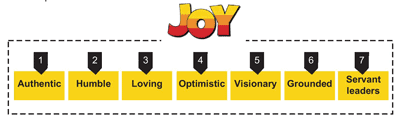
Sheridan organizes much of the book around five intertwined traits of joyful leaders: authenticity, humility, love, optimism, and vision. Each is illustrated with stories from his own company, but their relevance extends well beyond software design.
-
Authenticity means being congruent — aligning words and actions.
-
Humility invites us to learn from others rather than lead from ego.
-
Love, perhaps his most radical concept, challenges us to treat people as whole beings, not as roles or resources.
-
Optimism is the belief that the future can be better — and that our work contributes to that better future.
-
Vision ties it all together: a shared purpose that allows others to find meaning in the work they do.
These qualities don’t come from leadership training manuals; they emerge from reflection, intentionality, and practice — much like the work of teaching and learning itself.
The Mindset Economy
Sheridan positions leadership within what he calls the “mindset economy,” where the most valuable resource is not capital or technology but human creativity and engagement. This framing echoes what we see in education: the real differentiator for schools isn’t infrastructure but culture — how people feel when they work, learn, and grow together.
As Sheridan puts it, “Joy is the ultimate high-performance fuel.” Leaders who build cultures of joy don’t ignore results — they achieve them through relationships, not in spite of them.
Storytelling and Learning Cultures
Throughout the book, Sheridan reminds readers that joy thrives where stories are shared. He writes, “Our stories are what make our values real.” In his company, stories of small triumphs, mistakes, and recoveries become the connective tissue of culture. This lesson translates beautifully to schools: storytelling is how we make learning visible and leadership human.
Why This Matters for Educational Leadership
As a Head of School, I see Chief Joy Officer as a timely invitation to rethink what success looks like in education. Sheridan’s framework offers a lens through which leaders can design cultures that are both high-performing and deeply humane. Joy, in this sense, becomes a leadership discipline — one that integrates purpose, empathy, and continuous learning.
In a time when schools are navigating volatility, uncertainty, complexity, and ambiguity, Chief Joy Officer reminds us that joy is not naïve — it’s necessary. It is what gives leadership its heartbeat.
Final Thought:
Richard Sheridan’s book is not about happiness at work — it’s about hope in leadership. For those who believe that schools and organizations can be joyful, purposeful, and profoundly human places, Chief Joy Officer offers both a vision and a roadmap.