Book Review: “How Good People Make Touch Choices” (Kidder)
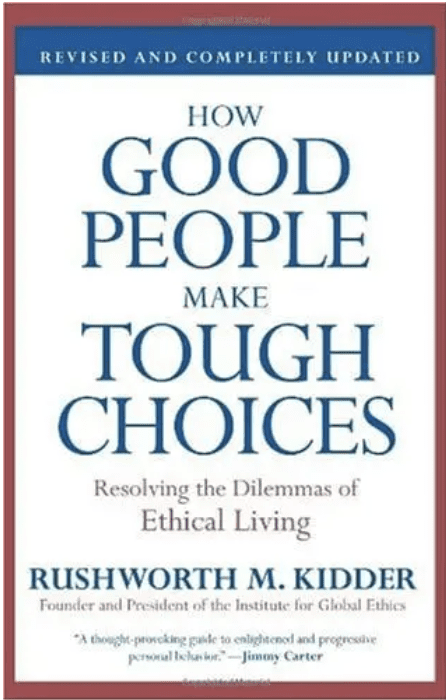
As we head into the winter holidays, I am excited to share with you a book I read back in the Fall, and one that was recommended this book by a friend and former colleague, Vanessa Wade. She is responsible for discipline at her current school, and is currently pursuing an Ed Diploma in Ethical Decision Making. When Jason Rogers and I interviewed her on our podcast (LINK HERE) the way that she described her thought experiments, her research and the significance of this work on the way she is interacting with and leading her peers and students was too compelling to not pick up this book. While our energy might be running low, but emotions running high, this book is a great reminder to anchor ourselves in our values. While it is light in weight, Kidder’s book is indeed heavy in learning…

You would be interested in this book if:
-
You want an exercise in values-based leadership, learning how to make decisions guided by clarity, integrity, and courage.
-
You are drawn to real-world case studies that unpack moral and ethical dilemmas — and explore frameworks for resolving them.
-
You are seeking to refine your thinking about leading from an ethical or values-based center, especially in complex or high-stakes environments.
You would not be interested in this book if you are looking for simple or formulaic answers to ethical dilemmas. As Kidder cautions on page 161:
“You don’t stick in the dilemma at one end, turn the crank, and pick up your answer at the other. Indeed, no one expects moral principles to provide that sort of precision. Making ethical decisions depends on judgment, character, moral awareness, perception, discrimination, and a whole host of imponderables.”
In this book, the author Rushworth M. Kidder opens a crucial door to what he calls “ethical fitness,” and he does so with a gentle but firm invitation. On page 69, he writes:
“That’s what this book is about. Not an emergency manual for extremities; it is instead intended as a vehicle for reflective dialogue…so that when the moment for action arrives, the thinking has already been done, the impulses internalized, and the institutions prepared to lead to resolutions that make the world a better place.”
This concept of ethical fitness is central. Kidder wants us to prepare our moral muscles in advance, by thinking through dilemmas before they arise. To help us do so, her offers his 4 main Ethical Dilemmas and 3 main principles to resolving ethical dilemmas.
The structure of the book is especially intriguing. Kidder lays out four main ethical dilemma paradigms that he believes encompass most of the tough choices we face. These are characterized as being “Right vs Right” questions – and he spends considerable time explaining, and exploring why they are not Right vs. Wrong. The latter being far more navigable by the law, or your own sense of truth and justice. However, these Right vs. Right dilemmas put you, and your leadership, in a fuzzy place:
(i) justice versus mercy
(ii) short-term versus long-term
(iii) individual versus community
(iv) truth versus loyalty.
To navigate these paradigms, he offers three guiding principles. First is ends-based thinking, a utilitarian approach: do what’s best for the greatest number. Second is rule-based thinking, inspired by Kant’s categorical imperative: follow your highest sense of principle. And third is care-based thinking, rooted in the Golden Rule: do unto others as you would have them do unto you.
By weaving these paradigms and principles together, Kidder turns the book into a practical, case-based guide for reflective leadership. It’s not about prescribing moral formulas but about cultivating moral clarity and courage in the face of complexity.
What I found most helpful when reading this, is having a present or a recent past, challenge arise. It made me think about the hard, really hard, elements and get to the core of why these were dilemmas. This book is a great one to have at your quick reference – the case studies are very applicable, and the thinking and thoughtfulness are great ways to “stay in shape”.
Here is a great 15mins video on “Good Kids, Tough Choices” – listening to it will give you a sense of his approach:
A Reflection for Educational Leaders
For those of us in educational leadership, Kidder’s work offers more than an ethical framework — it offers a mirror. Schools are, at their heart, communities of values, and every decision we make — about curriculum, equity, staffing, or student well-being — carries moral weight. Kidder challenges us to lead not by instinct alone, but through reflection, dialogue, and the steady practice of ethical fitness. In doing so, we model for our students what it means to act with integrity when the answers aren’t easy, and to hold fast to our values when the path ahead is uncertain.