
HMW Question: How might we transform the grade 10 Global Leadership (Capstone) Program’s reflective journals into a tool for improving written communication skills that make the program feel more cohesive and valuable?
The Challenge
Global Leadership Day reflections are a powerful touchpoint in your Capstone Program, but they’re currently underutilized as a communication skills development tool. While English teachers provide content feedback, grammar quality—particularly verb tense agreement—isn’t being systematically addressed. With multiple audiences (teachers, parents, universities, head of school) reviewing these reflections, polished writing becomes a program asset rather than an afterthought.
Your Design Thinking Solution
Core Strategy: Preventative Grammar Instruction + Self-Correction Mastery
Rather than correcting errors after the fact, you’re embedding targeted grammar lessons before Global Leadership Day, with explicit expectations that students will apply and then practice these skills in their reflections.
The Three-Part Framework
- Standalone Verb Tense Lessons in English Class (Pre-GLP Day)
Students receive focused instruction on verb tense agreement with clear messaging: “This skill is essential for your Global Leadership reflection and will be visible to multiple audiences.” - Direct Application in Reflections
Students apply the verb tense lesson immediately in their Global Leadership Day reflection, making the learning purposeful and concrete. - Structured Practice & Refinement
Post-reflection, students engage in targeted practice to deepen their ability to identify and self-correct tense shifts independently.
Success Metrics (By April 2026)
Primary Goal 1: Students can identify and self-correct their own verb tense shifts with increasing independence and accuracy.
Primary Goal 2: Global Leadership reflections are polished—creating a cohesive program narrative.
Actionable Implementation Timeline: December 2025 – April 2026
December 2025: Foundation & Planning
- Week 1-2: Collaborate with English department to design standalone verb tense lesson(s) that explicitly connect to Global Leadership reflections
- Week 2-3: Create a simple self-correction checklist for students (e.g., “Circle all verbs in your reflection. Do they match your intended timeframe?”)
- Week 3-4: Pilot the lesson with one class; gather feedback on clarity and applicability
January 2026: First Application Cycle
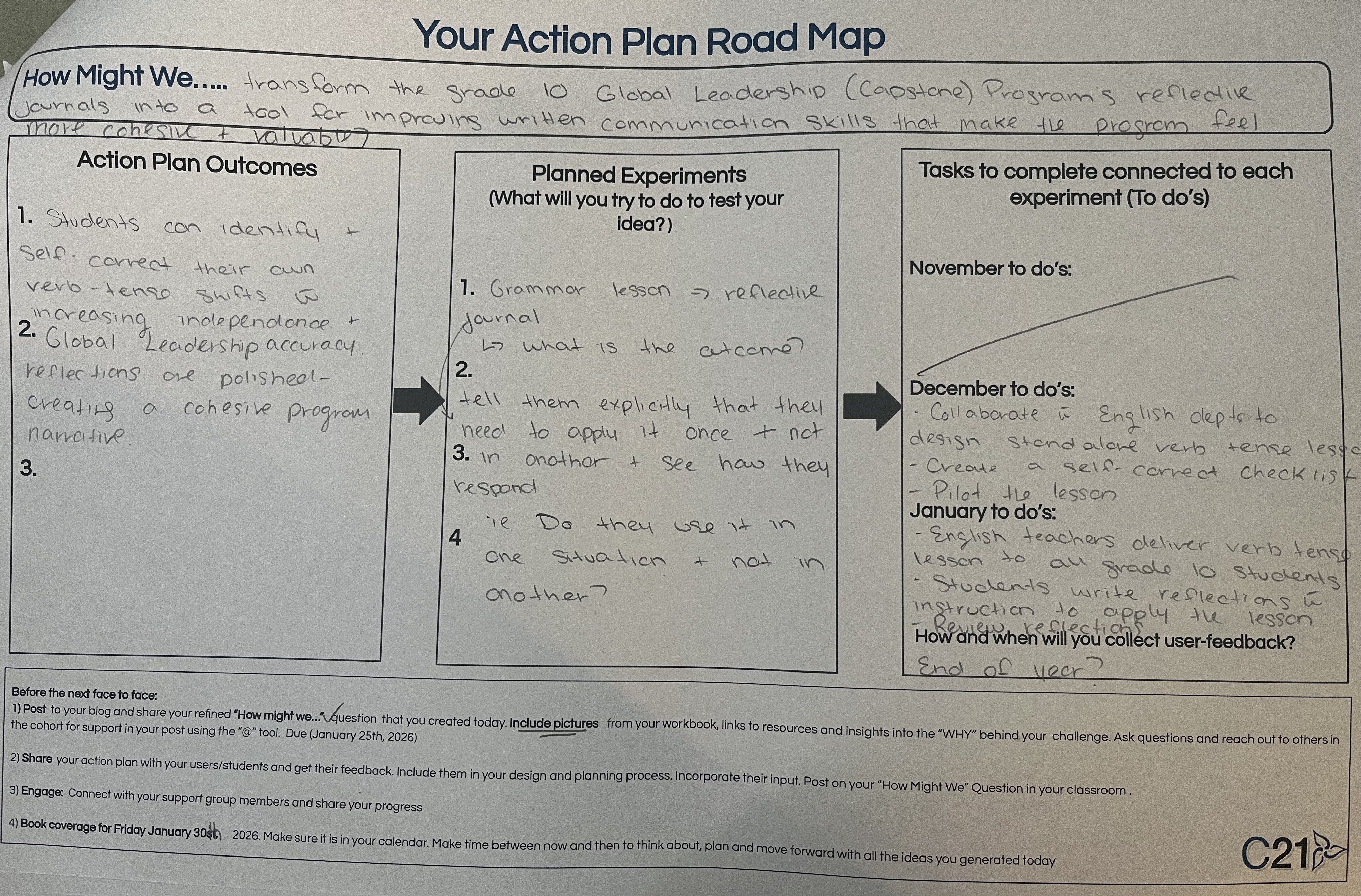
- Week 1-2: English teachers deliver verb tense lesson to all Grade 10 students
- Week 2-3: Students write Global Leadership Day reflections with explicit expectation to apply the lesson
- Week 3-4: Teachers review reflections; note patterns in verb tense errors and successes
February 2026: Practice & Refinement
- Week 1-2: Introduce structured practice activities (e.g., editing exercises, peer review focused on tense consistency, self-assessment protocols)
- Week 2-4: Students engage in targeted practice; build metacognitive awareness of their own tense-shifting patterns
March 2026: Scaling & Expansion
- Week 1-2: Reflect on what’s working; identify which students need additional support
- Week 2-3: Consider layering in additional writing skills (clarity, organization, conciseness) for future cycles
- Week 3-4: Prepare reflections for broader audiences (university applications, head of school review)
April 2026: Celebration & Iteration
- Week 1-2: Showcase polished reflections; celebrate student growth in self-correction and writing quality
- Week 2-3: Gather data: Compare verb tense accuracy across cohorts; measure student confidence in self-editing
- Week 3-4: Plan next iteration: What worked? What needs adjustment? How do we expand this framework to other writing skills?
Key Success Factors
- Explicit Expectation-Setting: Students must understand that verb tense mastery is a program priority and will be visible to multiple audiences
- Preventative Approach: Teaching before writing, not correcting after
- Self-Correction Focus: Build independence and metacognitive awareness, not dependence on teacher feedback
- Scalability: Design the framework so additional writing skills can be layered in over time
- Audience Awareness: Remind students that polished reflections serve their university applications and program reputation
Potential Obstacles & Solutions
| Obstacle | Solution |
|---|---|
| Students forget the lesson by reflection time | Create a one-page reference guide; post it in classrooms; include it with reflection prompts |
| Some students need more practice than others | Differentiate practice activities; offer optional workshops or peer tutoring |
| English teachers feel overwhelmed adding this focus | Provide ready-made lesson materials; frame it as enhancing existing content feedback, not replacing it |
| Reflections still contain tense errors despite instruction | This is data! Use it to refine the lesson, extend practice time, or identify students needing intervention |
Long-Term Vision (Beyond April 2026)
This verb tense framework is your foundation. Once students master self-correction for tense agreement, you can layer in:
- Clarity and conciseness in academic writing
- Organization and flow in reflective pieces
- Voice and audience awareness for different contexts (university applications vs. internal reflections)
- Peer review protocols that build collaborative writing culture
By building this systematically, your Global Leadership Capstone Program becomes known not just for leadership development, but for communication excellence—a differentiator for university applications and a source of pride for your school.
Next Steps (This Week)
- Schedule a conversation with your English department lead to align on the verb tense lesson design
- Draft the self-correction checklist students will use
- Set a date for the first lesson delivery
- Share this plan with your head of school—she’ll appreciate the intentionality and the polished reflections it will produce
You’ve got this! Your Design Thinking process has moved from a challenge to a concrete, actionable plan. The key now is implementation and iteration. 🚀
Hi Emily,
I am VERY impressed by your super detailed and extremely thoughtful plan! Looks like you really got it and put your ideas in a concrete plan with specific deadlines and measurable success criteria.
That point in particular caught my attention: “Preventative Approach: Teaching before writing, not correcting after”
I have no experience teaching Grade 10, let alone English, but I can definitely relate to this through my lens of French teacher. My students almost always have this disconnect between standalone grammar lessons and application of grammar rules when producing written texts and/or speeches. You are working with students whose level of language is native or native-like, so they already have a highly developed sense of the language, but not necessarily know all of its mechanics. So, in a way, you and I have the same challenge, but for very different reasons, hence a reverse approach to how to solve it. I am curious to learn more about your helping your students closing that gap between grammar knowledge and real life / project application. I also wonder if those standalone lessons may have many examples from similar pieces of writing, such as essays, university applications, etc., so that the students internalize the importance of applying those tense agreements rules even better.
Looking forward to learning more about your project and its development next time!
Thank you for your thoughtful insight and feedback, Irina. I really appreciated how you highlighted the connection between French and English. Although students are learning different languages, many of the challenges they face—particularly when trying to grasp and apply grammar rules—are remarkably similar.