
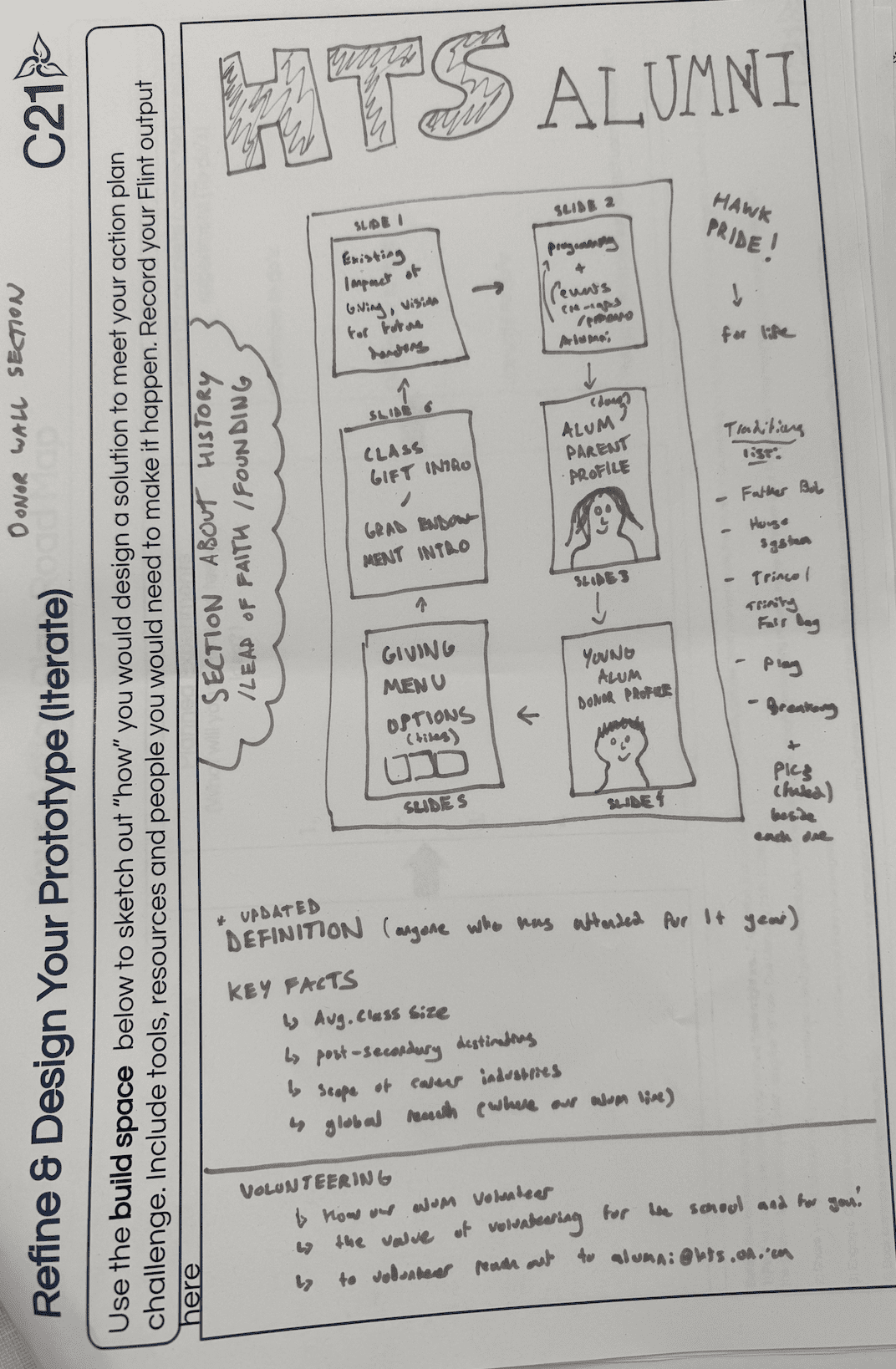
Design Thinking Challenge: How might we help alumni discover ways to give back that align with their financial capacity while helping them see how their contributions directly support the transformative experiences that shaped their HTS education?
Your Vision
Create a personalized, historically-grounded giving experience that:
- Honors alumni’s past experiences and contributions to HTS
- Provides transparency through personalized updates and class-based crowdfunding dashboards
- Empowers alumni as giving ambassadors within their peer networks
- Scales as technology (Almabase/Graduway) becomes available
Phase 1: Foundation (December 2025 – January 2026)
Experiment A: Pilot Giving Category Story
Goal: Build the complete narrative for ONE giving category (e.g., Debate Program, Arts Initiative, etc.)
Deliverables:
- Historical timeline: Where this program came from, key milestones, alumni who shaped it
- Giving menu: Multiple entry points ($250, $500, $1,000+) with specific outcomes tied to each level
- Impact promise ex: “Your $500 gift will [specific outcome]”
- Personalization template: How you’ll communicate back to donors about their specific impact
Success Metric: One fully-developed giving category ready to launch
Experiment B: Identify Giving Ambassadors
Goal: Identify 3-5 alumni influencers who are passionate about this category and willing to champion it
Approach:
- Look for alumni who: participated in/benefited from this program, have given before, are active in alumni networks
- Reach out personally: “We’re re-imagining how alumni give back. Would you help us tell this story?”
- Invite them to a brief call to share their experience and get their input on the giving strategy
- Position them as “founding ambassadors” for this initiative
Success Metric: 3-5 committed ambassadors who understand the vision
Phase 2: Pilot Launch (February 2026)
Experiment C: Ambassador-Led Peer Outreach
Goal: Test whether peer influence + compelling narrative drives giving
Approach:
- Provide ambassadors with: the giving story, talking points, personalized email templates
- Ambassadors reach out to 3-5 peers in their class/network with the story
- Track: How many people they reach, conversion rate, average gift size
- Gather feedback: What resonated? What questions came up?
Success Metric: 10%+ of contacted alumni engage; at least 3-5 gifts received
Experiment D: Personalized Impact Communication
Goal: Test your personalized update model
Approach:
- For each gift received, create a personalized thank-you that includes: how their gift will be used, connection to HTS history, invitation to see impact (campus visit, video update in 3 months)
- Send first impact update at 3-month mark showing real outcomes
Success Metric: Donors feel seen and connected; they’re willing to give again
Phase 3: Refine & Scale (March – April 2026)
- Analyze what worked: Which ambassadors were most effective? Which giving amounts resonated? What stories moved people?
- Refine the narrative and process based on feedback
- Plan Phase 2: Expand to second giving category OR expand ambassador network
- Prepare for dashboard integration when technology arrives
- Document lessons learned for your exit ticket/blog post
Key Principles Throughout
- Yes, and approach: Build on what alumni already care about; don’t replace it
- Transparency first: Always show where money goes and who benefits
- Legacy honored: Every ask acknowledges the past while inviting future impact
- Multiple entry points: Different giving levels for different capacities
- Peer power: Ambassadors are your most credible messengers
Quick Wins to Start This Week
- Choose your pilot giving category
- Gather historical materials (photos, stories, alumni testimonials from that program)
- Identify your first 3 potential ambassadors
- Draft one personalized thank-you email template
You’ve got this! 🚀
I really appreciate how clearly you’ve framed the challenge, balancing alumni capacity with meaningful impact is no small task, and your approach demonstrates both strategic thinking and empathy. What stands out most is the emphasis on personalization and historical context. By connecting giving opportunities to the transformative experiences that shaped alumni, you’re not just asking for support, you’re inviting them to continue the story of HTS in a tangible way.
I love the ambassador model. Peer influence is incredibly powerful, and positioning alumni as storytellers and champions feels like a smart way to build credibility and engagement. The phased rollout, especially starting with one giving category, keeps the project manageable while allowing for iteration based on real feedback.
The attention to impact communication is also impressive. Personalized updates that show exactly how gifts are used, and tie them back to HTS history, will likely strengthen donor loyalty and encourage repeat giving. It’s a great reminder that transparency and storytelling go hand-in-hand.
Overall, this feels like a scalable, thoughtful framework. I’m curious to see which narratives resonate most with alumni and how the ambassador approach evolves as more people engage. You’ve laid out a model that feels both practical and inspiring!
Thanks, Emily! Appreciate your feedback. Since posting, much of this has changed, but the commitment to storytelling, engaging our network of alumni champions and scaling this slowly is still there.