Retention, Retention, Retention

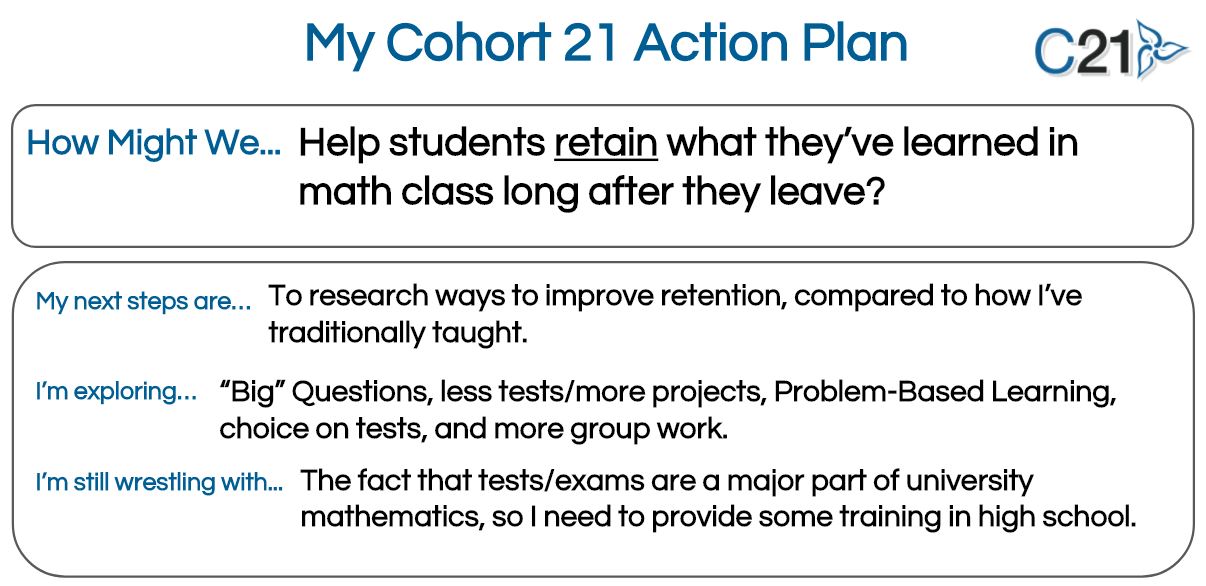
Since our last F2F meeting, I’ve been wrestling with this idea of retention. Of course I want my students to retain what they’ve been taught, but I think I need to get more specific. Do I need my calculus students to have memorized the quotient rule, or am I satisfied if next year in university they are able to look up the formula and know how to use it? Do I expect my grade 10 students to walk into grade 11 math and remember every factoring rule, or am I happy if they have some recollection what’s happening and, with a little bit a practice, can get themselves right back up to speed? … Serious question did these two examples just describe students who have had good retention of knowledge? I think I’m confused by my own action plan! What is good retention? Is it remembering how to use a learned skill immediately with no assistance? This isn’t how the real world works. Do we expect professional Engineers to remember everything from their 4th year classes? No, they would be able to read, research, and get assistance from colleagues to help solve the problem they are tasked with.

Although I haven’t exactly landed on my true focus, I have tried a few new things to this point and I’m curious to find out if they help with retention of knowledge.

In calculus this year, I assessed our first unit on limits and the definition of a derivative with a traditional assignment and test. Students haven’t seen these concepts since early November and I wonder how much they’ve retained. So, I plan on surprising them on their first day back in January with the assessment below (shhhh, don’t tell them). I’ll be sure to update this post once the data is collected.

Recently, I tried a more authentic form of assessment that I like to call The Smarties Project (please feel free to use it and/or pass it on to your colleagues). I’m hoping this way of learning about optimization will stick with my students longer. As part of this project, I tried grading it using the single point rubric, hoping that my students will engage more with the feedback I am providing. I’m planning on doing another “retention research assessment” about optimizing volume in a few months, afterwards I will compare if retention improved.

A few other non-traditional things I’ve tried this year are:

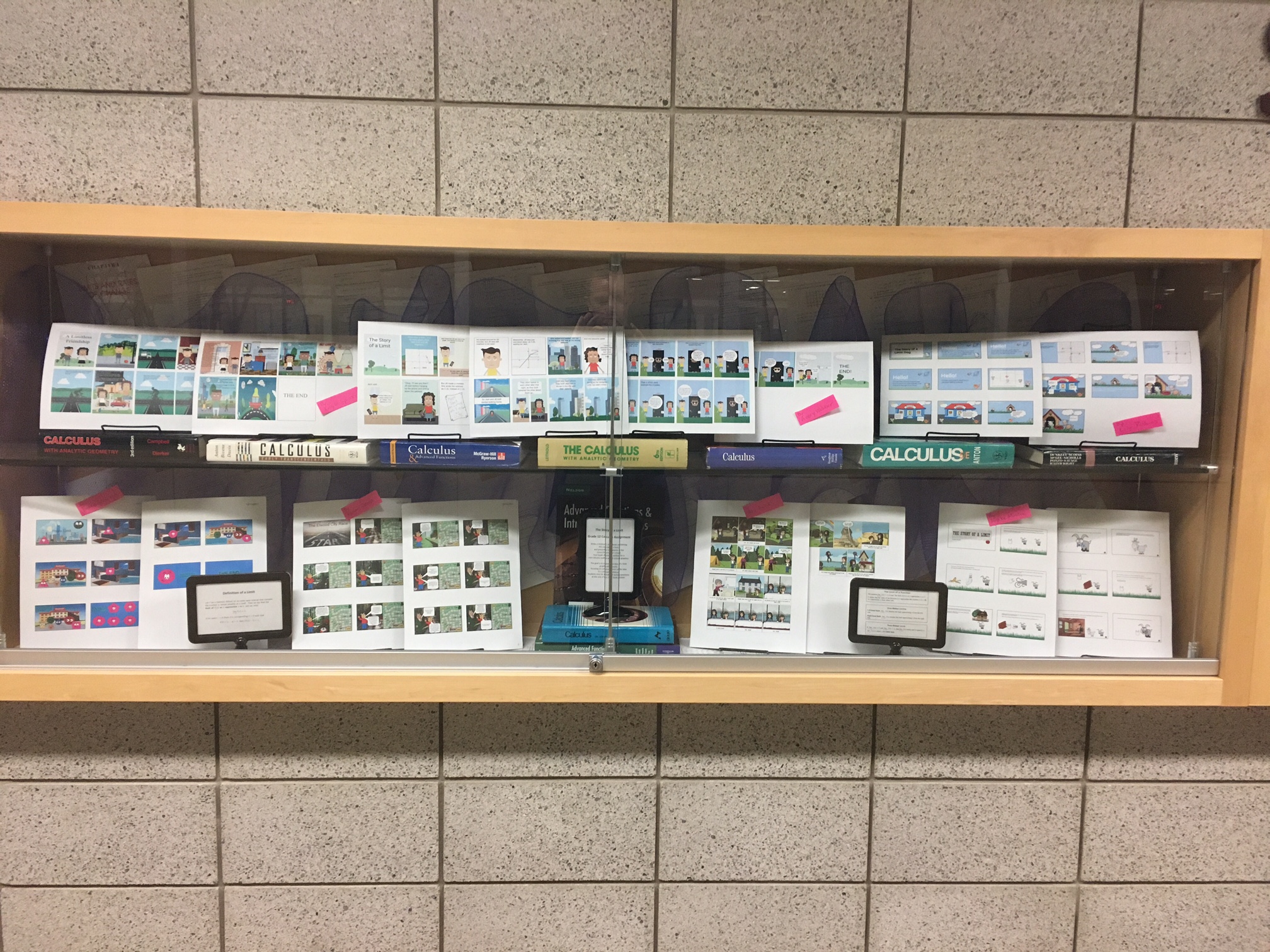
  • “The Story of Limit” (thanks to @hpalmer for the idea!) – my calculus students wrote children’s stories that tried to explain the concept of a limit to children who are at least 7 years old. We then visited Junior and Montessori school classes where my students presented their stories. They are now on display outside our Senior Learning Commons (see picture below).
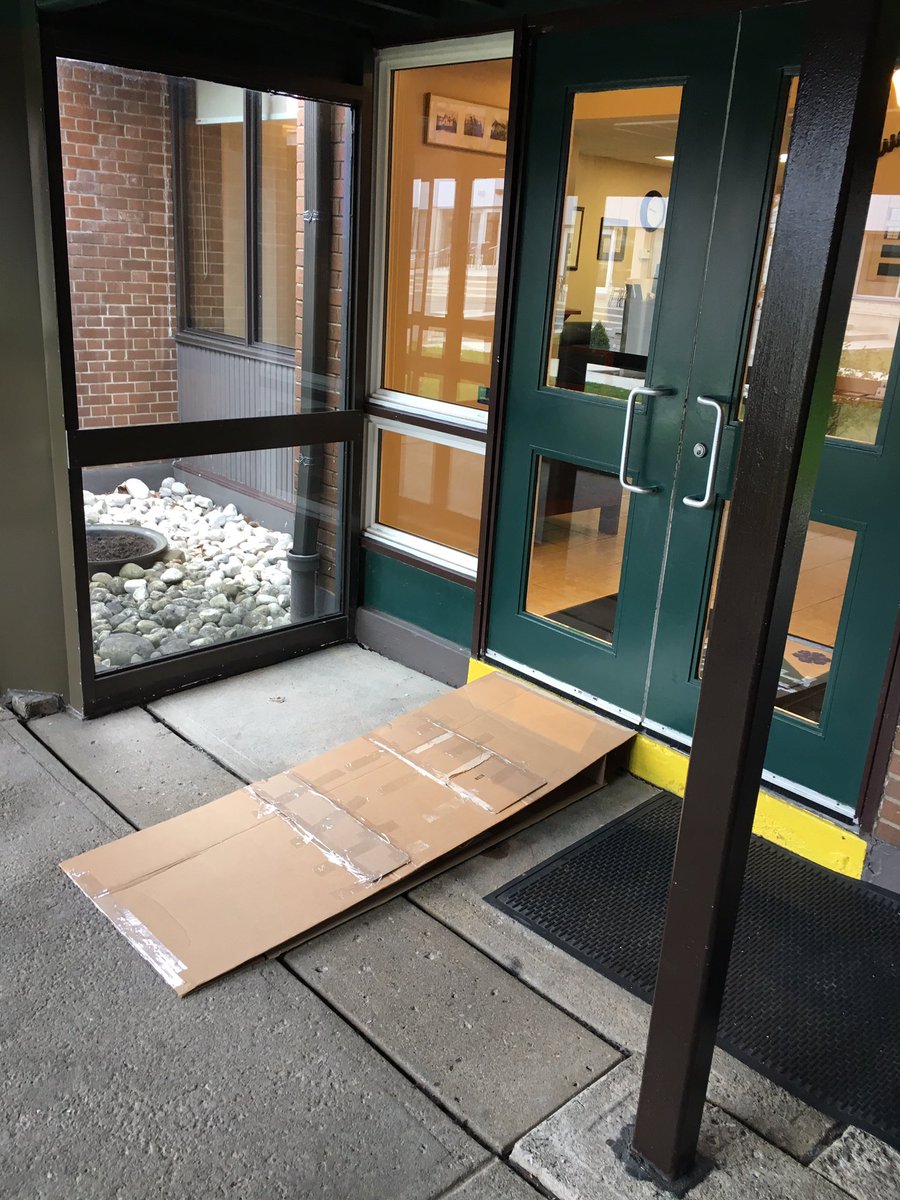
  • PBL in grade 10 applied math – my students investigated how wheel chair friendly the older buildings on our campus are, measured current ramps on campus to see if they were below the legal angle (they were!), designed a legal wheel chair ramp for one of our school’s office buildings (see picture below), and lastly, presented their findings to our Head of College.
  • In the New Year I’m hoping to teach vector addition with the help of billiards (thanks to @rutheichholtz for the idea!)
I honestly have no idea if these non-traditional ways of learning will improve a student’s retention of knowledge or not. Something I’ve been considering more recently is should I be focusing more on the skills required for good retention? Essentially, if a student has not retained a concept fully, what avenues can they take to help correct this?

If you can’t tell by now, I’m in desperate need of another F2F session! Hopefully my fellow Cohort 21ers can help straighten me out.

Lastly, here are some articles/blogs that have me reflecting on my current practice:

  1. How I Abolished Grading
  2. Applying Archaic Math Assessment Ideas To Other Skills/Activities
  3. Grades are for Onions, Beef, and Other Produce; Not Children
  4. Retrieval Practice: The Most Powerful Learning Strategy You’re Not Using
  5. Assessment Thoughts: A few past thoughts relevant for today?
  6. A venture capitalist searches for the purpose of school. Here’s what he found.

(Retention image courtesy of zacjohnson.com)

Posted in Action Plan, Classroom Reflections | 6 Comments

My Head is Spinning… And I Love It!

Is it Saturday yet? I need some of that “Cohort 21 Face-to-Face” magic.

Since the last F2F, I feel like my head hasn’t stopped spinning. Aside from Cohort 21, I’ve got 4 preps (never experienced this before), I’m trying to get comfortable in my new role of Subject Coordinator for senior math, and I’ve got a 2 year old at home who is the most fun kid you’ve ever been around (okay, I might be a little biased here. Side note, he can now count to 6 and correctly identify a hexagon! … Sorry, I’ll move on now). All of this would have been enough to keep me busy this year, then Cohort 21 entered my life and has me questioning everything I’ve ever done!

I’ve really enjoyed Twitter so far – everyone’s willingness to share their thoughts and ideas has been inspiring. However, the downside can be educational opinions overload. Every time I look, someone has posted or retweeted an article about how education needs to change. Some of these speak to me and force me to reflect on my practice, and others I completely disagree with, but then I stop and wonder if I should be more open-minded?

As part of reflecting on my own practice, I’ve been reading the blogs of other teachers. I read about a calculus teacher who has stopped giving grades and gives personalized assessments. I feel inspired reading his thoughts and the testimonials from his students, but I’m left to wonder if I truly believe his methods are best for my students, or am I suffering from recency bias? In short, is this lust or love that I’m feeling? Should I jump in the deep end starting tomorrow, or should I try one new approach in our next unit and see how it goes? As I said before, my head spinning.

As overwhelmed as I feel right now, I can’t remember a better time in my teaching career! I’m inspired by what my Cohort 21 colleagues are doing and it drives me to be better for my students.

Do I have too many ideas? Yes. Can I try them all tomorrow? No. Okay then, which ones should take priority? Which would benefit my students the most? Which could inspire my colleagues the most?

I need some help. Is it Saturday yet?

Posted in Face 2 Face Sessions | 2 Comments

“Math is Fun Fridays”

When I was at the University of Waterloo (shameless plug), one of the mandatory courses for my undergrad degree was CO 350Linear Optimization. The description for this course reads:

“A first course in optimization, emphasizing optimization of linear functions subject to linear constraints (linear programming). Problem formulation. Duality theory. The simplex method. Sensitivity analysis.”

As it turns out, this course is the second lowest mark on my transcript (my lowest mark is a conversation for another day). For whatever reason, I just couldn’t wrap my mind around the concepts. After hearing all this, you probably wouldn’t expect that this was one of the most enjoyable courses I ever took and the reason is simple… Dr. Steve Furino.

Every Friday, Dr. Furino would take time out of his 50 minute lecture and talk to us about the history of mathematics. I still remember the day he spoke about Archimedes and his part in the war between Syracuse and Rome. The depth of knowledge that he had, and the passion that oozed out of him when he spoke about these historical topics is something that will always stick with me. Our lectures were on Mondays, Wednesdays, Fridays at 8:30 am. Attendance was decent on Mondays and Wednesdays, but no one missed a Friday! We couldn’t wait to hear what Dr. Furino had in store for us.

About midway through last year, I felt a bit stuck in my daily routines and I wanted to try something new… something fun. I borrowed the idea from Dr. Furino and started “Math is Fun Fridays”. Every Friday, I would take between 2 and 10 minutes to discuss something that I find fun and/or interesting related to mathematics. The results, so far, have been excellent. Students now walk into the room on a Friday and ask when the “math is fun” activity will be discussed.


Hopefully you’re still with me because this is by far the most important part of this blog post…

I want to create a living document that houses all of these fun activities, so other teachers can use them in their classrooms. 

Here’s how I’m going to start this. Here is the link to a google doc, where I have listed many of the activities I have used, or will use. Feel free to use them in your classroom, but what I ask in return is that you also add a fun/cool/interesting activity or idea that interests you. (To do this, please email me at [email protected] so I can give you editing capability for the google doc). My hope is that this becomes like the “take a book, leave a book” stands you see in some neighbourhoods.

“Like a small boat on the ocean, sending big waves into motion. Like how a single word can make a heart open. I might only have one match, but I can make an explosion.” – Rachel Platten

Let’s turn our single match into an explosion!

Posted in Classroom Reflections | 9 Comments

Are You Ready… For Calculus?

Calculus (and Vectors) is a course that uses almost all the math knowledge a student has learned from Kindergarten to Grade 12 Advanced Functions. I find myself, on almost a daily basis, saying to my students, “remember in grade so and so when you learned about such and such? This is why! So you can tackle this calculus skill!”. This isn’t exactly true, of course, but my students seems to enjoy hearing about how all math is connected and built upon itself. Where was I? It seems I’ve gone “off on a tangent” (YES! Calculus pun in a calculus post!), oh yeah, not only does calculus use a student’s prior math knowledge, it ASSUMES that all students can recall this prior knowledge with no review or assistance. I (as well as every other calculus teacher anywhere) realize that this is NOT the case, so I often have mini side-lessons during a calculus lesson (example: the other day we came across a limit that required us to use difference of cubes factoring, which of course only one student in the room remembered how to do, so I did a quick reminder lesson before proceeding). At this point I really hope you’re still reading as I realize that this hasn’t been the most griping opening for a blog post (except for the pun, that was gold!). Here’s the question that has plagued me for years: WHAT CAN WE DO ABOUT THIS? Well this year I tried something new.

To start the year, I made our first three classes together work periods for my students to complete these Khan Academy activities as well as a printed take-home assignment (for those of you who know Khan Academy, I only required my students to answer 3 questions correctly per activity, to save them time). All of this practice led up to a 40 question multiple choice diagnostic test. My goal was to identify the specific areas of need for each of my students, prior to starting any calculus material. I created a spreadsheet that, after inputting a student’s multiple choice answers, sorted the results into the 8 categories being assessed. Below is a screenshot of the results for a sample class. I also looked at their Khan Academy progress, as well as their take home assignment.

After all this, I shared each student’s results with them and their parents, highlighting the areas where I feel they need to improve upon (see below for a sample of what I sent) and I provided them with a recommended questions list. The idea being that they will work on their areas of weakness now, early in the school year, before the grade 12 year becomes chaotic.

So now here we are in mid-October, our course is in full swing and my students’ lives are becoming increasingly busy. The questions I have are:

  1. How am I going to know if this process worked? (and to what extent?)
  2. Did it have a lasting affect on my students? (How will I measure this?)
  3. Should I continually refer back to this? (i.e. as practice before we start a new unit that uses certain skills), or it this their responsibility as 17 year olds who are about to go off to university?

With this being the first time I’ve tried this process, I’d like to know how I can maximize (pun intended) its effectiveness for my students this year as well as improve it in future years.

I’d love some feedback on this, and not just from math teachers 🙂


If you or another teacher would like a copy of the test I used and/or the blank spreadsheet, email me at [email protected] and I’d be happy to share.

Posted in Classroom Reflections | 7 Comments

Help! I’ve Got Voices in my Head!

Does anyone else feel like they’ve got two different voices in their head competing with each other? Ok, so now that you think I’m completely crazy, hopefully you’ll read on so this question makes more sense.

I find myself flip-flopping between favouring one voice one day, and the other voice the next day. For the purposes of this story I will call these voices “Old School Guy” and “New School Guy”, and their back and forth goes something like this…

New School Guy – “Come on, Old School Guy, teaching math needs to move into the 21st Century. You need to be doing Problem-Based Learning, flipping your classroom, and using tools like EdPuzzle, Quizlet, Khan Academy, … (he continues on like this for about 3 minutes)YouCubed, Kahoot, and Quizizz in order for your students to learn better and get more out of their high school math experience.”

Old School Guy – “Well, have you ever considered that the reason we’ve taught math this way for this long is that it works for most students? Ever heard the old saying ‘if it ain’t broke, don’t fix it’?”

New School Guy – “HA! You just said it works for ‘most students’ which means it’s NOT working for a considerable number of students! Is it possible that the system isn’t ‘broken’ per say, but may have several cracks in it that need our attention? What if you just tried ONE of these new approaches to learning in ONE of your classes? Ever heard the old saying ‘don’t bite off more than you can chew’?”

Old School Guy – “Ha ha ha… Have you ever considered that introducing these new approaches could make things worse?”

New School Guy – “There’s a lot of research that says it won’t, but I grant you, I guess it could. But is that a reason to not try it at all?”

Old School Guy – “Ok, ok. What about time? If I try your new fancy tactics it’s going to take me a lot longer to get through certain topics, compared to previous years. Now when June rolls around, I’ve run out time and I’m passing my students on to the next grade level missing core knowledge needed for success at that level.”

New School Guy – “But isn’t it better for students to learn some concepts REALLY well and make a personal connection with them, which improves retention in future years?”

Old School Guy – “We all want good retention, but you still haven’t answered my question. How do you plan on filling in the gaps caused by us spending more time on certain topics?”

New School Guy – “Wanna know a secret? If you set it up properly, using PBL and/or various classroom tools will take the same amount of time as if you taught a concept the way you always have! If you structure the time properly, the unit that used to take three weeks to cover will still take three weeks, you just have to be willing to give up some of those favourite lectures of yours and instead be a guide for your students while they figure out some of this stuff on their own.”

Old School Guy(opens his mouth to speak)

New School Guy – “Ah ah ah, I already know your next question – ‘how does assessment work if I’m teaching this way’?”

Old School Guy – “Cheater… Stop reading Mike’s thoughts. You know you’re supposed to stay in the right hemisphere of his brain and I stay in the left. No crossies, remember?… Ok smart guy, how does assessment work if I’m teaching this way?”

New School Guy – “Simple… you are the teacher, you decide! Obviously you will be observing their progress each day, but you can have paper-pencil assessments on certain days in order to ‘check-in’ on their knowledge level. You could do daily exit quizzes, have them fill out reflective journals… you can use any number of techniques.”

Old School Guy – “Alright, alright. You are very convincing. I think I’m going to give this a try. Now, where’s my time to research and develop a project like this? Or try all these new educational tools for myself? You can’t expect me to teach a full course load, coach a team, be a good husband and father, AND develop something like this from scratch. ARE YOU NUTS?! Where’s my time to do this?”

New School Guy – “Well you can always create it during the summer! :)”

Old School Guy(Gives the deepest of death stares)

New School Guy – “Ok, seriously. If you’re looking to try PBL, you don’t need to start from scratch. There are so many resources available on the internet. There are lots of projects that many teachers are currently using, and you can use these as a starting point and modify them to fit your specific needs. As for the ed tools, you will have to spend some time familiarizing yourself with these to see which ones work best for your practice, but once you do this, your students are going to be much more engaged. Remember what I said earlier about not biting off more than you can chew? Maybe just try one tool in one class and see where it goes.”

Old School Guy – “Ok, so Google finds hundreds of PBL resources for me with a single search. When do I have the time to go through all of them to find what works best for me?”

(At this point, I feel like Derek (@ddoucet) would somehow jump into this conversation and say something like “You don’t need to search through hundreds of resources, just start a Twitter Chat and ask the other Cohort 21ers for help!”… Alright, back to the convo…)

New School Guy – “I’m sorry. I don’t have an answer for you. Time is the unsolved mystery in education. Yes, going through a new process is going to take time, but if you’re going to give this a try, don’t give it a half try. Don’t just dip your toe in the water because when your new attempt fails, the fault will have been yours. You need to give this a full try. Dive in head first, get messy, get uncomfortable, and if it fails after that, then go back to your old ways, but I’m telling you, it’s NOT going to fail. You’re going to see that the time you put in beforehand is going to pay off in ways you can’t imagine! And you’re going to be better for it and, most importantly, your students are going to be better because of it.”

Old School Guy – “Ok, but what about…”


And on and on this goes. Is anyone else out there having a similar internal struggle? I feel like the right approach lies somewhere in the grey area between these two guys’ philosophies, but where exactly? That’s a lot of grey.


(picture courtesy of comicvine.com)


Posted in Classroom Reflections | 13 Comments