

 Urgent Vs. Important – 2021 – A Pivotal TIME to Take Action
Question 1: During the first face to face we used the language of Urgent vs Important to help frame our discussions and thinking around the use of TIME. Reflect on why you joined Cohort 21 and your professional goals for this year. Now that the year has begun and you have met your students what IMPORTANT goal might you like to address and leverage this community to get support with.
Reflecting on the Eisenhower Matrix throughout the beginning of this school year has undoubtedly been a poignant experience. As a Junior Kindergarten teacher in 2021, there are three big things that jump out at me as being both urgent and important right now:
1 – Climate Change – UN Sustainable Development Goals – We are called by goal #13 to take urgent action to combat climate change and its impacts.
2 – Reciprocity in the wake of Grief– Truth and Reconciliation Commission of Canada: Calls to Action – After this summer’s eye-opening media coverage of the atrocities that took place at residential schools, the 2015 Calls to Action are certainly both urgent and important. Educators are called, in action #62, to make age-appropriate curriculum on residential schools, Treaties, and Aboriginal peoples’ historical and contemporary contributions to Canada a mandatory education requirement for Kindergarten to Grade Twelve students.
3 – Shadow Pandemic – Mental Health Crisis in our Young People – “impacts could linger for years,” says CBC What can we do as educators?
With these three urgent and important matters looming, it is a pivotal time for educators to take action. But how? What can I possibly do? These are huge problems that stretch well beyond the walls of my classroom! What can I do in my JK classroom to impart change? How can I positively improve the mental health of my student’s “post” pandemic, promote reconciliation with Indigenous people and help combat climate change? My learners are only four years old!
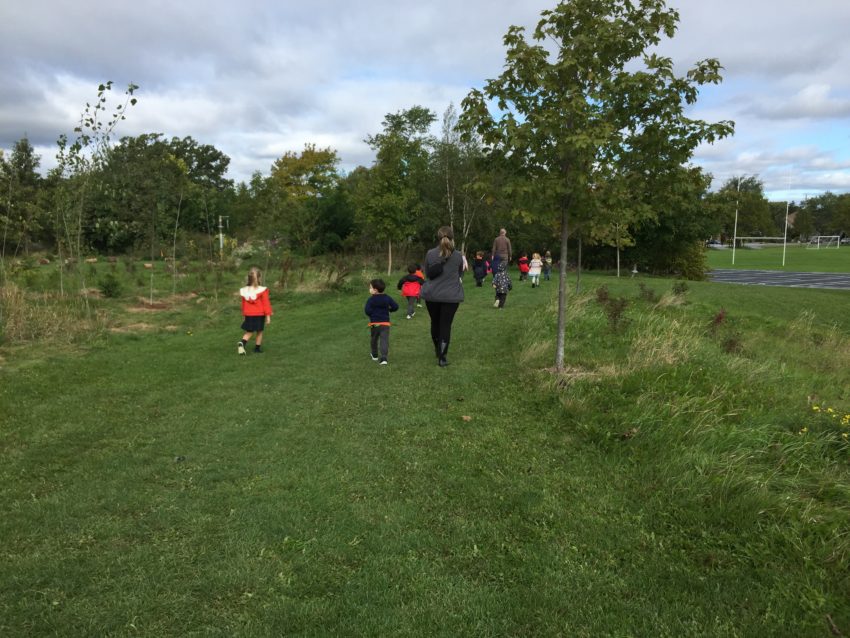
Although it sounds daunting (I mean, those are three massive problems), I believe the answer to be simple. I need to take my students out of the classroom. I need to take my students outdoors.
Over the last several months I have embarked on a journey of learning about environmental education and its benefits for my students. I am an avid gardener and nature lover, but I have much to learn about outdoor education! I participated in a book club discussing Gillian Judson’s Walking Curriculum. I attended Natural Curiosity’s Virtual Summer Institute, where I explored the importance of Indigenous perspectives in children’s environmental inquiry. I participated in Take Me Outside Day with my students and signed up for the Take Me Outside for Learning school year challenge, pledging to implement outdoor learning for my students at least once per week. I attended a webinar with David Sobel on Place-Based Education and am currently reading Braiding Sweetgrass by Robin Wall Kimmerer. Overwhelmingly, I keep hearing the same answer echoed over and over: I need to take my students outside!
By taking my students outside and into nature, I can not only teach the curriculum in an inquiry-based and authentic way, but I can also increase students physical activity, boost their mental health, lower their stress level, increase their immune response, and connect my students to the places where they play and learn. By developing my students’ love of the place (our schoolyard), and engaging their emotions, I can help facilitate the development of the next generation of environmental stewards. Once my students have a relationship with the land, they can begin to explore reciprocity, and how Indigenous people in Canada respect and care for Turtle Island. Through this reciprocity, protecting and living with the land, my JK students can take steps toward reconciliation.
So glad you joined Cohort 21! Looking forward to your posts.
@jadams
Looking forward to your response on our first two Season 10 prompts. Here is a video explaining how https://bit.ly/c21season10firstpost
@gvogt @gnichols
@jadams
We are looking forward to connecting this weekend. If you have a free moment before Saturday; create a 2nd post that answers the following 2nd F2F reflection questions and post your HMW question.
This will be really helpful to your coaches/facilitator in their support of your Action Plan. It should not take more than 5 minutes so don’t overthink it. We just want to pile on the support and the blog is the most efficient way to do it.
1) What was the process like in coming up with your HMW question at the last face-to-face? Where did you land? Share your first attempt so we can see where your action plan is headed.
2) Who should you talk to next to help guide your inquiry? In order to answer your HWM question, what voices and perspectives need to be consulted? What did you learn when you talked to them?
3) Why are you engaging in this line of action and inquiry? What important unmet need sits central to your question?
See you Saturday!
Justin