Book Review: The Culture Map by Erin Meyer
This book is another recommendation from my friend and ISEEN Board Colleague, Erin Hawk. Thank you so much for this recommendation, and it was great to see you put into practice the 8 Scales of Culture that really impact how we work together. While this book is written for those working in places other than their home culture, the framework and the questions and strategies are excellent cultural practices for all leaders to consider.
“If you go into every interaction assuming that culture doesn’t matter, your default mechanism will be to view others through your own cultural lens and to judge or misjudge them accordingly.” (p. 13)
What if some of our greatest leadership challenges aren’t actually about leadership at all, but about the invisible cultural assumptions we bring to our interactions with others?
What if the way we communicate, give feedback, make decisions, build trust, or navigate disagreement is not nearly as universal as we think?
And what if understanding these differences could make us significantly better leaders?
These are some of the questions that stayed with me while reading Erin Meyer’s The Culture Map: Breaking Through the Invisible Boundaries of Global Business.
Meyer comes to this work through her extensive experience consulting with international business leaders and organizations navigating the complexities of working across cultures. Her book offers a systematic, research-informed framework for understanding how cultural differences shape our behaviours, expectations, and interpretations of one another.
She writes:
“The process begins with recognizing the cultural factors that shape behavior and methodically analyzing the reasons for that behavior.” (p. 6)
What makes this book particularly compelling is that although it is written primarily for people working across national and cultural boundaries, I found myself continually applying its lessons to my own work as a school leader.
After all, every school is its own cultural ecosystem. Every faculty member, administrator, student, and parent brings their own experiences, expectations, assumptions, and ways of interpreting the world. And as leaders, we often assume that our intentions are understood in the way we intended them. The Culture Map challenges that assumption.
It reminds us that what we communicate and what others understand are not necessarily the same thing.
You would be interested in this book if…
- You are a leader interested in understanding how culture influences communication, decision-making, trust, feedback, and organizational effectiveness.
- You work with diverse teams and want to become more intentional about how you lead and collaborate.
- You are navigating organizational change and wondering why some people embrace your approach while others resist it.
- You are interested in building stronger relationships, developing psychological safety, and improving how your team engages in constructive disagreement.
- You believe that understanding your own leadership tendencies is just as important as understanding the people you lead.
Culture Is More Than What We Can See
One of Meyer’s central arguments is that cultural differences often operate beneath the surface of our awareness.
We notice behaviours, interpret them, and then we make judgments based on our history, experience and perceptions and expertise.
For example, if someone doesn’t challenge an idea in a meeting, so we assume they agree, or if someone challenges an idea directly, we might assume they are being confrontational.
By understanding that these behaviours are rooted in different cultural expectations rather than differences in motivation, competence, or character, we can become more discerning and effective.
Meyer encourages us to examine three interconnected dimensions of culture:
- Perceptions: What we see.
- Cognitions: What we think.
- Actions: What we do.
For leaders, this is a powerful reminder of the importance of curiosity, so that before interpreting someone’s behaviour, we should spend more time understanding the assumptions and expectations behind it.
Eight Scales That Reveal the Invisible
The heart of The Culture Map is Meyer’s framework of eight cultural scales.
Each represents an important dimension of how people work together:
| Cultural dimension | Contrasting approaches |
|---|---|
| Communicating | Low-context ↔ High-context |
| Evaluating | Direct negative feedback ↔ Indirect negative feedback |
| Persuading | Principles-first ↔ Applications-first |
| Leading | Egalitarian ↔ Hierarchical |
| Deciding | Consensual ↔ Top-down |
| Trusting | Task-based ↔ Relationship-based |
| Disagreeing | Confrontational ↔ Avoids confrontation |
| Scheduling | Linear-time ↔ Flexible-time |
Meyer uses these scales to compare national cultures and explain why seemingly straightforward business interactions can become unexpectedly complicated.
What I particularly appreciated is that these scales also provide an excellent framework for reflecting on our own leadership practices.
Even within a single school, department, or leadership team, people can have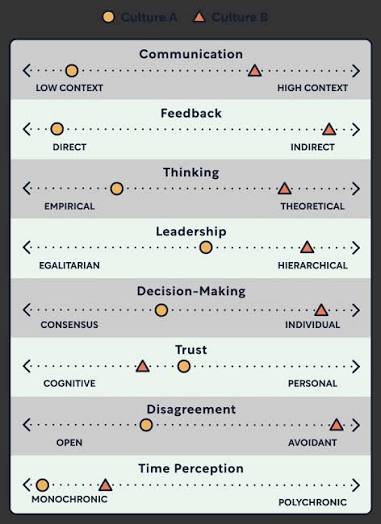 different expectations about communication, authority, feedback, trust, and decision-making.
National culture is not the only influence on these expectations. Professional experiences, organizational norms, individual personalities, and previous leadership environments matter too.
So while Meyer’s framework is designed to help us understand cross-cultural differences, it also provides an opportunity to examine the culture we are creating within our own organizations.
Where do we sit on these scales? Where do our colleagues sit? And what happens when those expectations don’t align?
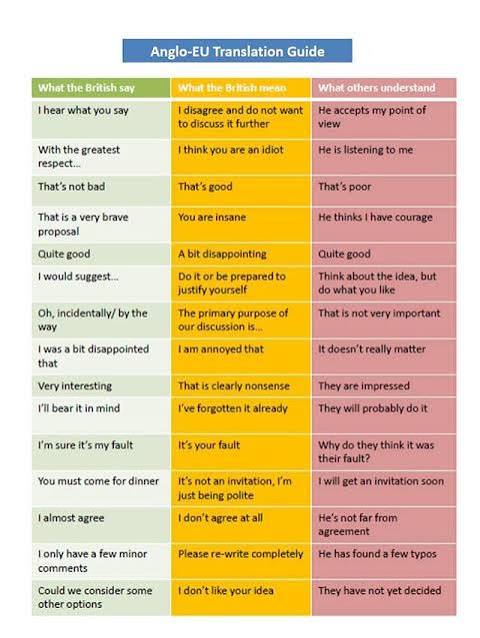
Communication: What Is Said, and What Is Understood?
The first scale explores communication along a continuum from low-context to high-context.
In low-context cultures, communication tends to be explicit, direct, and detailed. The expectation is that the message should be clear from the words themselves.
In high-context cultures, much more meaning is conveyed through relationships, shared understanding, tone, context, and what remains unsaid.
Meyer reminds us:
“When considering strategies for improving your effectiveness, one crucial principle to remember is that communicating is not just about speaking but also about listening.” (p. 50)
That sounds obvious.
But I think it is a profound leadership lesson.
How often do we measure the effectiveness of our communication by how clearly we believe we have delivered a message?
We send an email.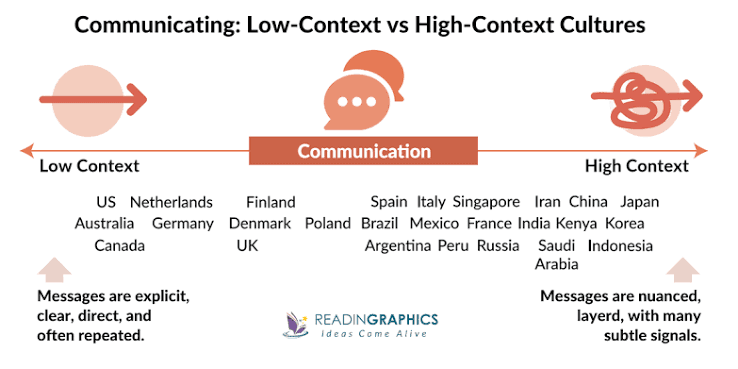
We explain a decision.
We outline expectations.
We provide an update at a faculty meeting.
And we assume that because we have communicated, we have been understood.
But effective communication requires us to consider how others receive, interpret, and make meaning from our words.
For school leaders, this raises important questions.
Do our faculty members need more context before understanding a decision?
Do our leadership teams prefer explicit direction or room for interpretation?
Are we creating opportunities for people to ask clarifying questions?
And are we listening carefully enough to recognize when our message has landed differently than intended?
Communication is not simply the transmission of information.
It is the creation of shared understanding.
Feedback: Constructive or Destructive?
The second scale explores how different cultures approach negative feedback.
Some cultures value directness.
Others place greater emphasis on preserving harmony, relationships, and dignity through more indirect approaches.
What one person experiences as refreshingly honest, another may experience as unnecessarily harsh.
What one person considers tactful, another may interpret as vague or evasive.
This chapter has significant implications for anyone responsible for performance appraisals, professional growth, coaching, or difficult conversations.
As school leaders, we regularly provide feedback to faculty and staff.
We observe teaching.
We discuss professional goals.
We address performance concerns.
We encourage growth.
But how often do we consider the recipient’s expectations about feedback before deciding how to deliver it?
A leader who values directness may believe they are demonstrating honesty and respect by getting straight to the point.
A colleague who values a more relational approach may experience that same interaction very differently.
The lesson here is not that we should avoid difficult feedback.
Rather, we need to become more sophisticated in how we deliver it.
Clarity matters.
So does trust.
And so does understanding how another person is likely to interpret our approach.
Persuasion: Do We Begin With the Why or the How?
Another fascinating dimension is Meyer’s exploration of persuasion.
She distinguishes between two approaches to reasoning.
Principles-first reasoning, often associated with deductive thinking, begins with broader concepts, theories, or principles before moving toward practical conclusions.
Applications-first reasoning, often associated with inductive thinking, begins with examples, observations, or practical experiences before arriving at broader conclusions.
This distinction immediately made me think about strategic planning and organizational change.
When introducing a new initiative, some leaders naturally begin with the underlying philosophy.
They explain the research.
They outline the rationale.
They establish the principles.
Only then do they move to implementation.
Other leaders begin with practical examples.
Here’s the problem we’re trying to solve.
Here’s what it could look like.
Here’s how it might work.
And then they connect those examples to a larger theory.
Neither approach is inherently superior.
But their effectiveness depends on the people receiving the message.
I find this particularly relevant when working with educators.
Some colleagues want to understand the educational philosophy behind a proposed change before considering its practical implications.
Others want to see what the change will actually mean for their classroom, students, and daily practice.
How might we become more intentional about matching our approach to persuasion with the needs of our audience?
That seems like an incredibly useful question for any leader navigating change.
Leadership and Power Distance: What Does Your Behaviour Communicate?
One of my favourite sections of the book explores leadership through the concept of power distance, developed by cultural researcher Geert Hofstede.
Power distance refers to the extent to which people accept and expect unequal distributions of authority.
Meyer invites readers to consider several questions:
- How much respect or deference is shown to an authority figure?
- How elevated or even “godlike” is the boss perceived to be?
- Is it acceptable to bypass levels of authority within an organization?
- What behaviours give a leader credibility and authority?
These questions are fascinating because they ask us to examine not only how we intend to lead, but how our leadership is interpreted.
Meyer tells the story of Steve Henning, an Australian leader who regularly rode his bicycle to work.
In Australia, this was entirely unremarkable and could even reinforce his image as approachable and grounded.
But when he moved to China, the same behaviour was interpreted differently.
In a more hierarchical cultural environment, his choice to cycle to work could undermine the authority and status that colleagues expected a senior leader to demonstrate.
Same person.
Same behaviour.
Different cultural interpretation.
I love this example because it challenges the assumption that authenticity alone guarantees effective leadership.
We can be entirely authentic in our intentions and still communicate something very different from what we intended.
Meyer goes further with Henning’s reflections on managing teams in different cultural environments.
He describes how, while working in Europe, considerable time was spent debating ideas and building consensus.
In China, he initially found it frustrating that colleagues were less inclined to challenge his direction.
But over time, he came to appreciate a different leadership dynamic:
“There is great beauty in giving a clear instruction and watching your competent and enthusiastic team willingly attack the project without pushing back or challenging.” (p. 133)
This passage gave me pause.
In North American educational leadership, we place considerable emphasis on collaboration, consultation, and creating buy-in.
And rightly so.
But how much time do we spend creating buy-in?
When is consultation essential?
When does it genuinely improve a decision?
And when might it inadvertently create confusion, delay, or uncertainty about who is responsible for making the decision?
Meyer’s framework challenges us to consider the expectations that exist around leadership authority.
It also reminds us that egalitarian leadership does not necessarily mean every decision must be made collectively.
Sometimes people want to be consulted.
Sometimes they want to contribute.
And sometimes they want their leader to make a clear decision and provide direction.
The art of leadership is knowing the difference.
Decision-Making: Consensus Is Not the Same as Commitment
Closely connected to leadership is Meyer’s exploration of decision-making.
Some cultures favour consensual processes, where significant discussion occurs before a decision is finalized.
Others are more comfortable with top-down decision-making, where authority rests with a designated leader.
What makes this particularly interesting is that the speed of the initial decision does not necessarily determine the speed of implementation.
A consensual process may take longer at the beginning but produce strong alignment once the decision is made.
A top-down process may produce a decision quickly but require more work afterward to establish commitment and understanding.
This is an important distinction for school leaders.
We often talk about the importance of collaboration.
But do we always make clear what kind of collaboration we are inviting?
Are we asking colleagues to help make a decision?
Are we seeking advice before making the decision ourselves?
Are we inviting feedback on implementation?
Or are we communicating a decision that has already been made?
These are very different processes.
And confusion between them can quickly undermine trust.
Meyer’s work encourages leaders to be explicit about how decisions will be made, who has authority, and what participation is expected.
Trust: Competence or Connection?
Another particularly compelling chapter explores the difference between cognitive trust and affective trust.
Cognitive trust develops through confidence in another person’s competence, reliability, skills, and accomplishments.
Affective trust develops through emotional connection, personal relationships, empathy, and friendship.
Some cultures build professional trust primarily through demonstrated competence.
Others place greater emphasis on developing personal relationships before engaging deeply in professional collaboration.
Meyer introduces a memorable metaphor: peach cultures and coconut cultures.
In peach cultures, people may appear warm, friendly, and open from the outset. They smile, engage in conversation, and establish social rapport quickly.
But beneath that initial warmth can be a more protected inner circle.
In coconut cultures, people may initially appear more reserved or difficult to approach.
Yet once a genuine relationship develops, that connection can become deep and enduring.
Meyer explains:
“Different cultures have different social cues that mark appropriate behavior for strangers, as opposed to cues that indicate a real friendship is developing.” (p. 177)
This is a valuable reminder that friendliness and trust are not synonymous.
Nor is reserve necessarily a sign of disinterest.
For leaders, the implications are significant.
How do we build trust with new colleagues?
Do we assume that demonstrating competence is enough?
Do we invest sufficient time in developing personal relationships?
And do we recognize that different people may require different pathways toward trust?
This connects strongly with my own belief that relationships are foundational to effective leadership.
But Meyer adds an important nuance.
Relationships matter, and the way we build them matters too.
Disagreement: What Makes a Meeting Successful?
One of the most practical sections of the book explores how different cultures approach disagreement.
In some environments, openly challenging ideas is considered a sign of engagement, intellectual rigour, and respect.
In others, direct disagreement can threaten relationships, undermine authority, or create unnecessary tension.
Meyer asks readers to consider three different definitions of a successful meeting:
A. A decision is made.
B. Various viewpoints are discussed and debated.
C. A formal stamp is placed on a decision that was made before the meeting.
(p. 213)
What a great exercise for a leadership team!
Imagine asking everyone around the table which of these best describes a successful meeting.
I suspect the answers would be revealing.
Some people leave a meeting energized by robust debate.
Others leave that same meeting wondering why there was so much conflict.
Some want closure and a clear decision.
Others value the opportunity to explore multiple perspectives, even if no decision is reached.
And still others expect the important conversations to happen before the formal meeting begins.
These differences can easily be misinterpreted.
A person who challenges ideas may be viewed as difficult.
Someone who remains quiet may be viewed as disengaged.
Someone who pushes for a decision may be seen as impatient.
But perhaps these individuals are simply operating with different expectations about what productive collaboration looks like.
Meyer suggests that one of the most effective strategies is to make our intentions explicit.
Explain why we are inviting debate.
Clarify whether a decision is expected.
Acknowledge that different approaches may feel uncomfortable.
And do so with a little humility and humour.
This strikes me as an excellent way to strengthen psychological safety.
People are far more likely to engage constructively when they understand the purpose and expectations of the conversation.
Final Thoughts: Culture Is Something We Need to Learn to See
I thoroughly enjoyed The Culture Map.
Erin Meyer has developed an accessible, practical, and remarkably useful framework for understanding the invisible forces that shape how people work together.
Her examples are memorable.
Her research is compelling.
And the eight cultural scales provide leaders with a language for examining behaviours that might otherwise be misunderstood.
What makes the book particularly valuable is that it encourages us to question our own assumptions.
We all have preferred ways of communicating.
We all have expectations about leadership.
We all have beliefs about how decisions should be made, how trust should develop, and what productive disagreement looks like.
But those preferences are not necessarily universal.
And they are not always the most effective approach for the people we lead.
For me, the greatest value of The Culture Map is its application beyond international business.
Every organization has a culture.
Every team has norms.
Every leader brings assumptions.
And every interaction offers an opportunity either to reinforce those assumptions or to become more curious about them.
As a school leader, I finished this book thinking about several questions.
How might we better understand the different cultural expectations within our own faculty and leadership teams?
How might we become more deliberate about the ways we communicate, provide feedback, build trust, and make decisions?
How might we recognize when our preferred leadership style is creating unintended barriers for others?
And perhaps most importantly:
How might we create a school culture where differences in perspective, communication, and approach become sources of strength rather than misunderstanding?
I think the answer begins with curiosity.
Curiosity about ourselves.
Curiosity about others.
And a willingness to recognize that the way we see the world is only one of many possible perspectives.
Meyer’s framework gives us an excellent place to begin.
Highly recommended for school leaders, educators, leadership teams, and anyone interested in understanding how culture shapes relationships, collaboration, and organizational effectiveness.