Book Review: “The Genius Myth” (Helen Lewis)
“The argument over whether Elon Musk is a genius is really an argument about what our society values and what it is prepared to tolerate. A suite of behaviors that would otherwise be inexcusable are forgiven when they are the price of greatness.”
— Helen Lewis, p.3
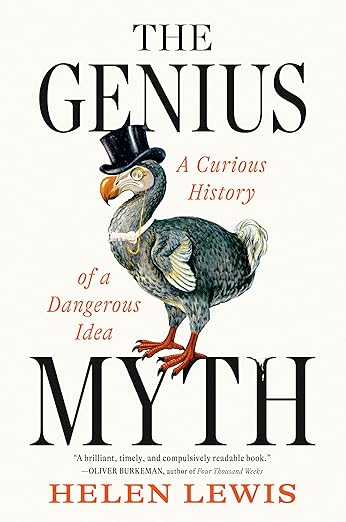
Helen Lewis opens The Genius Myth not with a question, but with a provocation. Her argument is not just about IQ scores or individual brilliance—it’s about the cultural scaffolding we build around people we deem “geniuses” and what that reveals about our values. In this book, she takes a scalpel to the idea of genius as moral exemption, intellectual dominance, and solitary brilliance, and in its place offers a more grounded, democratic—and uncomfortable—truth: we invent genius to justify who we want to celebrate, and what we value.
This book could not be more relevant for educators and leaders trying to recalibrate what we value, reward, and excuse in schools and society.
You Would Be Interested in This Book If…
-
You work in education or leadership and want to dismantle the “great man” myth of brilliance
-
You’re rethinking how we identify talent, potential, or merit
-
You’ve ever wondered why some people get away with destructive behaviour in the name of “genius”
-
You’re building a culture of character, collaboration, and humility in learning
1. What Is Genius, Really?
Lewis traces how the meaning of genius has shifted—from something one had to something one was. That subtle shift has created immense cultural license. On page 16, she writes:
“Because there is no objective definition of genius, and there never can be, societies anoint exceptional people as geniuses to demonstrate what they value. We call some people special to demonstrate what we find special, and in turn, we give those special people latitude that is not extended to ordinary mortals.”
This reframing lands hard in education. When we treat genius as fixed, innate, and rare, we start building systems—admissions processes, awards, selective programs—around exclusion rather than development. We start asking, Who is gifted? instead of What does this student need to grow?
The author uses great examples of how genius, and the myth of “Great Men” (aka The Great Man Theory) still are prevalent in our society. By virtue of these stories we forget that Edison was a meglomaniac, John Lennon had mean streaks, and Jackson Pollack was married to a much more influential artist than he was. In this way, we still hold up in our education systems ways to exclude different ways of thinking. This book does a great job of trying to dismantle that.
2. The False God of IQ
One of the strongest sections of the book is Lewis’ takedown of the intelligence quotient and the many myths that cling to it. On page 65, she offers this insight:
“Research showed then, and still shows now, that middle-class children dominate grammar schools, independent schools, and that there is no such thing as a tutor-proof test for entry to selective education.”
The IQ test, she argues, has become a kind of numerical prophecy, reinforcing privilege rather than identifying promise. And yet it continues to carry cultural weight—sometimes more than it should. She warns us against mistaking IQ for wisdom, character, or creativity, and especially cautions against the “omni-expert” trap, writing:
“It is one of the worst outcomes of the mythology of genius because it encourages exceptional people to stray far outside their competence… to see themselves as superior minds who have much to contribute on any issue.”
— p.93
For example, when brilliant minds in one domain start to believe, prostelitize, and claim expertise in others. One example involves the resurgence of eugenics. This critique has implications far beyond psychology—it asks educators to resist idolizing single measures and instead foster multidimensional assessments of intelligence and contribution.
3. Genius as Marketing Strategy
Genius, Lewis argues, is often less about discovery and more about self-positioning. On page 125, she writes:
“If you want to be hailed as a genius, take a tip from Isaac Newton, who trashed the reputation of his German rival by accusing him of plagiarism when both men claimed to have discovered calculus.”
This section explores how figures from Newton to Elon Musk, from Tolstoy to Polanski, shaped their legacies not only through achievement—but through narrative. It is not that their work was unremarkable, but that their genius was built in part through the willingness of others to look the other way. For many, this ‘grace’ given by others, made it seem that their actions, illegal, cruel and otherwise were the price society had to pay in order to benefit from their brillance. This is where the idea of genius as a person is dangerous.
In classrooms and institutions, this prompts a critical question: Who gets the benefit of the doubt? And why?
4. Demystifying the Lone Genius
One of the most satisfying sections of The Genius Myth is its clear-eyed dismantling of the lone genius trope. Lewis writes:
“Great minds are open minds by necessity. But if you open your mind too much, your brains will fall out.”
— p.148
Genius, she reminds us, is not just intelligence—it’s collaboration, persistence, curiosity, and character. She gives the example of Jackson Pollack’s wife, the wife of Tolstoy and others – that their genius was only made real by the hard work of others to literally feed, clothe and ensure they were sober when they needed to be. The danger of the myth is that it isolates. It creates exceptions. It excuses harm. It suggests that brilliance and goodness are incompatible.
But what if, instead, we cultivated a culture where contribution mattered more than charisma? Where humility, not hubris, was the hallmark of excellence?
Final Recommendation
Helen Lewis’ The Genius Myth is an unflinching, witty, and well-researched dismantling of one of our most dangerous cultural myths. For educators and school leaders, it is essential reading—because the myths we believe about genius shape the systems we build, the students we elevate, and the behaviours we excuse.
Let this book be a challenge: to celebrate minds that are open, not entitled.