Book Review: “The Explorer’s Gene” (Alex Hutchinson)
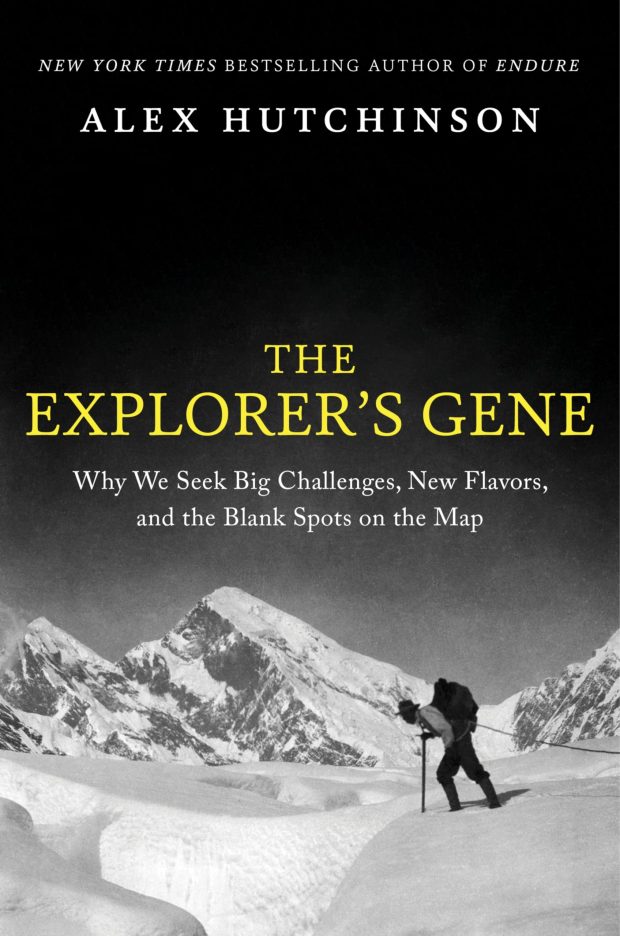
“Meaningful exploration, I will argue, involves making an active choice to pursue a course that requires effort and carries the risk of failure—what the mythologist Joseph Campbell called ‘a bold beginning of an uncertain outcome.’” (p.10)
You would be interested in this book if:
You’re an educator or leader who believes curiosity is a muscle that must be trained — not a switch that’s flicked.
You’re navigating a tension between rigor and relevance in today’s AI-saturated learning environments.
You’re exploring how to create schools that are more than credential factories — places where students find wonder, direction, and themselves.
You would not be interested in this book if you’re looking for a simple “how-to” guide. This is a thinking book, steeped in neuroscience and biology, case studies, etc… one that asks you to wrestle with paradox, uncertainty, and the neuroscience behind discovery itself.
1. The Explore–Exploit Trade-Off: Effort Over Ease
Hutchinson begins with a powerful truth: we are hardwired to explore. But exploration, by definition, involves failure, effort, and risk. In contrast, exploitation — getting better at what we already know — offers predictable, proximate payoffs. We avoid exploration not because it’s bad for us, but because it’s harder to quantify and optimize.
And yet, our brains crave what he calls “uncertainty bonuses” — the delight of reward prediction error. Dopamine spikes not when something is good, but when it’s better than expected. That’s the science of surprise, the logic of learning.
“Uncertainty bonuses are encoded in our brains… You get a shot of dopamine not because something is good, but because something is better than expected.” (p.9)
We teach students to chase certainty. Hutchinson reminds us that it’s uncertainty that unlocks joy, resilience, and meaning.
2. Play and Cognitive Mapping: Learning Without a Lesson Plan
Exploration isn’t just a metaphor — it’s a cognitive system. Hutchinson threads neuroscience with play theory to make the case that “useless” knowledge is often the most useful kind.
“One of the things that really characterizes play, possibly above all else, is that it’s so fun and engaging and internally motivating. You don’t have to force kids to play. They follow their instincts, and in doing so, they make choices that maximize their learning about the world.” (p.159)
This is more than recess. It’s how brains develop “cognitive maps” — internal mental models of the world. In a world of combinatorial novelty, where breakthroughs come from interdisciplinary intersections, play becomes preparation in seeing how two or three different ideas become a net-new idea, i.e. a breakthrough! Think of “Thinking Fast and Slow” by Daniel Kahnamin
Flexner’s classic argument on the “usefulness of useless knowledge” returns here with teeth: if we design schooling that overvalues instruction and undervalues extraction, we build obedient replicators — not innovators.
This is a great explanation that supports this concept of combinatorial knowledge. It is from a while-back now, but still worth it, by Steven Johnson.
3. Active vs. Passive Exploration: Who’s Driving the Curiosity?
One of Hutchinson’s most profound critiques lands here: our society is increasingly substituting passive exploration for active. We scroll instead of seek. We consume instead of create. The algorithm has become our compass — even though it only takes us places we already know.
“Why take the risk to explore something new when their phones will just send them to never-ending content related to things that already interest them?” (p.179)
“Teaching is a great way of helping learners zero in on key ideas… leaving the kids to figure out how they wanted to play with the toy led them to explore it more thoroughly.” (p.179)
This is where place-based learning, mentorship, and experiential education rise to the surface. In my job, I get to work with incredible educators from around the world. Leif Magnussen, from University of Southern Norway, has developed a concept of experiential education that he has dubbed “Extruction” – in contrast to “Instruction. It is an active, educational and intentional “non-action”. Our job as educators isn’t just to provide knowledge — it’s to create conditions for curiosity. We must help students act on the world and be acted upon by it.
4. The Effort Paradox: Why Struggle is the Source
In one of the most resonant sections of the book, Hutchinson explores what psychologist Michael Inzlicht calls the Effort Paradox: we value outcomes because they require effort, not in spite of it. Struggle isn’t a tax on learning — it’s the reason learning matters.
“The most challenging paths often turn out to be the most meaningful, not in spite of the effort required, but because of it.” (p.236)
Social media gives us the feeling of discovery without the depth. Algorithms offer the dopamine but none of the development. That’s a dangerous trade. The most significant exploration must be embodied, in the real world. In this way the student, the explorer can ACT on the real world, and have the real world ACT on them too!
In education, this is a clarion call to shift from efficiency toward depth. From “covering content” to uncovering meaning. From knowing the answer to living the question. This will be critical in world that is full of uncertainty and ambiguity!
5. Educator Takeaways: Purpose, Play, and Permission to Explore
The final section of The Explorer’s Gene is a short manifesto. Hutchinson outlines five takeaways:
Explore, then exploit. Chase uncertainty first — then deepen.
Seek the uncertainty sweet spot. Not chaos, not comfort — but challenge.
Play more. It’s not off-task — it’s brain-building.
Minimize regret. Choose optimism, not certainty.
Embrace the struggle. It’s not failure. It’s what makes the journey matter.
This book belongs in the hands of every educator who’s tired of shallow metrics and ready to rewild learning. From neuroscience to playgrounds, Hutchinson shows that the real danger isn’t failure — it’s never trying. In a world that’s algorithmically addicted to what’s next, The Explorer’s Gene dares us to dwell in what’s unknown.
This book is full of excellent knowledge and case studies, journal articles etc…, but it is also full of the author’s own experiences, his storytelling provides an excellent context and accessibility to these complex and important ideas.
Highly recommended.