 Written by
 I began this whole process last year with a problem: my Grade 9 math students made the same mistakes over and over again, and my feedback wasn’t helping.
So I then I did some research, found a reflection template that I liked, played around with it a bit and gave it a go. The results were significantly better than I expected, but in sharing with the rest of my staff at the end of the school year, a question came up about how I could use technology to make the process more efficient. Cohort 21 seemed like the perfect way to examine the problem and find some sneaky tool to make it both flashy and efficient. Simple, right? Wrong.
There can’t be that many tools out there or ideas about how to approach reflection that will be helpful for math, right? Wrong. There’s so much more ed tech out there than I could anticipated and it was overwhelming at first.
But all that needed tweaking was the technology to deliver my reflection, right? Wrong.
After (finally) making my first blog post, I was flooded by a stream of supportive and helpful comments. One of these posts was from Derek Doucet, who pointed me towards this article about assessment for deeper learning. That’s where I saw an image that changed the direction of what I want to do completely.
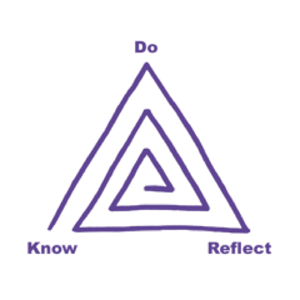
Assessment as learning could be a process rather than end point – ah ha!
Lucky for me, I teach a course that is semestered, so I begin a brand new course with a familiar bunch of Grade 12 boys on Friday. While they spend this week preparing for an exam, I’ve been planning to experiment on them with this reflective process.
My (draft) action plan is as follows
- Students will blog three times per unit – before we begin, during the unit and after they have completed all the assessments (of learning) for that unit
- Students will comment on at least two other blogs per unit
- I will read and comment on their blogs regularly
- I will research and read about student blogging as reflection
- I will share any relevant research with my students and encourage them to see reflection as a process
Questions
- Could I use mathematical prompts rather than always focusing on reflection in order to encourage students to communicate about mathematical ideas? Would that dilute the goal that I have?
- How I ensure that Grade 12 students take the time to make their posts meaningful at a time in the year when they can be challenging to motivate?
- Will students feel comfortable reflecting in a public space?
Love it Beth,
Chat with Brent Hurley at the next Face to Face. He has done quite a bit of blogging with his students. Great Action Plan!
Cheers,
Tim
Hi Beth!
So great to hear that you’re exploring reflection in math! I love the blog idea, and I think it’s important to get at the meta-cognition piece in STEM. Something that will help learners move forward for sure.
So, there is an Add-On to Google Forms called Doc-Appender which could be very useful to you in your quest for consistent and continuous reflection. Check out this video!! https://www.youtube.com/watch?v=DDjPreGtr0k
Also, C21 Coaches Tim Rollwagen (who showed me how to use it) & Brent Hurley are currently using it in their courses. I’ll make sure we all touch base on Friday’s F2F and you can have a look at it in action. I use it to track my learning skills. What I like about it is that I can do an assessment and the students can do a self-assessment and the info is kept in the same place. They can reflect on the data that is collected over an extended period of time.
It’s funny, French & Math are not all together dissimilar. The visual from the article has helped some of my students with not improving with feedback but I think what’s at the heart of it is helping students believe that they can improve!
I am looking forward to seeing how this action plan goes!
Hey Beth,
Check out @ckirsh ‘s most recent post on reflection! http://cohort21.com/ckirsh/2015/01/03/the-three-rules-of-reflection/
Hey Beth,
What I loved reading in your post was the power of your own blogging! It was awesome to read that by putting your questions out there, you were able to get some fantastic resources and supportive suggestions to push you in your thinking. You are really highlighting the power of reflection yourself and I hope that this can somehow be shared with your students.
While I don’t have answers to your excellent questions, I just thought I would share this article that I wrote my last blog post about: http://blogs.kqed.org/mindshift/2014/12/what-meaningful-reflection-on-student-work-can-do-for-learning/
It has some great ideas about meaningful reflection that I think might be useful at this stage.
Thanks for a great read, Beth!