 Written by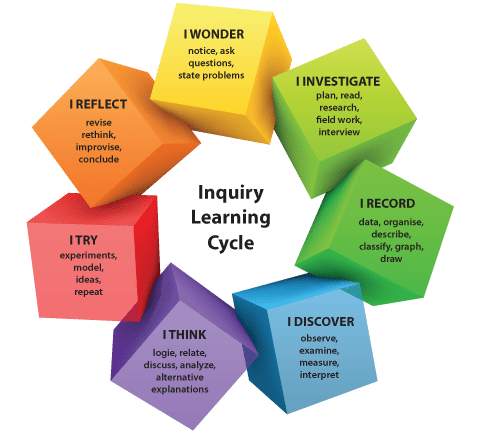
Part of my Action Plan has been to learn more about inquiry-based learning. I was introduced to the book, Dive into Inquiry, by Trevor MacKenzie, by a fellow C21 member. I thought I would summarize my thoughts/ takeaways from reading this book.
What the author has managed to achieve in his classroom is outstanding. He has truly been able to shift the classroom to a student-centered, student-driven environment. I really liked how a section of the book discusses the importance of collaborating with the Teacher-Librarian as part of an inquiry-based learning environment. However, because the author is a classroom teacher and frames his book from this perspective, it was challenging for me to understand how I could bring this type of learning to my school, as the Teacher-Librarian, not the classroom teacher. To truly shift to an inquiry-based environment, it feels like this has to happen in the way the classroom explores student learning, and the role of the Librarian is to support this process in the library when it comes to providing research.
The author is also a highschool teacher, whereas I am at an Elementary school, so I found it challenging to invision how to apply what he talks about to a younger audience.
As I was reading this book, a lot of my thinking leaned towards the Personal Project (PP), which is a required, student-centered project, that occurs in grade 10, as part of the Middle Years Project for the International Baccalaureate program. A few years ago I helped oversee this project at my school. There are a lot of similarities between the PP and inquiry learning. A student decides on a project that they would like to learn more about. It should stem from personal interest and the output (how they show their learning), the criteria (how they are assessed) is created by the student (with a teacher supervisor as a guide). I found that there were two groups of students. One group of students are able to define their project based on an area of interest and are very successful and engaged throughout the year-long process. However, there is also a second group of students who are not interested at all (even though they can choose what they wish to study and it should be based on their interest). I guess as a result of this experience, I am skeptical of whether inquiry-based learning is as amazing as MacKenzie makes it seem to be, or if it is the right approach for every student?
Part of me also wonders if inquiry is just one technique… in the sense that if every classroom had a “Wonder Wall” would it have less meaning for students? Or should every lesson be framed this way?
On a side note, I think one of the biggest strengths of C21 is the encouragement (requirement?) to write these blog posts. It really does make you reflect on your learning, the process, your thoughts, etc. in a very explicit way. Of course, we all think about how our days go, how lessons went, but there is something very concrete to be said about sitting down and writing out our thoughts, to articulate what we’ve learned, what additional questions we may have, and also use this medium to gain insight from other professionals.
So, to the group, does anyone have any online resources that they go to for inquiry-based learning inspiration that has an elementary focus?
Does anyone have a strong opinion that inquiry-based learning is the way to go? Does it really work for every student?
Image sources:
https://www.edelements.com/blog/5-tips-for-infusing-student-reflection-into-blended-classrooms
http://wellingtonlibrary.com/teacherinquiry/
Nicole! I’m so sorry I’m stumbling upon this post so late! What an amazing process you’ve modelled and the extent of your initiative has inspired me.
1. You posted in search of resources that may help to inform your action plan.
2. You tracked down a book and thoroughly read it.
3. You synthesized your reading and reflected upon its relevance to your situation.
4. You shared it with all of us.
And now you’ve got my wheels spinning. Thank you! This is the cohort magic in full effect.
I think you’ve touched on a common theme for the many experimenting with Inquiry Based learning in their respective learning cultures. And yes, like any new approach, the success cannot be found in a magical outcome of inspired, excited engagement for all (although I still dream this way). Like any approach to learning that is unfamiliar to the students, it will seem to have the effect of distancing the students from their learning. (I am eternally frustrated, for instance, by those students that crave the routine, the norm). I don’t think, however, that this means the learning isn’t available to those students in some profoundly important way. And it is likely the hard work of the skilled teacher that draws the student to that learning.
Nicole, this is a great discussion you’ve started. I’m tagging some cohort members who have at some point challenged themselves in a similar way. Let’s see what we can generate here.
@pcobban @dduguay @jdykerman @timrollwagen @ddoucet @edaigle @jmedved @gnichols @tfaucher @nbendle
Hi Nicole,
You have shared some wonderful insights into the world of inquiry based learning and identified some key areas that we should look deeper into.
I am very excited about you teaming up with some of your colleagues to explore how this collaboration with Teacher Librarian and Classroom teacher will work. The fact that you have connected and inspired a member from each level of our school to step into this with you is fantastic.
Well done!
In doing some reading myself i came across a quote that sums up why this strategy is so important.
Why student led inquiry? Why now? “If we are only teaching what we know, our children can only do as bad as we are doing, and this is the challenge we are facing – we have to go beyond it.” (Pauli, 2009, TEDx)
There world is changing faster than ever and we must prepare them as best we can to find information and research for themselves.
I am looking forward to hearing more as you and your colleagues advance this and attending the last face to face.
Blaine
Hi Nicole!
The post I wanted to read turned out to to be written by you 🙂 The ‘Inquiry Learning Cycle’ graphic and title caught my eye as it scrolled past on the right hand side of the screen. I had to click on it because teaching through inquiry is what I strive to do in my practice.
You mentioned that the author was a high school teacher and you were struggling to envision the elementary application? 2 things: (1) Have you read Guided Inquiry Design by Kuhlthau?
(https://www.amazon.com/Guided-Inquiry-Design®-Framework-Libraries/dp/1610690095) Our Co-ordiator of Teaching and Learning introduced this book to our staff and this model makes clear how to implement guided inquiry from the youngest grades on up. This model, you might note, features the word ‘guided’ and this is key in the implementation of inquiry with students.
(2) Our primary teachers do a fabulous job of weaving inquiry into their classrooms. You would be most welcome if you wanted to come by our school for a day, or half day, to visit some of our classrooms and teachers to see the inquiry process in action from our very youngest learners (JK) and up the range.
You also asked about an online resource? The author of Guided Inquiry Design, Carol Kuhlthau, has information about her framework up on the Rutgers site. She even has a copy of a presentation for the framework that you can use to share with your staff when you are collaborating with them. http://wp.comminfo.rutgers.edu/ckuhlthau/guided-inquiry-design/
Thanks @sneesham!
I have ordered the book you suggested and can’t wait to get into it!
I am absolutely going to take you up on that offer to visit your school.
I think part of my struggle is also trying to find the place the Teacher-Librarian fits in the inquiry process. For the most part, it seems like the Teacher-Librarian supports the research side (which makes perfect sense) but part of my HMW is supporting classroom teachers initiate the inquiry in their classrooms – which has been hard.
Hi @nbrooksbank – I’m coming to this conversation VERY late and you may already know this but Trevor Mackenzie has a new book out geared at elementary-aged students — Inquiry Mindset. Here’s the link: https://www.amazon.ca/Inquiry-Mindset-Nurturing-Curiosities-Youngest/dp/1945167432/ref=sr_1_1?ie=UTF8&qid=1523976345&sr=8-1&keywords=inquiry+mindset+trevor+mackenzie
I definitely can understand your frustration at wanting to implement something but feeling like you are dependent on the wishes of the teachers. Have you thought about approaching an open-minded colleague and offering to co-teach an inquiry-based unit with them? I’d like to think that if I were a classroom teacher I would jump on the chance to share the load a little bit! 🙂
@jweening I did not know that T. Mackenzie has written another book. I’ll have to check it out! Thank you 🙂
I have approached a few teachers who are definitely on board. I have a couple projects that will hopefully come to fruition come May. Fingers crossed!