 Written by

Jump for Joy or Run for Cover?
It was about this time on Saturday of last week that our 2nd Face to Face meeting was wrapping up. Having missed the first Face2Face, there was a lot for me to take in. My emotions at the time were a mixed bag of pure joy and excitement about the world of opportunity, and utter concern about my ability to make the grade as a cohort member. System overload sums it up pretty well. By the time we hit the TIMS model, I was done. I felt so far behind, that there was no way I’d ever get where I felt I needed to go. I just wanted to run for cover and find comfort in the known with my existing toolkit.
At Rosseau Lake College, our motto is Best of Self. Ask any student, and they can tell you what it means. As a teacher, I talk to my students a lot about how they can be their best academic self and help them as they strive to get there by providing clear expectations, lots of opportunity for practice, and descriptive ‘for’ learning feedback. Now that growth mindset is also on my radar, I’ve been working on adding that to my repertoire, too.
In our 2nd FAce to Face meeting, we were introduced to the notion of ‘Leveling Up.’ I can’t remember if this was before or after my brain exploded, but the important part is that it’s stuck. It got me thinking about how so much of my, and other teachers’ efforts, go into helping students ‘level up’ that we don’t always focus on how we, too, can (and should) ‘level up.’
To me, this is what the Cohort21 experience is all about, so I made the conscious decision this week to leave my cover and step into the big unknown and see where it took me. I ‘leveled up’ in and few areas, and…. it was awesome!
How I ‘Leveled Up’ This Week
Having had a week to ruminate and reflect on my (perhaps over) reaction to all the new information, I decided it was time to spend some time on leveling up myself.
Twitter: For you Tweet-a-holics out there, you can skip this part. But for any other reluctant tweeters, I made a huge step this week. I made a few tweets, checked in frequently to my Tweetdeck (Thanks, Justin), and even invited my students and parents to follow me. That was my accountability piece, so I’d actually keep up with tweeting. I did a search using hashtags and found some great information. My comfort level has gone up from next to nothing to about a blue sticker. I like the colour blue.
Socrative: after our introduction to Socrative, I was intrigued, so I thought I’d give it a whirl. In my Gr. 7 and 8 Lanugage Arts classes, we’ve been working on asking great questions and have been using Garfield Gini-Newman’s Q Chart as a basis for this.
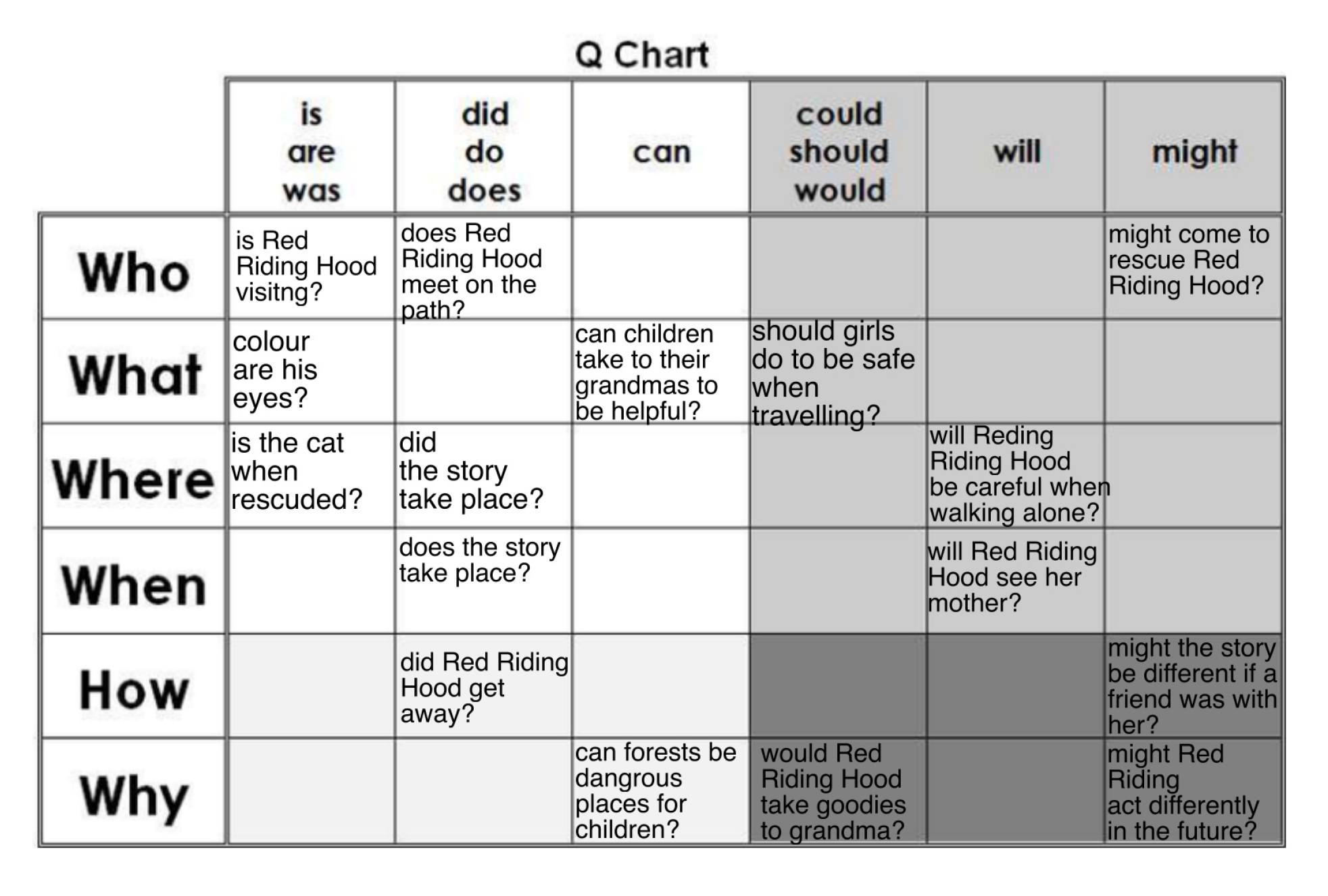
As Garfield Gini-Newman explains, critical thinking or inquiry occurs, “only when (students) are attempting to assess or judge the merits of possible options in light of relevant factors or criteria.” I created questions using the words ‘could/should/would/will/might’ for my students and put them on Socrative. Once they’d posted their answers, students discussed them. The level of engagement and quality of discussion was phenomenal. After their discussions, they had to vote on which answer they felt was the best.
This questioning/discussing/voting exercise is something I’ve done before, but without the use of Socrative. In the process of using Socrative, I was hoping to ‘level up’ on Dr. Ruben Puentedura’s SAMR model, as well. Certainly, it augmented the process, in that Socrative acted as a substitute for the traditional paper/pencil method with functional improvement. The process was faster, and the students were totally engaged in the process. In my quest for leveling up on the SAMR model, I wonder, though, could Socrative be used as a modification? I’d love to hear how other people are using Socrative in their classes. Does anyone have some good tips?
My next ‘Level Up’ goal is to discover the benefits of Google+
Meg,
I really loved reading about how you are embracing the challenge and uncertainty of this kind of learning. You are such a great example of a growth mindset AND grit in action. Your students should be reading your writing, as it gives such a great example of what they should all be striving towards in their practice as students: not settling for the easy / comfortable option, challenging themselves, and being passionate about learning. These are all the things we hope for our students, right?
I hope you don’t mind me sharing out this post to some fellow friends who could use a daily dose of motivation and inspiration!
Hi Celeste,
Thanks so much for your comments. I know most people are way ahead of me with regard to effective/enhanced use of IT in the classroom. There was a big part of me reluctant to blog about my little successes knowing most people have been doing them for ages. That said, as you mentioned, the easy thing to do was just carry on with the way I’d been doing things. But that’s not what the Cohort experience is about, and I want to get the most out of this amazing opportunity. Great things are very rarely easy! I’d be tickled pink if you think sharing my post with others might inspire and/or motivate them. Thanks!
Meg: I have had a very similar journey during the Cohort 21 process to date. It’s comforting to know I am not alone but rather I stand along side other educators who are dipping their feet in and trying new tools in order to “level-up” on the IT front. I too was new to Twitter and have found such value in Tweetdeck (especially once I found the right hashtags to follow). Twitter went from being an overwhelming world of information to one with a narrow focus that I could manage and was filled with wonderful resources! Socrative is also one I’ve played around with, with some success. I love the possibilities and know I will be using it more often if my classroom. Good on you for being your best self and looking for ways to “Level Up!”. My next challenge: explore Diigo and test out some new resources to help enhance my flipped class.
Hi Melissa,
Thanks so much for your comment. It’s good to know I’m not alone in how I feel, and it’s great to know how others are moving forward in areas outside their comfort zones. I’ll be working on how to better use Diigo as a tool in my classes as well, so let’s connect at the next F2F. Happy New Year!
Hey Meg,
What a great reflection! Yes, it’s true that brain exploding seems to be a given when participating in C21 and it’s easy to run for cover. So great to see you coming out of the woods and driving the learning. It’s important that teachers “buy what they’re selling” so to speak because students learn from our experience and behaviour so let’s fail forward in the learning and show our students that failure isn’t something to fear. Failure in moderation on our part is of course something to bear in mind 🙂
Let’s touch base via Hangout about better use of Diigo in the classroom and we can Melissa in on it too! She’s using it as well and it would be great to have as many different people in on it as possible. Keep an eye out for a Doogle form to see what your availability is like.
This is exciting stuff!
Thanks, Derek!
I’d love to get some tips on using Diigo better with students.
Meg