 Written by
Hello everyone, and Happy New Year!
I am posting my first blog, in an attempt to sort through the intricate web of thoughts that are becoming tangled in my brain. For my action plan this year I have decided to consider the ways that I can bring decolonization into my school community. This has been a focus of mine since completing my Masters in Education at OISE with a focus on decolonization a few years ago. I was moved by the works of Linda Smith, Paulette Regan, Edward Said, Gerald Vizenor, Fanon, Simpson, Tuck and Yang, Vowel, and Anzaldua. I continue to struggle through the ways I can incorporate these ideas into my teaching practice and school community, but in the spirit of “dialoguing and living well together”, here it goes…
My decolonization journey was reignited this year when a former student of mine (now in Grade 12) approached me to ask if we could attend the Decolonization Conference hosted at U of T through CIARS (the Centre for Integrative and Anti-Racism Studies). To my happy surprise, I received a plethora of applications and attended the conference with 10 students from my school in partnership with students from the First Nations School of Toronto. Students described this conference as “transformational”, and “life-changing”. It sparked so many authentic and critically reflective conversations and continues to fuel my passion for working with students at my school. We have now started a Decolonization Club which meets weekly, and we are planning a student-led conference in partnership with the First Nations School of Toronto for students in the GTA this spring. This club continues to push us all to begin to be comfortable with uncomfortable conversations and tread thoughtfully through muddy waters.
I thought I would share some of the takeaway messages for me from the decolonization conference I attended with students. If you (whoever you are) are still reading this, feel free to skip to the end as a navigate through my confused inner monologue.
Many of the speakers from the conference (Eve Tuck, Njoki Wane, Marie Battiste, Sandy Grande, Ruben Fernandez, George Dei, etc.) are referred to below based on the chicken scratch I could decipher from my frantic note-taking throughout the 3 days. Several speakers referenced the ways in which schools have, and continue to function as a tool for manipulation to further colonize the mind. Several speakers referred to this idea as ‘cognitive imperialism’ or ‘cognitive assimilation’, pointing out the ways that educational institutions define success according to dominant norms, create a language of elites (English and French), and often discount Indigenous knowledge as having no contemporary significance. As a Canadian History teacher, this is something I’m working to confront within my classes. Dr. Fernandez explained that, “Colonization begins with the cannon and continues through education and language”. Colonial violence is largely undisputed within the historical context, but the erasure of diverse voices within various curricula, texts, and routines is in and of itself a form of violence that I’m working to confront.
Throughout the conference, educational spaces were sometimes referred to as “wounded spaces” where there are clear beneficiaries and victims, often exacerbating inequalities rather than challenging them. It is difficult to think of schools within this context, but has been such an important step for me in rethinking programming and curriculum design. Battiste argued that these inequalities are often explained as the result of history, culture or nature, while not emphasizing the Eurocentric privilege and discrimination that continues to perpetuate these inequities. Tuck built on this idea explaining that schools often serve assimilationist agendas by teaching a prescribed heteronormative set of knowledge, teaching specific mannerisms, and by subtly (sometimes not so subtly) setting predefined goals for students. Grande explained, “We value diversity upon entry into schools but erase it in order to graduate”. It influences how we come to define what is ‘legitimate’ (schools, jobs, etc.).
Grande urged audience members to consider the question: “What does it mean to be a good relative?” in all the work that we do. Asking ourselves critically reflective questions is a crucial starting point. How did I come to be here? What has colonization done to implicate me in my current situation? What is our relationship to land? We need to examine how our relationships are now in order to understand how to deconstruct and eventually reconstruct them.
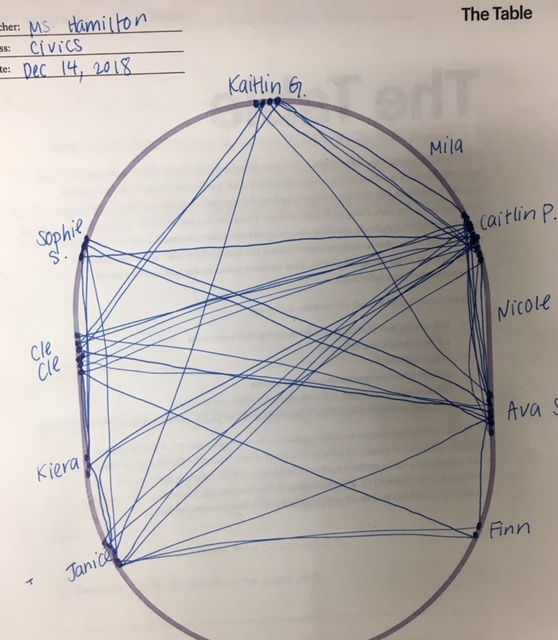 Moving forward, I am considering the ways that I can challenge the idea of the colonial classroom and use the 2-step process of deconstruction and reconstruction that Battiste referred to in her keynote address. I’m working to continuously situate my personal privileges and work with many communities in open and trusting dialogue. I’m working through the ways I can do this through harkness discussions in my classes, through our partnerships with the First Nations School, course content in my classes, consultations and diverse texts, assemblies, and more.
Where there is an Aboriginal right, there is a corresponding responsibility to teach that right. Wouldn’t it be a better world for all of us if we could take up Ian Campeau’s idea of Indigenizing our ideas of wealth and success; rather than hoarding, move toward how much we can afford to give away? He also argues that success should be based on how well we take care of the most vulnerable people. I’m going to continue to chew on this food for thought until next time. Apologies for the lengthy post!

Meagan
Wow, Meagan! You’re right, there is a lot to chew on here. What an amazing opportunity for your students to go to that conference. I work with students in my school as part of the TRUE (truth, reconciliation, understanding and empathy) group. We can get lost in these big ideas, as well. I think you’re doing the right thing exposing your students to some hard truths about Canada’s history. My hope is that more history teachers are having these real conversations with their students about this pervasive Eurocentric interpretation of events. For my part, you’re on the right track, and it’s so worth it for your students!
Hi Wendy,
I would love to learn more about the work you’re doing with TRUE at your school. Hopefully we can find time to chat on Friday about this! 🙂
Meagan
Another wow! I read this twice because it was so rich in big ideas and challenging questions, and it was extremely inspiring.
I love the idea of creating a club that “continues to push us all to begin to be comfortable with uncomfortable conversations”. Having had Harkness discussions about contentious issues — most notably a major one last year about racism and discrimination in my classroom, I have seen the value in having the uncomfortable conversations. In fact, the reason we had a major Harkness on racism last year was that some of my students had previously said they didn’t want to hurt anyone’s feelings when talking about “hard” topics.
Unfortunately, I still find myself shying away from them at times. Sometimes I feel like I don’t have enough information or I overthink it coming from the settler privileged perspective. However, I think it’s essential to continually remind ourselves that considering and educating ourselves on these issues, having the tough conversations, and taking action are essential.
I would love to hear more about the 2-step process of deconstruction and reconstruction from Battiste; maybe we can discuss in person next Friday?
I would love that! I’m still a Harkness newbie and would love your feedback on incorporating it in different contexts! I also struggle with questioning whether I even have the right to have these conversations with students, as I also come from a white settler place of privilege. There’s lots to unpack and I’d love to have more conversations about this with you next Friday! 🙂
Meagan, this is so powerful – thank you for sharing and for the comments from @wdarby and @sthompson. This really resonates with the work that we are doing at Havergal through our Forum for Change because they are doing some great work with MOSAIC institute and we are in an ongoing partnership with the Center for Social Innovation with indigenous partnerships. Let’s connect on Friday about this. In the meantime, I’ll share this post with them.
Meag,
As your colleague I am consistently in awe of your dedication to decolonizing the classroom – and hearts and minds along the way. In my brief conversations with you, learning about “the erasure of diverse voices within various curricula, texts, and routines is in and of itself a form of violence” has already prompted me to be more thoughtful the selection of information to inform my practice. Thank you – and please keep sharing, this is such important work!
Allison
Meagan – thank you so much for this thought-provoking and inspirational post! I recently joined my school’s Reconciliation Council whose mandate includes a commitment to the development of a multi-year action plan to address the Truth and Reconciliation Report’s calls to action. My participation on the Council has inspired my action plan to investigate different teacher education options to support pluralism and the refinement of our school curriculum to reflect Indigenous content and rights in Canada. I hope we can find some time on Friday to discuss some of the issues and challenges connected to engaging in this type of work.
Wow. I don’t even know where to begin. I learned so much about the importance decolonization in your blog post. I never even thought of school as a place were we could be further colinzing our minds. Having these hard conversations is healthy for the adults and students in out schools.
Your blog post reminded of a recent post title “Priviliged” by Kyle Korver (nba basketball player)
“The fact that inequality is built so deeply into so many of our most trusted institutions is wrong.”
https://www.theplayerstribune.com/en-us/articles/kyle-korver-utah-jazz-nba