 Written by
 How Might We Improve Student Engagement in High School Science Classes?
Here’s the motivation for my action plan: most of my students are very social. They are also (for the most part) lower achievers than students I’ve taught in the past. So, I have many students who are more interested in talking than listening, and tend to get lower marks. It’s probably a “chicken-or-the-egg” situation. I decided to see if I could get them more interested in learning, and if that could carry over and possibly lead to higher marks. I tried two things in the last few weeks. Here’s what happened:
Self-Assessment
I gave each of my grade 10 science students (68 kids in 4 sections) a simple self-assessment. I told them it is the half-way point of the year, so let’s look back on your personal level of focus (code for “engagement”), homework completion, and marks. Then, let’s make 3 goals for the second half of the year – a mark goal, a behaviour goal (such as doing more homework, or not getting sent to the office again), and an organization goal (such as always bringing a pen, or completing assignments on time). Finally, I asked them to list 3 actions that they will do to reach these goals.
My results were, predictably, interesting.
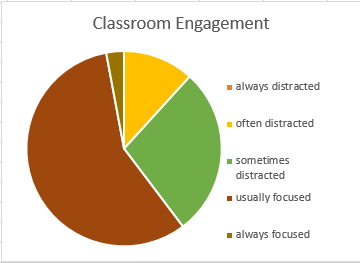
While none of my students admitted to being “always distracted”, 39 students (57%) rated themselves as “usually focused”. Let’s just say if 57% of my students were usually focused, I wouldn’t need this survey in the first place. Good for the 8 kids (12%) who admitted to being “often distracted”. At least they’re honest.
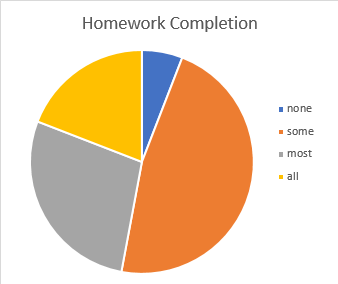
A total of 36 students (53%) admit to doing little or no homework this year. I instituted a policy in September that I would be checking homework – not every day, but at each test. Students are to upload their homework to OneNote, where I will check it and give a completion mark. This is a mark that counts, but with a very low weighting. Let’s look on the positive side: 47% of students are doing most or all of the homework, which is a pretty significant number. If I did this survey in the past few years, 47% would probably be a high water mark.
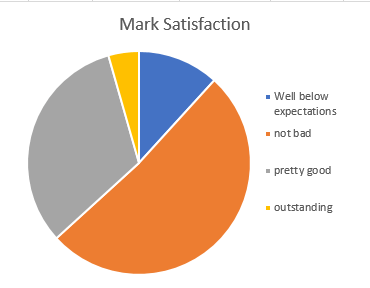
As for marks, a whopping 43 students (63%) rate themselves as “not bad” or “well below expectations”. Only 3 students are completely satisfied with their achievement based on their hard work so far. This seems like a fair and honest assessment. My students could definitely do a little better.
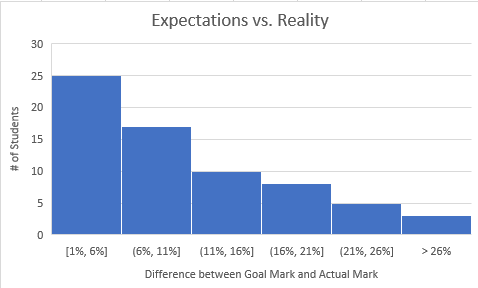
Now for the especially interesting part. I took each student’s current mark and subtracted it from their Mark Goal. Not surprisingly, each goal was at least 1% higher than the student’s current average. Kids want higher marks. However, the difference between their goals and achievement so far was staggering! The average difference was 11%. Students set lofty expectations as much as 40% over their current average. Only 25 students (37%) were within 6% of where they currently stand. I think this whole exercise only proves that our students lack the metacognition to properly self-assess their performance and abilities! That will be an action plan for another day.
Kids want better marks. That’s no surprise. The key is in the “Actions” – how will they go about attempting to achieve these higher marks? Will they take a hint from the first two questions and pay more attention, or do more homework? Or is it up to me to make the classroom a more engaging environment so that they forget about distractions and want to do homework? Let’s find out!
Learning Stations
Here’s something that I have been thinking about for a while and finally got down to doing, thanks to some good old fashioned Cohort Guilt™. Plus, it fit perfectly with my chapter on Human Body Organ Systems. I broke my class up into four groups, strategically splitting up the chattiest and goofiest kids. During a class period, students rotated with their groups between four learning stations. Our periods range from 45 – 75 minutes, depending on the day, so each station lasted about 11 – 16 minutes. I encouraged students to take notes at each station, adding to one big note for the topic. Each day focused on one of the human body organ systems and I did this three times with each class (Digestive, Circulatory, and Respiratory systems). I also said that if any time was leftover during a station that students should start on the homework.
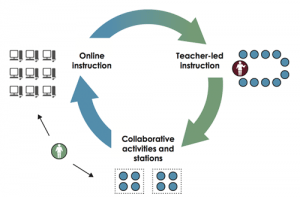
- Listen – a traditional chalk-and-talk lesson at the board, provided by me. The students sat in close proximity to me, on stools. I figured, even if they do nothing at the other stations, at least I get about 13 good minutes with each student right in front of me, where they can’t goof off.
- Read – reading about the organ system from the text book, and my OneNote page summarizing that system.
- Watch – watch a video about the organ system on Youtube (Crash Course!)
- Play – links to various matching games, simulations, and quizlets, plus access to our human body model with removable organs.
During initial feedback, some students suggested that the time for each station was too short. So I put Watch and Play together, giving them an opportunity to do either or both, and extending the rotations up to 15-18 minutes. It seemed like the vast majority of students rated “Listen” as their favourite station, which is bizarre since so few of them were actually listening during my previous lessons. I have just decided to get concrete data on this, rather than rely on anecdotal evidence.
Students complained about the usual things, I suppose (mostly not being allowed to choose their group members). Overall, I’m not sure that I accomplished much, but I am glad that I tried it. I will take a class survey this week and see if they would want to do this again. It required a little bit of prep work to find the links, but otherwise wasn’t too hard or time-consuming. Be sure to comment if you have any suggestions!
What a great blog post Jason! I feel like the ideas you’re talking about here are really applicable in any subject (love the categories you broke your stations down into – I’ll definitely be trying to do the same at some point soon!). And the numbers-person in me loved the quantitative data you’ve gathered and the charts you’ve used to represent it!
I’m really fascinated by a few things in particular here – that some of the students have a mark goal of 40% higher than their current grade (ambitious!!!), and that they liked the “Listen” station the best. Do you think they preferred listening because it was only 13 minutes long (maybe it held their attention because it was so short?), and they were in a smaller group (so they felt they had more of your attention? or more opportunities to ask questions? or more accountability?) I’ll be interested in hearing more about your process as you keep going with this, I’m super inspired just reading about what you’ve been doing! Keep up the great work! 🙂
Thanks @dtaylor! The 40% gap shocked me too! How can someone literally failing my class have a goal of 85%?! It seems ludicrous, but perhaps he took the survey as seriously as he takes my class. Anecdotally, the students who spoke out loudest in favour of “Listen” are the ones who usually pay the most attention in class anyways. Although, an informal survey indicated some support for each station. I will need to formalize each student’s preferred station and sort the data this week.