
 Written by
 Before I make my “Final Action Plan Post”, I have a few other things that I want to put out there.
1. Some More Authentic Learning Tasks
Dilution
While teaching my grade 11 chemistry students about dilution, I challenged them to determine the concentration of my (randomly prepared) sample as accurately as possible. The solution itself contained only food colouring and water. This task required my students to utilize a new equation that I taught, and some new lab techniques (preparing solutions using pipettes and volumetric flasks).
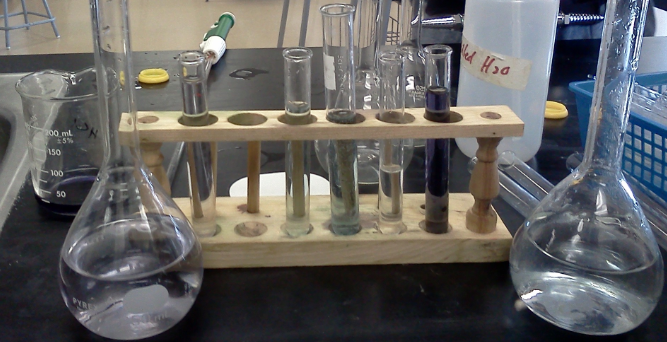
The middle test tube (above) is the sample I provided. All students agreed that the far left solution was too dilute and the the far right solution was too concentrated. The inner solutions are my students’ best attempts.
After a few calculations and attempts, this task became a matter of trial and error, as my three groups of students tried to match my solution through brute force. Eventually two of the groups gave up on proper lab technique and just added slight increments of water until the colours matched. Of course, this creates a visual match, but not the qualitative concentration value. My third, most diligent, group persevered and found the concentration to within a narrow window, but couldn’t match the exact shade of the solutions.
In some ways, this task is a great indicator of “GRIT” as it is easy to give up after a few trials, yet a methodical method and perseverance should eventually lead to success. Although my sample size was small – not to mention this was the last day before March Break, so students weren’t exactly at peak motivation – my predictably gritty students had the best results. Upon reflection, this could potentially build grit through friendly competition: attempting to solve the problem faster than peers, or attain a more accurate shade.
What’s in the Big Beaker?
Last week I gave my grade 11’s a multi-step problem and a full period to work on it. The questions mimicked a possible exam situation: combining knowledge from Units 1, 2, 3, and 4, as well as some “outside-the-box” thinking. Two different solutions were combined into one beaker, and the students were challenged to determine “What’s in the Big Beaker?” I required them to calculate the mass of the precipitate and concentrations of any dissolved compounds.
While some students repeatedly met snags, many groups solved nearly the whole problem flawlessly. The “outside-the-box” portion was that there was a 3rd compound in the beaker other than the 2 products: leftover excess reactant. For my non-chemistry readers, imagine dumping a bunch of LEGO on the floor and making as many 6x6x6 red cubes and 6x6x6 yellow cubes as possible. It is unlikely that you will use every last piece – there will likely be some leftover red/yellow pieces, so it’s not enough to figure out how many large cubes are produced, I challenged them to include the leftover pieces. Only a few of my sharper students realized this, and only with a bit of prodding. It wasn’t meant to trick them, just to see if they could conceptualize everything in the big beaker.
2. The GRIT Survey
I recently asked all of my students to complete Angela Duckworth’s Grit Survey (thanks to @gnichols ). So far 57 of my 73 students have voluntarily completed the survey and shared their results. According to my anecdotal evidence and impressions of the students and their work ethic, only about half are in the right ballpark. There are almost as many who over-estimate their GRIT and those who under-estimate their own GRIT. I think part of the challenge here is with the metacognition of my students, who may yet be too young and inexperienced to fairly assess themselves.
Whether or not the data is valid, I will attempt to analyze it here.
26 of my 38 grade 10 academic science students completed the survey. Their average GRIT score was 3.58 (higher than about 50% of Americans). All 11 of my grade 10 “STEM” (advanced) science students completing the survey, averaging 3.79 (higher than about 50% of Americans). 20 out of 24 Pre-AP Grade 11 Chemistry students completed the survey, averaging 3.48 (higher than about 40% of Americans). At first blush, it is hard to believe that my AP Grade 11 class is less gritty than my grade 10s, even after months of my Action Plan designed to build grit in that group! I suppose it’s all relative.
Next, a graph of my students’ marks compared to their GRIT. Taken with a grain of salt, as well as the knowledge that scores of 3.6 and 3.8 are not significantly different (both being “higher than about 50% of Americans”), my graph is a predictable hodge-podge (an extremely low R² value of 0.16). This means that – according to my data – there is NOT a substantial relationship between a student’s mark and his or her GRIT score. One thing I can state, however, is that all of my students with a GRIT score above 3.5 have at least an 80% average in my course.

Conclusion: High Achieving students are not necessarily gritty, but grittier students are generally more successful academically.
Great reflection on students defining “grit”and the grade variance. Are the grade 11’s just more realistic with their self-analysis? Your conclusion is telling…how do we communicate the importance of ‘grit” in the learning spectrum?
Thanks for your comment Jan! I think the grade 11’s have erred towards under-estimating their grit and the grade 10’s have erred towards over-estimating theirs (at least according to my personal observations). Plus, it’s a small sample size. Grit is definitely important, and perhaps I can use my graph to help my students understand that.
@jbornstein –
Thanks for sharing these updates! Although much of it is all Greek — I mean, chemistry — to me, I am impressed with how you have carefully designed experiments to try to assess your students’ grit when dealing with complex challenges.
Jen
Thanks @jweening! I realize my blogs have been very “sciency” so I really appreciate you reading them and giving me feedback!
@jbornstein I love that you had students fill in the GRIT scale score and then look at relationships between their grades! I think this is something I will have to do this year. After reading this, what I think I might do this year, it give the students the GRIT questionnaire the first day, during midterm exams and then before final exams to see how it changes throughout the year and how it correlates to their grades. Maybe next year we can collaborate with grade 11 and/or grade 12 chemistry students and put together our data to further investigate the GRIT scale!
I also love the idea of observing students grittiness through their laboratory work. Experimentation can be extremely frustrating and filled with a number of challenges. A great scientist is one that continues to persist and maintains curiosity when met with a challenge, not one that encounters no challenges. Thanks for including this, it serves as a reminder to me that encouraging perseverance in lab work is an extremely important for building a grittier student body.
Thanks for your positive feedback, @sregli. I definitely see some collaboration in our future. I would be interested to see how our classes’ GRIT scores compare.
I’m so glad you shared this story via your blog! I loved hearing about your Dilution challenge and it’s great you moved ahead with having your students complete the GRIT survey. You make sound observations about your grittier students having more success and I think this is a major pitfall of our system. Those who are traditionally successful in school when following directions and don’t experience many obstacles are going to be shell shocked when they leave school and face obstacles for the first time without some degree of stick-with-it-ness. Have you shared your results with your students?
What an incredible opportunity for you and @sregli to put the data together next year. I know we have a chem teacher here who would love to embark on this journey too – I’ll send her this blog later tonight.
Great final thoughts before your final blog post. Looking forward to seeing you on Friday!
@maragona you have to check this post out!
Great speed-dating with you, Jason, about GRIT, at our last Cohort21 of the year. Keep setting up your students for the “friendly fail” in order for them to build up their resilience toolkits. Well done!