 Written by
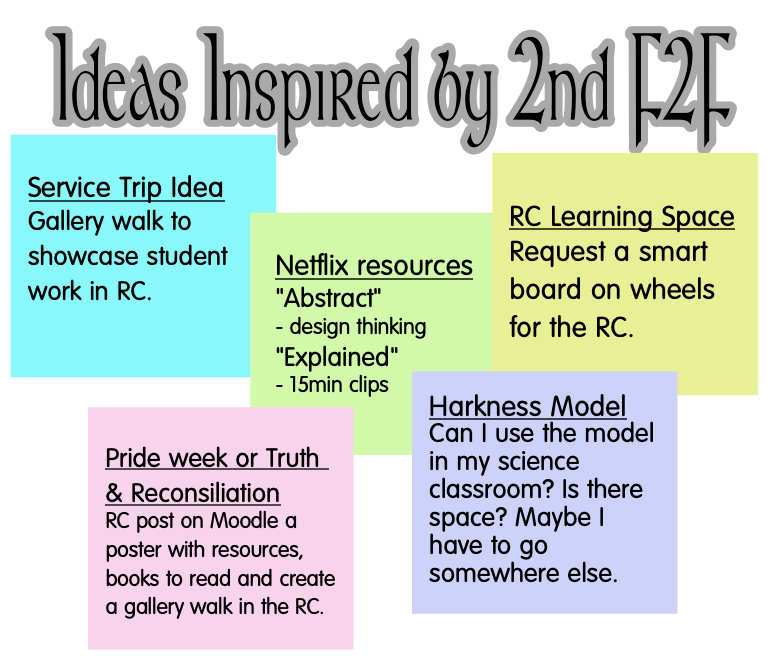
 Going into Cohort21 my group of Albert College colleagues (Whitney and Mark) had a question in mind. We wanted to investigate the use of ‘observations’ and ‘conversations’ in assessments. The Design Thinking model (2nd Face to Face) has allowed me to refine the question and to receive some inspirational comments from the entire Cohort21 team — Thank you!
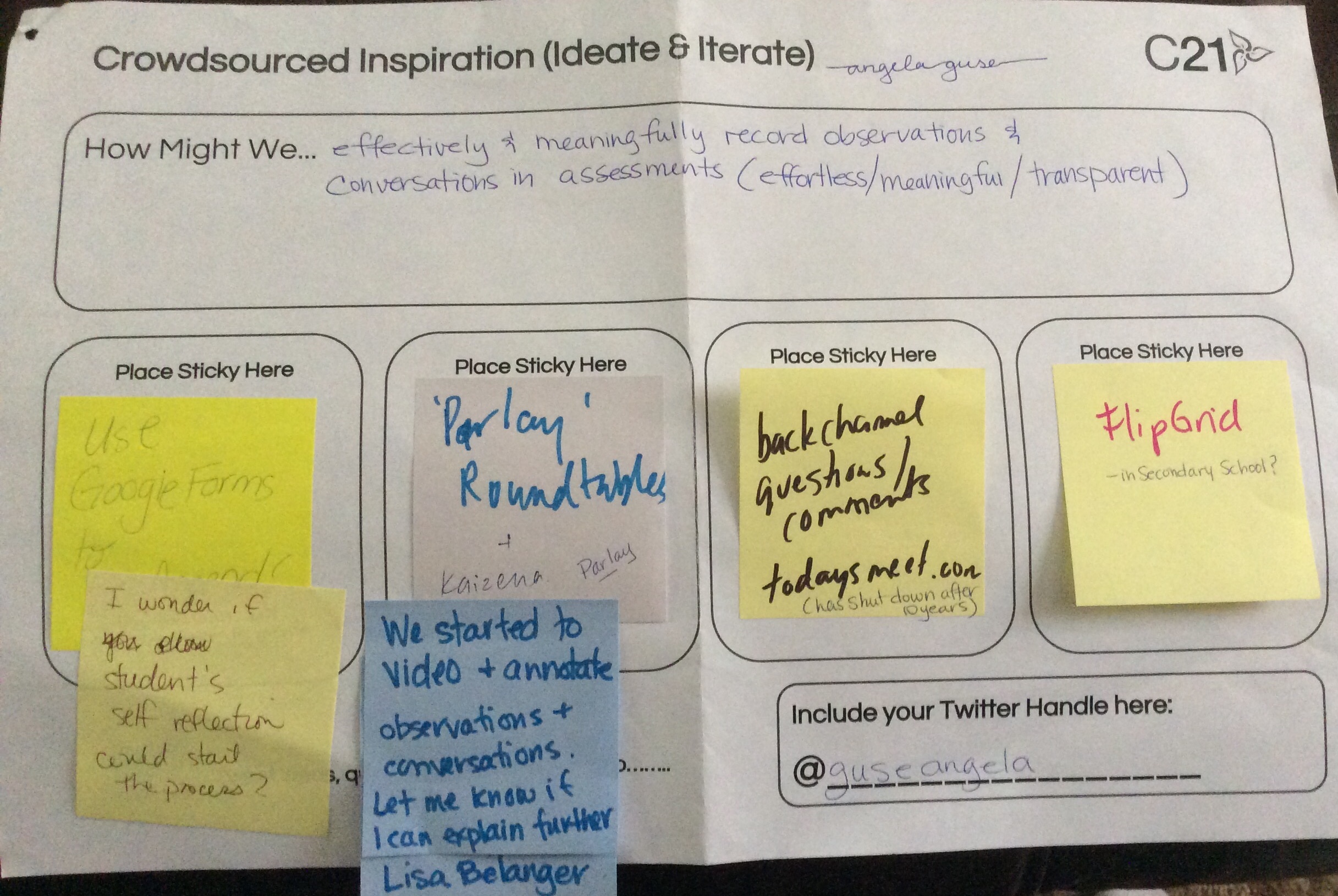
How might teachers effectively & meaningfully record observations and conversations in assessments because it will engage students and it will help students value learning more?
How Might We …..
– engage students and empower them in their learning?
– get students to value learning more than their grades?
– capture valuable anecdotal data about our students in an effortless & meaningful way?
– improve teacher facilitation for inquiry-based learning?
 .
. 
Plan of Action
1) Analyze data collected from a survey completed by both teachers and students
— We have already surveyed the students and teachers. Indicating to them that as a Cohort 21 team our year-long goal is to strengthen and improve how we assess observations and conversations so that they can be used for formal purposes, especially for reporting and grading.
2) Research some available technologies — Parlay, Kaizena, Backchanneling and Flip Grid
3) In my Biology class, I plan to use audio to record an explanation of a concept. They will be assessed on their use of Biological vocabulary and the depth of their understanding. After recording the students will also reflect on this assessment style – What went well? What was tricky? How has this assessment style allowed you to express your understanding?
4) Finally, I will talk with my Junior School Colleagues. They are experts in collecting observations and conversations, I need to take advantage of this amazing resource.
Hi Angela,
It sounds like you and your team have a plan of action! It is really cool that you are working as a team on this endeavor (your own in-school professional learning group!). I think you are wise to collect student feedback on learning from your biology class. This will allow you to gauge pedagogical effectiveness and also glean student perceptions of this new teaching and learning approach.
You have outlined several tech tools to support obs/cons. I have been using https://parlayideas.com/ for a few years, and find it very useful for assessing student conversations. Although it takes some getting used to (like anything new), Parlay provides tons of metrics on student participation, engagement data, and promotes digital literacy skills as part of the learning process. My students consistently rate it as one of their preferred assessment tools each year.
Looking forward to hearing how your action projects progresses in the coming months!
Thank you for your comments.
I look forward to meeting with you at the 3rd F2F. I am interested in hearing more about Parlay and brainstorming ways that I can use it in my Senior Biology classes.
Angela
Love that you are using different tools to assess. My daughter is an excellent verbal communicator (she literally doesn’t stop talking unless she’s sleeping) but so many assessments are written tasks which she struggles with. I also love that you are getting student feedback about the assessment style. It can be so important to find out how they feel about it and give them that outlet. I think this can encourage a very constructive and positive relationship between you and your students. Looking forward to hearing how it’s going!
w
Thank you, Wendy, for your comments.
I am only now realizing the power of conversations. I am beginning to recognize that there are two types of students out there. The students that play the game of ‘taking tests’ well but have a hard time showing their understanding in a casual encounter, and then there are those students that really shine during a conversation type of assessment.
I look forward to having more conversations on the topic.
Angela
Wow @aguse , what a powerful shared action plan, that intentionally engages , and in that way affects and perhaps even inspires, your entire school culture. And it is such a noble focus! Have you looked into Damian Cooper’s VOCAL model? http://www.planteachassess.com/vocal101/ . It connects strongly to your action and at the very least will provide some useful tools and approaches. We’ve been using this year to centre our discussion around assessment practices in the larger goal of some shared agreements about assessment; not the least of which are ‘what is a grade?’ ‘what should constitute it?’ ‘how do we better ensure authentic feedback in a way that empowers students?’ It seems that all of us can agree on the ambiguity of a grade that at least partially begins with an often convoluted approach to assessment (does it provide me with a clear picture of student learning? has it allowed the student to demonstrate the full extent of competency?). And what a great anecdote from @wdarby, highlighting inherent issues in how we traditionally think about assessment.
I’m really excited to follow this Angela!
Hey, when you find a moment, please remember to fill out this quick Action Plan survey: https://docs.google.com/forms/d/e/1FAIpQLSd5S3x5kKuWQkSVYXCMMe4ASoxFRRF13E0F7xqQ_okD4t-3fg/viewform
@mneale @ashaikh @acampbellrogers
Hi Angela,
What a great action plan – no doubt you will have many who are interested to see where you land. As you know, this remains a big area of interest for our CIS Ontario curriculum leaders, and will be a strand in the upcoming CIS Ontario Connects Unconference.
You should check out the work of @vkraus in her French class at Bayview Glen – she’s done some excellent work in this area. I’ve seen many different iterations of what this might look like, and in each of them the emphasis is on the paper trail. How can you support the observations and conversations with documentation. However, I wonder if this emphasis is not misplaced. In Growing Success, the Ministry of Education of Ontario writes, “Professional Judgement. Judgement that is informed by professional knowledge of curriculum
expectations, context, evidence of learning, methods of instruction and assessment, and the criteria and standards that indicate success in student learning. In professional practice, judgement involves a purposeful and systematic thinking process that evolves in terms of accuracy and insight with
ongoing reflection and self-correction.” In fact, under the “Fundamental Principles” section, it states “Teachers’ professional judgements are at the heart of effective assessment, evaluation, and reporting of student achievement.” And it goes on to state in the Assessment and Evaluation section, “Teachers will weigh all evidence of student achievement
in light of these considerations and will use their professional judgement to determine the student’s report card grade. The report card grade represents a student’s achievement of overall curriculum expectations, as demonstrated to that point in time.” And then, ” It is expected that both mathematical calculations and professional judgement will inform the determination of percentage marks.”
So evaluation data is held in balance with professional judgement. I thin that the emphasis then, can shift away from focussing on “how do I know the student earned this mark” and towards the effective articulation and placement of professional judgement in reporting. Building the trust of educators in themselves, and the shareholders is a monumental task, but it is done one conversation at a time.
I hope that this gives you some food for thought about the use of Observation and Conversation and how professional judgement can make the implementation of what you’re planning more integrated.
Thanks for a great post!
Garth.
Hi Angela,
What a thoughtful and interesting topic.
Gathering data and ongoing evidence of student learning is
fundamental to effective and inclusive instructional planning. That being said, feedback is more powerful than grades; Let students learn to amplify that.
I’ve found that by amplifying student work from the classroom to the world and seeking analysis from other students, other educators, and experts in the field gives them that learning feedback. Growing our students without grading is probably one of the biggest challenges in the 21st century.
I look forward to continuing this conversation and seeing you in person again this coming Friday.