 Written by
  I will never forget when I was asked to close my eyes and picture a classroom from 100 years ago, and then to picture a classroom of today. I was then asked to close my eyes and picture an operating room from 100 years ago, and picture an operating room of today.
Wow.
Why are we doing the same thing in education that we did 100 years ago?
My philosophy of education is that we, as educators, are facilitators of education. Information is so readily available, in fact, our students can find a video online (Khan Academy) that explains with examples, almost the entire high school curriculum, and it is explained well! They can stop the video, replay it, slow it down or speed it up. What do they need me for????
I do not believe that teachers can be replaced by computers or youtube videos. We hold immeasurable value to our students, but not necessarily in the form of just relaying information.
So what are we here for? What value do we hold? What do we want our students to graduate knowing?
A former colleague and mentor, Mary Gauthier, identified that Universities are looking for students who are able to:
- Understand who they are as a learner
- Self Advocate
- Manage attention
- Navigate and access resources
- Read effectively from a variety of texts and formats
- Write and speak with an understanding of purpose and audience
- Collaborate and work well with others
And personally, I would also like them to be able to:
- maintain positive and healthy relationships
- respect themselves, others and environment
- manage stress with a healthy understanding of the big picture
I am sure there are things I am missing here, but my point is that this other stuff REALLY matters.
So, with these thoughts burrowing under my teacher skin, I began to think about the ‘how’.
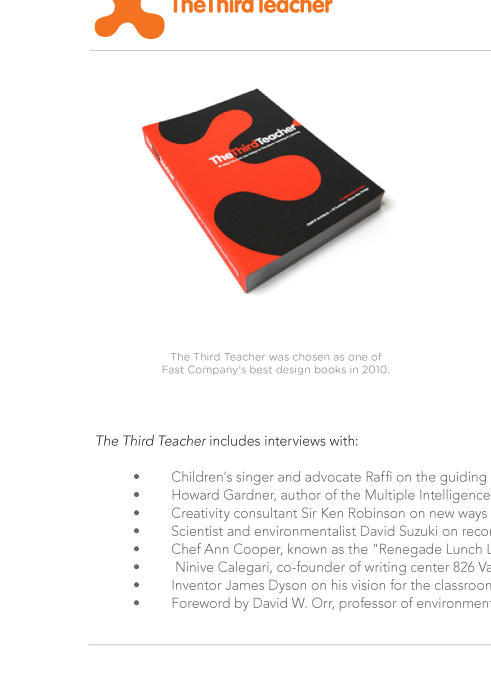
I was introduced to the book, The Third Teacher: 79 Ways You Can Use Design to Transform Teaching and Learning, as part of a focus group at Upper Canada College, where we were looking at our current furniture and classroom design. This was initiated because we were about to embark upon a very necessary and important renovation of our space. I don’t think I had ever thought through my environment with such a lens. I think it is because I didn’t think I had any control over my environment, it is a shared space, so what is the point in trying to change it?
I was inspired by the book, The Third Teacher, because it highlights how the physical environment can facilitate a better experience; I also feel like this is something that has been overlooked for too long.
The child starting kindergarten this fall will graduate in the third decade of the 21st century. All we know about the world she will step into is that it will have challeges and opportunities beyond what we can imagine today, problems and possibilities that will demand creativity and ingenuity, responsibility and compassion. Whether this year’s kindergarten student will merely survive or positiveily thrive in the decades to come depends in large measure on the experiences she has in school. These expereinces will be shaped by adults, by peers, and ultimately by places, by the physical environments where she does her learning. United in the conviction that environment is our children’s third teacher, we can begin anew a vital mission: designing today’s schools for tomorrow’s world.
I was encouraged and inspired to find the following document written by the Ontario Government outlining these very ideas. Follow the link here:
http://www.edu.gov.on.ca/eng/literacynumeracy/inspire/research/CBS_ThirdTeacher.pdf
Part of why I am interested in sharing these ideas, is I believe changes can be made even through the acknowledgment of the concept. A teacher is no longer just one person relaying information; a teacher is a multifaceted notion, helping our children make way through this world.
Mary Gauthier is the BEST!! I would love to learn, work, and collaborate with her in a school environment. I am also really interested in the idea of the classroom being the third teacher and the group of students I have this year are forcing me to redefine what my classroom looks like and how I set up the space to best suit there needs. Looking forward to seeing where your thinking and action plan goes!
Great post, Alison,
I’ve only just recently heard about this book. Our school has similarly begun the process of creating new Learning Spaces for our students. My hope, is in the next ten or fifteen years, students are going to the “space” that best helps the project they are working on, not the “subject” area. Wouldn’t that be cool?
It would be so interesting to have that model. Perhaps students would feel more in control of their learning and really construct their understanding more regularly.
Great post Allison
I wonder why after seeing the best companies in the world redesign their working spaces to improve the productivity of their employees we are still
attached to the “old” system of desks and chairs and static classrooms.
So interesting to think about how we can really use the physical environment as another dimension for engaging our students, Allison. It can be easy to take the physical space for granted, particularly when space is shared and you feel less ownership. I’m intrigued by the book that you mention- it sounds like good reading for all schools as we try to create spaces that are more engaging, more flexible and more personal. Have you read @ddoucet ‘s musings on his classroom environment and the impact a change in location had on his French class? http://cohort21.com/derekdoucet/2015/11/19/location-location-location/
I wonder how long it will take for us to move beyond thinking about individual classroom spaces and start thinking about creating spaces for students to learn, create, collaborate without the confines of four walls, a window, and a door. Like @edaigle mentions above, I love the idea of students finding a space that works for them, rather than a subject specific room.
Lots to dream and think about. Thanks for sharing your thoughts.